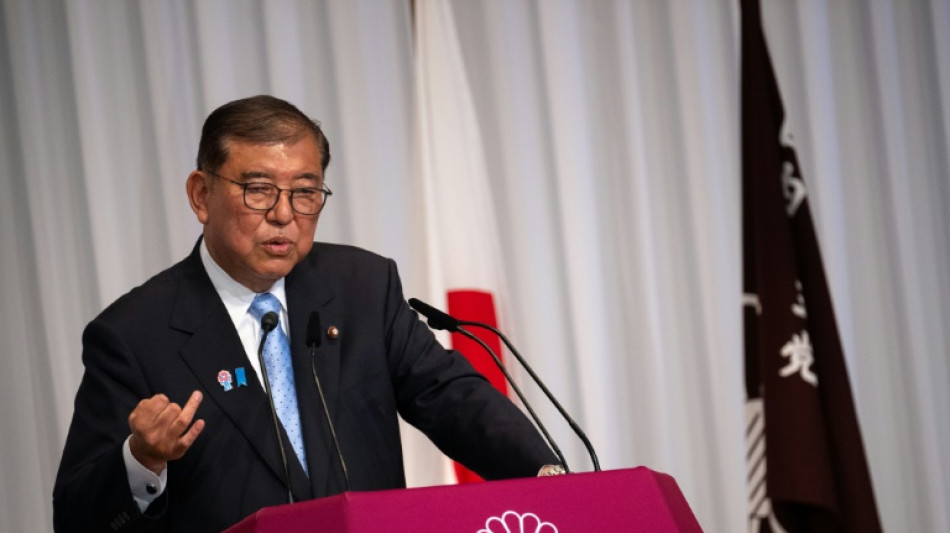
Japan PM hangs on after 'extremely regrettable' election / Photo: © POOL/AFP

 South African election results renew debate over identity-based voting

 South African voters report smoother local election but declining IEC trust

 Dolly Parton museum and Nashville hotel open after singer’s death

 George and Amal Clooney attend New York political-comedy reading

 British buyers pay substantial premiums for period-home appearance

 Thomas Markle released to house arrest after child-abuse-image charge

 Dawn of War 4 developers chose Adeptus Mechanicus for tactical variety

 Italy face unbeaten South Africa in Turin Nations Championship match

 ChatGPT interactive interface feature tested across six custom tools

 Freshways milk-price cut deepens pressure on UK dairy farms

 Labour and National remain virtually tied as New Zealand vote count advances

 The Good Daughter adapts Karin Slaughter thriller with Rose Byrne and Meghann Fahy

 Heavy-lift drone evacuates wounded Ukrainian soldier from frontline kill zone

 Morrison says West Brom recovered after pressure from successive derby losses

 Britain considers 2027 state visit for Ukraine’s Zelensky

 Arizona Democrats Secure Historic Trifecta with New Legislative Leadership

 Carney Welcomes U.S. Trade Reversal After Democratic Midterm Victory

 Armenian FM Discusses EU Accountability for Palestinian Rights in Madrid

 Trump and Vance Pursue Secret Diplomacy with Iran Amid Military Pressure

Japanese Prime Minister Shigeru Ishiba clung on Monday even after his coalition suffered what he called an "extremely regrettable" election result, as painful new US tariffs loom.
In Sunday's election Ishiba's Liberal Democratic Party (LDP), which has governed almost continuously since 1955, and its partner Komeito fell a projected three seats short of retaining a majority in the upper house.
Voters angry at inflation turned to other parties, notably the "Japanese first" Sanseito, which made strong gains with its "anti-globalist" drive echoing the agenda of populist parties elsewhere.
"I even think (the LDP) should have lost more," 25-year-old Kazuyo Nanasawa, who voted for a small ultra-conservative party, told AFP, adding that Ishiba should quit.
The debacle comes only months after Ishiba's coalition was forced into a minority government in the more powerful lower house, in the LDP's worst result in 15 years.
But asked late Sunday if he intended to remain in office, Ishiba told local media: "That's right."
"Changes in the external environment, such as the international situation, or natural disasters, cannot wait for the political situation to improve," Ishiba told a news conference on Monday.
"For this reason, although I'm acutely aware of our grave responsibility for the election results, in order to not let politics become stagnant, I believe I must fulfil my responsibility as the party with the most votes and to the people of the country, while listening carefully and sincerely to the voices of the local people," he said.
It was unclear in any case who might step up to replace Ishiba now that the government needs opposition support in both chambers to pass legislation.
LDP supporter Takeshi Nemoto, 80, told AFP that a new leadership contest "would be a losing battle" for the party, further complicating tariff talks with US President Donald Trump's administration.
"Diplomacy is under pressure at the moment," agreed Shuhei Aono, 67. "Who is going to take care of it? I think (Ishiba) cannot easily withdraw."
- 'Japanese first' -
The election saw 125 seats in the 248-seat upper house contested.
The coalition needed 50 of those but local media reported they only won 47, with the LDP winning 39 and Komeito eight, giving them 122 deputies.
Second-placed was the Constitutional Democratic Party of Japan (CDP), which won 22 contested seats, followed by the Democratic Party For the People (DPP) with 17.
The right-wing Sanseito party won 14 seats.
Sanseito wants "stricter rules and limits" on immigration, opposes "radical" gender policies, and wants a rethink on decarbonisation and vaccines.
It was forced last week to deny any links to Moscow -- which has backed populist parties elsewhere -- after a candidate was interviewed by Russian state media.
The opposition is fragmented, and chances are slim that the parties can form an alternative government, Hidehiro Yamamoto, politics and sociology professor at the University of Tsukuba, told AFP.
Expanding the coalition would be difficult, with the DPP the most likely partner "on the condition that (the government) delivers some of the positive fiscal measures, such as tax cuts," he said.
More likely is that Ishiba will continue needing opposition support on a case-by-case basis to pass legislation.
- Trump tariffs -
After years of stagnant or falling prices, consumers in the world's fourth-largest economy have been squeezed by inflation since Russia's 2022 invasion of Ukraine.
In particular, the price of rice has doubled, squeezing many household budgets despite government handouts.
Not helping is lingering resentment about an LDP funding scandal, and US tariffs of 25 percent due to bite from August 1 if there is no trade deal.
Japanese imports are already subject to a 10 percent tariff, while the auto industry, which accounts for eight percent of jobs, is reeling from a 25 percent levy.
On Monday tariffs envoy Ryosei Akazawa left on his eighth visit to Washington.
"We will achieve an agreement that is beneficial to both Japan and the US, based on the concept of investment rather than tariffs," said Ishiba.
L.Stucki--VB