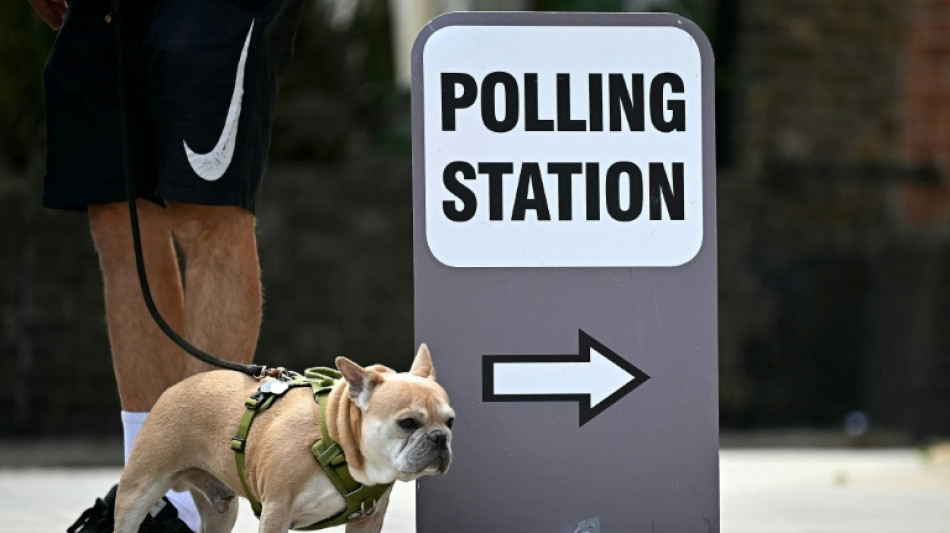
UK to lower voting age to 16 in general elections / Photo: © AFP

 'Thought they'd never be caught': The strike that killed Iran's Khamenei

 Djokovic, Sinner hope for easier ride after Wimbledon scares

 Injured Serena's Wimbledon doubles bid with sister Venus in doubt

 European stocks mostly drop with eyes on US Fed
 Genesio replaces Beye as Marseille boss
 Catholic society defies Vatican again by ordaining new bishops

 Breakaway Catholic society defies Vatican again by ordaining bishops

 Venezuelans search, suffer one week after deadly quakes

 Asian stocks mostly up as traders eye crucial US jobs data
 Ronaldo and Modric struggle to defy Father Time at World Cup
 The secret lives of Ukraine's deep-strike drone team
 NATO project tests perennial grass to clean Ukraine's war-hit soil
 Duffy returns for New Zealand against West Indies

 Mbappe dazzles as France march on at World Cup; Norway, Mexico advance

 US govt lifts restrictions on powerful AI models, Anthropic says

 Trump earned over $1 bn from crypto ventures in 2025

 The Afghan women farmers keeping their village alive

 Asian stocks fluctuate as traders eye crucial US jobs data
 Madison Square Garden: from Nazis to Knicks, and now... Taylor's wedding?

 'Love it': Wimbledon's military stewards tradition turns 80
 Venezuela quake survivors cherish kindness of strangers
 US deports first migrant to Pacific nation Palau

 Potter admits Sweden couldn't live with France in World Cup defeat

 US coach dismisses European jinx ahead of Bosnia clash

 World Bank to phase out lending to China by 2031

The British government said Thursday it would allow 16 year-olds to vote in general elections, a landmark change giving the UK one of the lowest voting ages worldwide.
The ruling Labour Party pledged to lower the age from 18 ahead of winning power last year. It is among several planned changes to the democratic system.
Some argue Britain's democracy is "in crisis", in particular due to low turnout.
The voting age change is contentious, however, with critics previously arguing it is self-serving as newly-enfranchised teenagers are seen as more likely to support centre-left Labour.
"I think it's really important that 16- and 17-year-olds have the vote, because they are old enough to go out to work, they are old enough to pay taxes, so (they) pay in," Prime Minister Keir Starmer said.
"And I think if you pay in, you should have the opportunity to say what you want your money spent on, which way the government should go," Starmer added.
The government will have to bring legislation before parliament, where it has a comfortable majority, to make the changes.
Only a small number of countries allow 16-year-olds to vote in national elections, according to online databases.
They include Austria -- the first EU country to lower the voting age to 16 in 2007 -- as well as Argentina, Brazil, Ecuador and Cuba.
- 'Democracy in crisis ' -
Labour ministers insist the change is intended to "modernise our democracy", while aligning general elections with the existing voting age for elections for the devolved regional parliaments in Scotland and Wales.
Other planned changes include introducing automated voter registration -- which is already used in Australia and Canada -- and making UK-issued bank cards an accepted form of ID at polling stations.
It follows changes to the electoral law introduced by the previous Conservative government which required voters to show a photo ID. The Electoral Commission found that rule led to around 750,000 people not voting in last year's election.
Harry Quilter-Pinner, executive director of the Institute For Public Policy Research think tank, called the changes "the biggest reform to our electoral system since 1969", when the voting age was lowered to 18.
He noted lowering the voting age and introducing automated voter registration could add 9.5 million more people to the voter rolls.
"Our democracy is in crisis, and we risk reaching a tipping point where politics loses its legitimacy," he added, backing the changes.
The main Conservative opposition however accused Labour of inconsistency as 16- and 17-year-olds will still not be able to stand as election candidates, buy lottery tickets or alcohol or get married.
"This is a brazen attempt by the Labour Party whose unpopularity is scaring them into making major constitutional changes without consultation," the party's communities spokesman Paul Holmes said.
A.Ruegg--VB