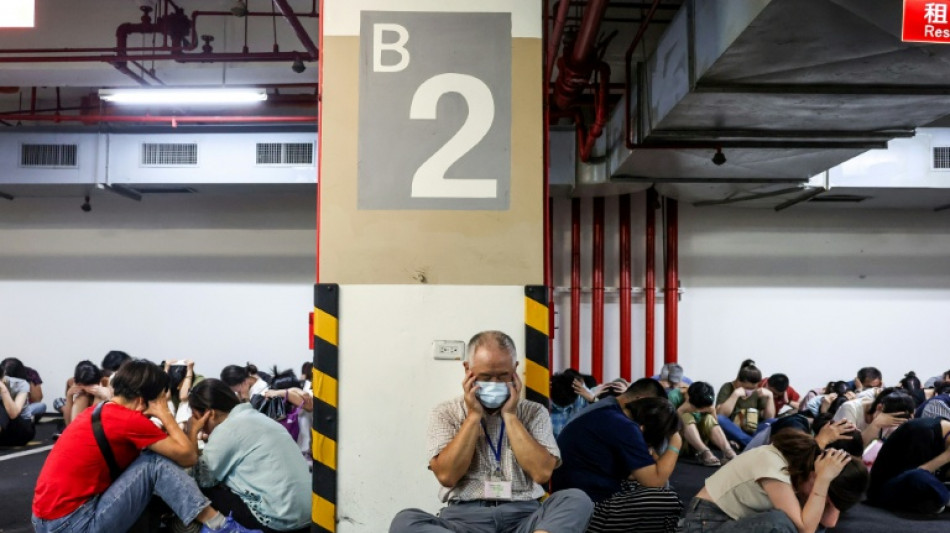
Taipei holds air raid drill to prepare for Chinese attack / Photo: © AFP

 South African election results renew debate over identity-based voting

 South African voters report smoother local election but declining IEC trust

 Dolly Parton museum and Nashville hotel open after singer’s death

 George and Amal Clooney attend New York political-comedy reading

 British buyers pay substantial premiums for period-home appearance

 Thomas Markle released to house arrest after child-abuse-image charge

 Dawn of War 4 developers chose Adeptus Mechanicus for tactical variety

 Italy face unbeaten South Africa in Turin Nations Championship match

 ChatGPT interactive interface feature tested across six custom tools

 Freshways milk-price cut deepens pressure on UK dairy farms

 Labour and National remain virtually tied as New Zealand vote count advances

 The Good Daughter adapts Karin Slaughter thriller with Rose Byrne and Meghann Fahy

 Heavy-lift drone evacuates wounded Ukrainian soldier from frontline kill zone

 Morrison says West Brom recovered after pressure from successive derby losses

 Britain considers 2027 state visit for Ukraine’s Zelensky

 Arizona Democrats Secure Historic Trifecta with New Legislative Leadership

 Carney Welcomes U.S. Trade Reversal After Democratic Midterm Victory

 Armenian FM Discusses EU Accountability for Palestinian Rights in Madrid

 Trump and Vance Pursue Secret Diplomacy with Iran Amid Military Pressure

Taipei came to a brief standstill on Thursday when air raid sirens forced people off the streets and into underground shelters in a rehearsal for a Chinese attack.
The annual civilian drill is being held in cities across Taiwan this week, alongside military training, to prepare the self-governed island for a potential Chinese invasion.
Communist China has never ruled Taiwan but Beijing insists the island is part of its territory and has threatened to use force to bring it under its control.
Sirens sounded across Taipei at 1:30 pm (0530 GMT), bringing the capital city of 2.5 million people to a halt for half an hour.
Police waving batons stopped motorbikes, cars and public buses on the streets and people were directed into shelters, including basements and subway stations.
Some people retreated into office buildings for the duration of the exercise.
Tracy Herr, 50, was on her way to a temple when she heard the air raid siren. She went to a nearby subway station where others were sheltering.
Pointing at a group of young women sitting on the floor and chatting, Herr said Taiwanese people had "lived comfortably for too long" and some didn't take the air raid drill seriously.
The drills also involved simulating wartime aid distribution and a mass-casualty event.
Dozens of people lined up at three distribution points to receive bags of rice, cooking oil and salt.
Taiwanese President Lai Ching-te has sought to raise public awareness of the threat posed by China since taking office last year.
"Each drill allows our country to further enhance its ability to defend itself," Lai said on Thursday.
While the exercises were "not intended to provoke", Lai said the constant threats to Taiwan meant "we have no choice but to stay fully prepared".
- 'Reality of modern warfare' -
Taiwan is keen to show the world, especially its key security backer Washington, that it is serious about boosting its defence capability.
Taiwanese regular troops were joined by the largest mobilisation of reservists for the 10-day "Han Kuang" military drills, which end on Friday.
Rather than only repelling a Chinese attack on its shores, Taiwanese troops this year have also practised fighting invading forces in city streets.
"It is as much training as acclimating the Taiwanese population to the reality of modern warfare," said Kitsch Liao of the Atlantic Council, a US think tank.
Heavily armed troops carrying US-provided anti-aircraft Stinger missiles stormed Taipei's metro system in a night-time exercise.
High-tech mobile missile launchers from the United States have also been positioned around the capital and elsewhere, in full view of the public.
Shoppers in a Taipei supermarket also recently became participants in a drill simulating a Chinese missile strike on the city.
"I didn't know there was going to be a drill," Yang Shu-ting, 70, told AFP.
"My heart was beating very fast and I was inevitably nervous. I think the point is to let you know where you should hide if something happens."
Troops have also simulated various scenarios, including "grey zone harassment" -- tactics that fall short of an act of war -- and "long-range precision strikes", defence officials have said.
Several minor collisions involving military vehicles during the exercises highlighted the challenge of manoeuvring through Taiwan's narrow streets.
Defence expert Chieh Chung said such mishaps were "difficult to avoid" in urban areas.
"In Taiwan, many roads and bridges create significant limitations for armoured vehicles when they move through," said Chieh, a researcher at the Association of Strategic Foresight in Taipei.
"So this becomes a problem and obstacle for both attacking and defending forces."
S.Gantenbein--VB