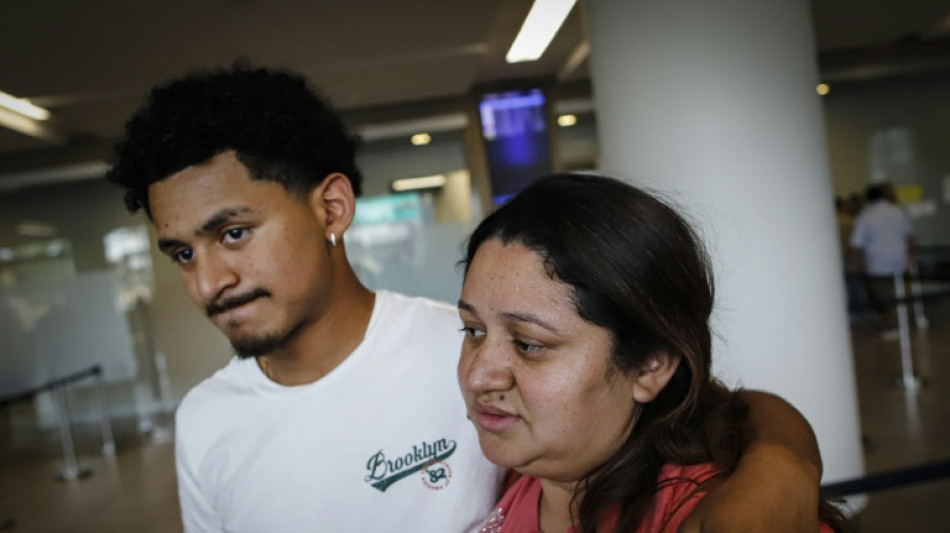
Honduran teen deported by US feels like foreigner in native country / Photo: © AFP

 South African election results renew debate over identity-based voting

 South African voters report smoother local election but declining IEC trust

 Dolly Parton museum and Nashville hotel open after singer’s death

 George and Amal Clooney attend New York political-comedy reading

 British buyers pay substantial premiums for period-home appearance

 Thomas Markle released to house arrest after child-abuse-image charge

 Dawn of War 4 developers chose Adeptus Mechanicus for tactical variety

 Italy face unbeaten South Africa in Turin Nations Championship match

 ChatGPT interactive interface feature tested across six custom tools

 Freshways milk-price cut deepens pressure on UK dairy farms

 Labour and National remain virtually tied as New Zealand vote count advances

 The Good Daughter adapts Karin Slaughter thriller with Rose Byrne and Meghann Fahy

 Heavy-lift drone evacuates wounded Ukrainian soldier from frontline kill zone

 Morrison says West Brom recovered after pressure from successive derby losses

 Britain considers 2027 state visit for Ukraine’s Zelensky

 Arizona Democrats Secure Historic Trifecta with New Legislative Leadership

 Carney Welcomes U.S. Trade Reversal After Democratic Midterm Victory

 Armenian FM Discusses EU Accountability for Palestinian Rights in Madrid

 Trump and Vance Pursue Secret Diplomacy with Iran Amid Military Pressure

Emerson Colindres had just finished high school when he was sent back to Honduras by the United States, a country that he had called home since he was eight years old.
Now, like many other young deportees who emigrated to the United States as children, he is struggling to adapt to life in a homeland that feels foreign to him.
The 19-year-old's life changed dramatically on June 4, when he was arrested while attending an appointment with US Immigration and Customs Enforcement (ICE) in Cincinnati, Ohio.
He had never been in trouble with the law before.
After two weeks in prison, the teenager was put on a charter flight with other deportees and sent to Honduras.
Colindres had left his home country in 2014 with his mother and sister to escape a life of poverty, entering the United States as undocumented immigrants.
Since US President Donald Trump returned to the White House in January, thousands of young migrants have been deported to the countries where they were born, but which they barely know.
Washington has deported 11,823 Hondurans this year, according to official figures from the Central American nation.
Of those sent back, 2,846 were under the age of 20.
- From Cincinnati to Guapinol -
On the same day Colindres was detained, ICE notified his mother Ada Bell Baquedano and his 16-year-old sister Alison that they had a month to leave the United States.
For years, the family had tried to obtain asylum or legal residency there, but without success.
They now live in a small metal-roofed house belonging to Colindres's grandmother in Guapinol, a hot and dusty village in the municipality of Marcovia, located in one of the poorest areas of Honduras.
Colindres has no friends in the country where he was born.
"I don't know anyone, I don't know what it's like here," he told AFP at an airport near the capital Tegucigalpa while waiting for his mother and sister, who returned to Honduras from the United States voluntarily.
- 'I miss everything' -
In the United States, Colindres's family lived in a two-story apartment in Cheviot, a suburb of Cincinnati.
His mother cleaned houses and sold food while Colindres attended a public high school, where he was a keen soccer player.
"It's hard to adapt (to Honduras) because I'm not used to it, but I have to," Colindres said.
"I miss everything about there," he said, adding that he had planned to go to university to study psychology and play soccer, hoping to become a professional athlete.
- Starting again -
In the United States, Colindres had a promising future, his mother said.
"He always had support from his coach and his soccer team," the 38-year-old told AFP.
"They were helping him to find a university. And they were also helping him coach children. Those people were a key part of Emerson's life," Baquedano said.
"What harm can a kid who plays soccer, attends church and goes to school do to a country?"
Before emigrating to the United States, Baquedano sold bread on the street, but she is not yet sure how she will earn a living in Honduras this time.
"Right now, I'm trying to come to terms with what happened, then start making a new life here," she said.
D.Schaer--VB