
China crackdown on gay erotica stifles rare outlet for LGBTQ expression / Photo: © AFP

 Hope fades, hunger sets in a week after Venezuela quakes

 Noosha Aubel: 10 km/h for residents – Potsdam’s approach to potholes: indifference or incompetence?

 Bayern to host Stuttgart in Bundesliga season opener

 US Fed chair says committed to combatting 'too high' prices

 Portugal braces for high temperatures in new heatwave

 Trump upbeat as US, Iran hold indirect talks in Qatar

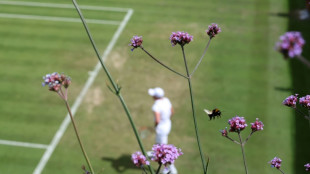
 Sinner sinks Borges to step up Wimbledon title defence
 Thomas targets yellow in Tour team time-trial

 Bike - or even walk: World Cup fans improvise to reach NY venue

 Swedish court orders Google pay nearly $2 bn for favouring its price comparisons

 England breaks record for warmest June: Met Office

 Stocks drop with eyes on US Fed

 Barca have bid for Atletico's Alvarez: president Laporta

 'Smart' and 'very rational'? Iran's new leaders post-Ali Khamenei

 Bordeaux-Begles handed favourable draw in Champions Cup defence

 'Thought they'd never be caught': The strike that killed Iran's Khamenei

 Djokovic, Sinner hope for easier ride after Wimbledon scares

 Injured Serena's Wimbledon doubles bid with sister Venus in doubt

 European stocks mostly drop with eyes on US Fed

 Genesio replaces Beye as Marseille boss

 Catholic society defies Vatican again by ordaining new bishops

 Breakaway Catholic society defies Vatican again by ordaining bishops

 Venezuelans search, suffer one week after deadly quakes

 Asian stocks mostly up as traders eye crucial US jobs data

 Ronaldo and Modric struggle to defy Father Time at World Cup

Chinese women who publish homoerotica online say they are being threatened with fines and jail time, as increasing enforcement of vague obscenity charges targets a rare space for LGBTQ identity and feminism.
In recent months, Chinese police have detaineddozens of writers on Haitang Literature City, a Taiwan-based website known for publishing serialised Boys' Love, a genre of erotic fiction mainly written and read by heterosexual women.
Originating as a strand of Japanese manga comics in the 1960s known as "yaoi", the genre has attracted a cult following in Asia and beyond, leading to popular screen adaptations and web series.
The stories defy social stereotypes about the roles of men and women, a 22-year-old writer who asked to go by the pseudonym Miu Miu, told AFP.
"It's a kind of resistance... resisting a male-dominated society," she said.
The latest crackdown ensnared mostly amateur writers who earned little to nothing for their work.
Under Chinese law, profiting from "spreading obscene content" can lead to fines and prison. "Serious" instances can carry jail terms of up to a decade.
The obscenity law applies when someone's work gets at least 10,000 clicks or is "used" to collect fees exceeding 10,000 yuan (nearly $1,400).
While the law excludes "artistic works or works of artistic value", that distinction is usually left to police.
"The rules are outdated," said a lawyer representing one of the authors and who asked not to be named due to the risk of repercussions.
"The general public's attitude towards sex is no longer the same as it was 30 or 40 years ago," the lawyer added.
One author phoned by police earned 2,000 yuan for two books with a total of 72 chapters that, combined, drew around 100,000 clicks.
"Are there really 100,000 people who have seen my work like they said? Are they really going to sentence me to three to five years?" the author wrote on Weibo.
"Don't they know how precious three to five years of life are?"
- Censors without borders -
The investigations have also renewed criticism of a practice known as "distant water fishing", cross-provincial policing by cash-strapped local governments.
The profit-driven enforcement typically involves authorities travelling to another jurisdiction and seizing a suspect's assets.
"Police find this kind of stuff can make them money," Liang Ge, a lecturer on digital sociology at University College London, said of the targeting of Boys' Love authors.
In one case, a policeman from northwestern Lanzhou travelled 2,000 kilometres (more than 1,200 miles) to investigate a writer in her coastal hometown.
She was driven to the police station and questioned for hours about her writing.
She is currently on bail but could face criminal charges, which would disqualify her from taking China's civil service exam and positions in some hospitals and schools.
Another 20-year-old author received a police summons which prompted her to travel hundreds of miles from the city of Chongqing to Lanzhou.
On arrival police urged her to "return the illegal income" she had earned from her writing to reduce her sentence.
"It's a very dirty practice," said the lawyer, noting the central government in Beijing has issued several directives against it.
- 'Social awakening' -
Activists see the crackdown on alleged obscenity as part of a wider push to suppress LGBTQ expression -- an effort that has expanded under President Xi Jinping.
China classified homosexuality as a crime until 1997 and a mental illness until 2001. Same-sex marriage is not legal and discrimination remains widespread.
The Boys' Love genre -- often lightly erotic but sometimes overtly explicit -- has become increasingly censored as its popularity has boomed.
Television adaptations have rewritten male lovers as friends, as same-sex relationships are banned from the screen.
In 2018, a writer known by her pseudonym Tianyi was sentenced to over a decade in prison for earning $21,000 from a homoerotic novel about a teacher and his student.
Last year, a court in Anhui province heard 12 cases involving spreading obscene content for profit, according to public records which do not give outcomes of the trials.
Many in China "feel less and less space to express themselves freely", said Ge, the lecturer and a longtime reader of Boys' Love.
"It's not just about posting something on social media, it's about reading something in their private life."
As news of the crackdownspread, Haitang users rushed to cancel their accounts.
But writer Miu Miu said she has not given up hope she might be able to finish her favourite stories.
"Sexual knowledge has become taboo," she said.
"This is a social awakening."
F.Wagner--VB