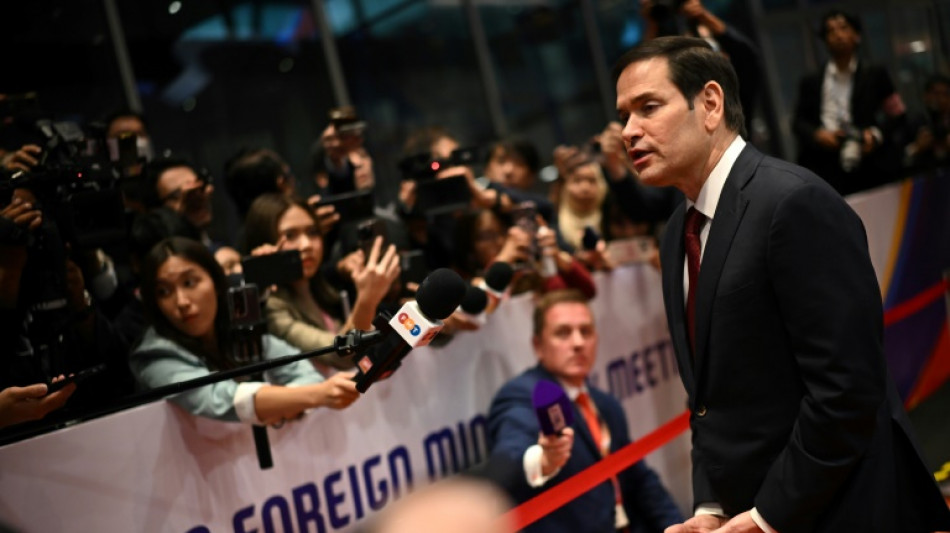
Rubio says Asia might get 'better' tariffs than others / Photo: © POOL/AFP

 Hope fades, hunger sets in a week after Venezuela quakes

 Noosha Aubel: 10 km/h for residents – Potsdam’s approach to potholes: indifference or incompetence?
 Bayern to host Stuttgart in Bundesliga season opener

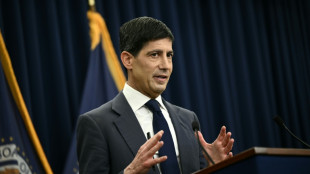 US Fed chair says committed to combatting 'too high' prices

 Portugal braces for high temperatures in new heatwave

 Trump upbeat as US, Iran hold indirect talks in Qatar

 Sinner sinks Borges to step up Wimbledon title defence

 Thomas targets yellow in Tour team time-trial

 Bike - or even walk: World Cup fans improvise to reach NY venue

 Swedish court orders Google pay nearly $2 bn for favouring its price comparisons

 England breaks record for warmest June: Met Office

 Stocks drop with eyes on US Fed
 Barca have bid for Atletico's Alvarez: president Laporta
 'Smart' and 'very rational'? Iran's new leaders post-Ali Khamenei

 Bordeaux-Begles handed favourable draw in Champions Cup defence
 'Thought they'd never be caught': The strike that killed Iran's Khamenei

 Djokovic, Sinner hope for easier ride after Wimbledon scares

 Injured Serena's Wimbledon doubles bid with sister Venus in doubt

 European stocks mostly drop with eyes on US Fed

 Genesio replaces Beye as Marseille boss
 Catholic society defies Vatican again by ordaining new bishops

 Breakaway Catholic society defies Vatican again by ordaining bishops

 Venezuelans search, suffer one week after deadly quakes
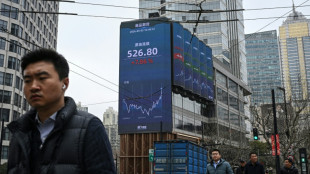
 Asian stocks mostly up as traders eye crucial US jobs data
 Ronaldo and Modric struggle to defy Father Time at World Cup

US Secretary of State Marco Rubio said Thursday that Asian nations might get "better" tariff rates than the rest of the world, as he attended ASEAN talks focused on Washington's trade war.
Rubio's visit to Malaysia came after US President Donald Trump threatened this week to impose punitive tariffs on more than 20 countries if they did not strike deals with Washington by August 1.
"I would say that when all is said and done, many of the countries in Southeast Asia are going to have tariff rates that are actually better than countries in other parts of the world," Rubio said on the sidelines of the Association of Southeast Asian Nations (ASEAN) meeting in Kuala Lumpur.
"But these talks continue. There'll be talks next week with Japan. There's ongoing talks with virtually every country represented here."
Trump said Monday that duties he had suspended in April would snap back -- even more steeply -- by the new deadline.
He has told more than 20 countries, many in Asia, they face tariffs ranging from 20 to 50 percent, and announced a 50 percent toll on copper imports and a possible 200 percent duty on pharmaceuticals.
Among those targeted were top trade partners Japan and South Korea, which could each be hit with 25 percent.
Indonesia, Laos, Thailand, Malaysia, the Philippines, Brunei and Myanmar -- all members of ASEAN -- face duties ranging from 20 percent to 40 percent.
Vietnam, which is also an ASEAN member, is one of only two countries -- Britain being the other -- to have reached a tentative agreement with Trump.
The levels were not too far from those originally threatened in April, although some were notably lower this time.
- 'Not going to walk away' -
US officials said ahead of Rubio's trip that Washington was "prioritising" its commitment to East and Southeast Asia.
In Malaysia, Rubio said the United States has "no intention of abandoning" the region.
"We've spent decades building these relationships," Rubio told reporters.
"Not only we're not going to walk away from them, we seek to expand them and build upon them with a part of the world that is essential."
Rubio's remarks followed a meeting with Russian Foreign Minister Sergei Lavrov where the US diplomat expressed "disappointment and frustration" about the lack of progress on ending the war in Ukraine.
He also attended a post-ministerial conference, trilateral talks with the Philippines and Japan and met with Malaysia's Prime Minister Anwar Ibrahim for talks on tariffs.
"Malaysia believes that such unilateral actions undermine free trade flows and could have a negative impact on regional economic growth, especially for trading nations like Malaysia," Anwar said in a statement.
"I expressed my stance that the space for negotiations should remain open to ensure fair, equitable and non-oppressive trade outcomes for developing countries."
Rubio said he might also meet with his Chinese counterpart Wang Yi, who is attending the ASEAN meeting.
The two largest economies remain locked in a range of disputes on issues from trade and fentanyl, to Taiwan and cutting-edge technology.
Without mentioning the United States, Wang on Thursday called for a "fairer and more reasonable" international order.
"At the same time, we are also confronted with challenges such as the impact of unilateral protectionism and the abuse of tariffs by a certain major country."
T.Zimmermann--VB