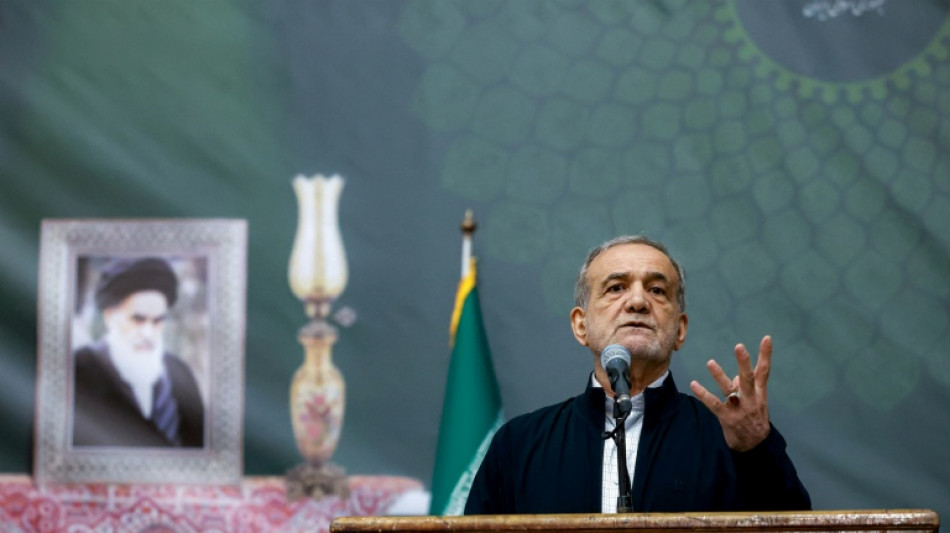
Iran suspends cooperation with UN nuclear watchdog / Photo: © Iranian Presidency/AFP/File

 South African election results renew debate over identity-based voting

 South African voters report smoother local election but declining IEC trust

 Dolly Parton museum and Nashville hotel open after singer’s death

 George and Amal Clooney attend New York political-comedy reading

 British buyers pay substantial premiums for period-home appearance

 Thomas Markle released to house arrest after child-abuse-image charge

 Dawn of War 4 developers chose Adeptus Mechanicus for tactical variety

 Italy face unbeaten South Africa in Turin Nations Championship match

 ChatGPT interactive interface feature tested across six custom tools

 Freshways milk-price cut deepens pressure on UK dairy farms

 Labour and National remain virtually tied as New Zealand vote count advances

 The Good Daughter adapts Karin Slaughter thriller with Rose Byrne and Meghann Fahy

 Heavy-lift drone evacuates wounded Ukrainian soldier from frontline kill zone

 Morrison says West Brom recovered after pressure from successive derby losses

 Britain considers 2027 state visit for Ukraine’s Zelensky

 Arizona Democrats Secure Historic Trifecta with New Legislative Leadership

 Carney Welcomes U.S. Trade Reversal After Democratic Midterm Victory

 Armenian FM Discusses EU Accountability for Palestinian Rights in Madrid
Iran on Wednesday formally suspended its cooperation with the UN nuclear watchdog, a measure drawn up in the wake of unprecedented Israeli and US strikes on the Islamic republic's nuclear sites.
The war between Iran and Israel, which broke out on June 13 and lasted for 12 days, has intensified tensions between Tehran and the International Atomic Energy Agency (IAEA).
On June 25, a day after a ceasefire took hold, Iranian lawmakers overwhelmingly voted in favour of the bill to suspend cooperation with the agency.
State media said on Wednesday that the legislation had cleared the final hurdle and was in effect.
The text, published by Iranian media, states that the legislation aims to "ensure full support for the inherent rights of the Islamic Republic of Iran" under the nuclear non-proliferation treaty, and "especially uranium enrichment".
The issue of enrichment was at the core of disagreements between Washington and Tehran in nuclear negotiations that had been derailed by the war.
Israel and some Western countries had for long accused Iran of seeking to quire nuclear weapons -- an ambition Tehran has consistently denied.
The text of the law did not specify concrete moves linked to the suspension of cooperation with the IAEA, whose inspectors have had access to declared nuclear facilities.
Following the parliament vote, the bill was approved by the Guardian Council, a body tasked with vetting legislation, before a final ratification from the presidency.
Iranian President "Masoud Pezeshkian promulgated the law suspending cooperation with the International Atomic Energy Agency", state TV said on Wednesday.
Iranian officials have sharply criticised the IAEA for what they described as the agency's "silence" in the face of the Israeli and US attacks on Iranian nuclear sites.
- 'Deceptive and fraudulent' -
Tehran has also lambasted the UN agency for a resolution adopted on June 12 that accuses Iran of non-compliance with its nuclear obligations.
Iranian officials said the resolution was among the "excuses" for the Israeli attacks.
On Wednesday, senior judiciary official Ali Mozaffari said that IAEA director Rafael Grossi should "be held accountable" for what he called "preparing the groundwork for the crime" against Iran, referring to Israel's air raids.
Mozaffari accused Grossi of "deceptive actions and fraudulent reporting", according to Iranian news agency Tasnim.
Iran has rejected a request from Grossi to visit nuclear facilities bombed during the war, and earlier this week Pezeshkian decried his "destructive" conduct.
Iran has said Grossi's request to visit the bombarded sites signalled "malign intent" but insisted there were no threats against him or against inspectors from his agency.
France, Germany and Britain have condemned unspecified "threats" against the IAEA chief.
Iran's ultra-conservative Kayhan newspaper has recently claimed that documents showed Grossi was an Israeli spy and should be executed.
- Damage -
On Monday, Iranian foreign ministry spokesman Esmaeil Baqaei said the parliament vote to halt cooperation with the IAEA reflected the "concern and anger of the Iranian public opinion".
The 12-day war began when Israel launched a major bombing campaign on Iran and killed top military commanders and nuclear scientists, with Tehran responding with waves of missiles and drones launched at Israel.
On June 22, Israel's ally the United States launched unprecedented strikes of its own on Iranian nuclear facilities at Fordo, Isfahan and Natanz.
More than 900 people were killed in Iran, according to the judiciary.
Iran's retaliatory attacks killed 28 people in Israel, according to authorities.
US President Donald Trump said the US attacks had "obliterated" Iran's nuclear programme, though the extent of the damage was not clear.
Iranian Foreign Minister Abbas Araghchi has admitted "serious" damage to nuclear sites.
But in a recent interview with CBS Evening News, he said: "One cannot obliterate the technology and science... through bombings."
T.Zimmermann--VB