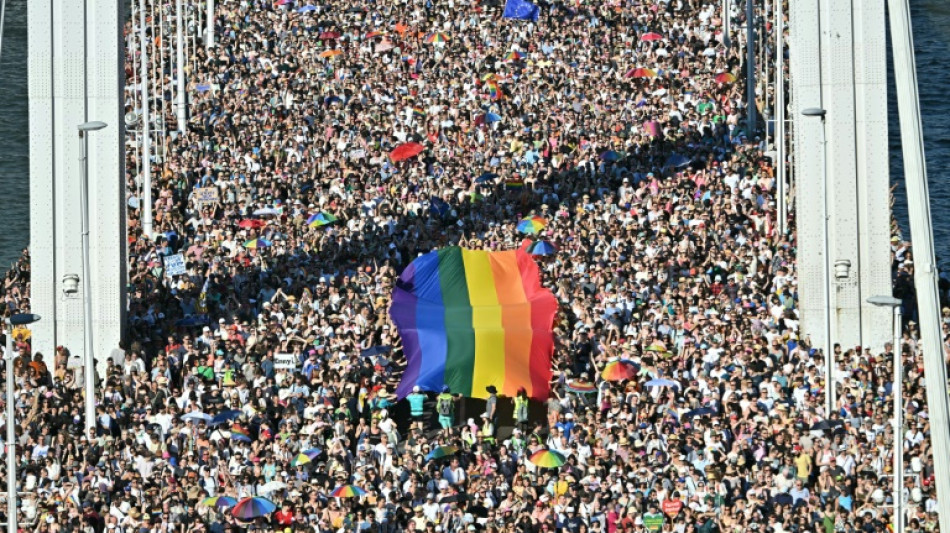
Biggest-ever Budapest Pride defies Orban ban in Hungary / Photo: © AFP

 South African election results renew debate over identity-based voting

 South African voters report smoother local election but declining IEC trust

 Dolly Parton museum and Nashville hotel open after singer’s death

 George and Amal Clooney attend New York political-comedy reading

 British buyers pay substantial premiums for period-home appearance

 Thomas Markle released to house arrest after child-abuse-image charge

 Dawn of War 4 developers chose Adeptus Mechanicus for tactical variety

 Italy face unbeaten South Africa in Turin Nations Championship match

 ChatGPT interactive interface feature tested across six custom tools

 Freshways milk-price cut deepens pressure on UK dairy farms

 Labour and National remain virtually tied as New Zealand vote count advances

 The Good Daughter adapts Karin Slaughter thriller with Rose Byrne and Meghann Fahy

 Heavy-lift drone evacuates wounded Ukrainian soldier from frontline kill zone

 Morrison says West Brom recovered after pressure from successive derby losses

 Britain considers 2027 state visit for Ukraine’s Zelensky

 Arizona Democrats Secure Historic Trifecta with New Legislative Leadership

 Carney Welcomes U.S. Trade Reversal After Democratic Midterm Victory

 Armenian FM Discusses EU Accountability for Palestinian Rights in Madrid
Record numbers of people marched in the Budapest Pride parade Saturday, defying a government ban that marked a major pushback against LGBTQ rights in the European Union.
Organisers estimated up to 200,000 people had taken part in the 30th parade in the Hungarian capital, which was held in a festive atmosphere with rainbow flags flying high.
Those numbers far exceed the previous record turnout of 35,000 people and come in spite of a police ban imposed by Prime Minister Viktor Orban's nationalist government.
The governing coalition amended its laws and the constitution this year to prohibit the annual celebration, justifying his years-long clampdown on LGBTQ rights on "child protection" grounds.
But the opposition-run Budapest city hall decided to co-host the march so it could go ahead.
"I am proud to be gay... and I am very scared that the government wants to bring us down," one participant, 66-year-old Zoltan, told AFP.
I am very surprised that there are so many people, I want to cry," he added. He declined to give his full name.
- 'Big embarrassment' -
Orban said Friday that while police would not break up the Pride march, those who took part should be aware of "legal consequences".
Parade organisers risk up to a year in prison, and attendees can face fines up to 500 euros ($590).
The latest legal changes also empower the authorities to use facial-recognition technology to identify those taking part, and cameras have recently been installed on lamp posts along the parade route.
Szabolcs Pek, lead analyst at research centre Iranytu Institute, said it would be difficult for Orban's Fidesz party to respond to the high turnout.
"This is a big embarrassment for Fidesz," he told AFP.
The march began chaotically under a scorching sun. Marchers repeatedly had to pause to wait for police to stop traffic, according to AFP journalists at the scene.
"I definitely wanted to come, if only to show my solidarity, and to show how important this issue is -- not only to me, but to almost everyone living in Budapest," economics student Marcell Szanto, 22, told AFP.
Dozens of European lawmakers also attended in defiance of the ban.
- 'Love can't be banned' -
"Freedom and love can't be banned," read one huge poster put up near city hall, the gathering point for the march.
Earlier this week, EU chief Ursula von der Leyen called on the Hungarian authorities to reverse the ban.
Thirty-three nations, including most EU countries, have also released a statement in support of the march.
And at a news conference Saturday, several French MEPs called on the EU to take tougher measures against Orban's government over the crackdown on civil rights and other rule-of-law issues.
Since Orban's return to power in 2010, the country of 9.6 million people has been steadily rolling back LGBTQ rights.
It is the first EU nation to ban a Pride march, and Orban has said he has been emboldened by the anti-diversity push by US President Donald Trump.
Some people also gathered along the route to protest LGBTQ rights, in demonstrations called by far-right groups, one of which featured a wooden cross adorned with protest messages.
But opposition leader Peter Magyar said on Facebook that the government "scored not a goal, but a huge own goal with their attempt to ban today's event".
Budapest mayor Gergely Karacsony in a post noting the big turnout thanked Orban "for advertising for a more tolerant society".
"Disgusting... it's become a fad to show off ourselves," she said.
D.Schaer--VB