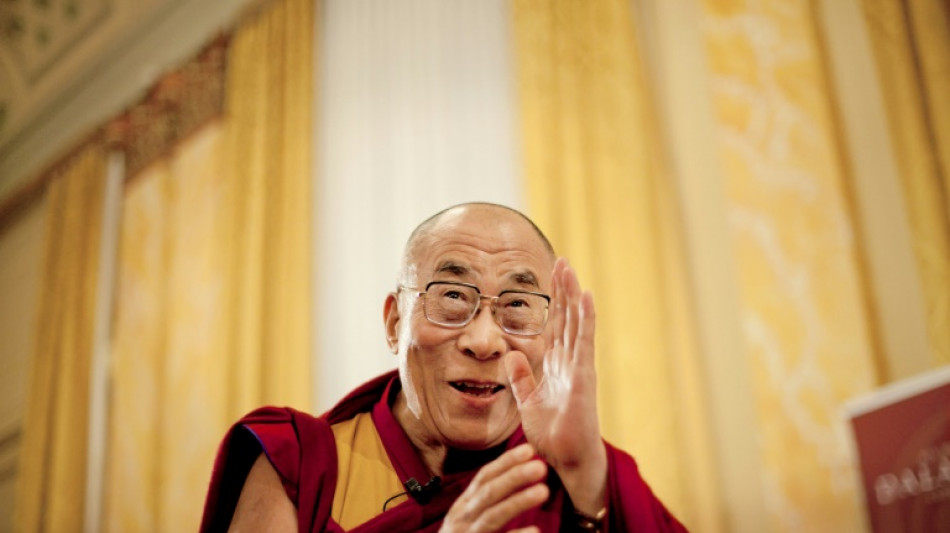
'Simple monk': the Dalai Lama, in his translator's words / Photo: © SCANPIX DENMARK/AFP

 South African election results renew debate over identity-based voting

 South African voters report smoother local election but declining IEC trust

 Dolly Parton museum and Nashville hotel open after singer’s death

 George and Amal Clooney attend New York political-comedy reading

 British buyers pay substantial premiums for period-home appearance

 Thomas Markle released to house arrest after child-abuse-image charge

 Dawn of War 4 developers chose Adeptus Mechanicus for tactical variety

 Italy face unbeaten South Africa in Turin Nations Championship match

 ChatGPT interactive interface feature tested across six custom tools

 Freshways milk-price cut deepens pressure on UK dairy farms

 Labour and National remain virtually tied as New Zealand vote count advances

 The Good Daughter adapts Karin Slaughter thriller with Rose Byrne and Meghann Fahy

 Heavy-lift drone evacuates wounded Ukrainian soldier from frontline kill zone

 Morrison says West Brom recovered after pressure from successive derby losses

 Britain considers 2027 state visit for Ukraine’s Zelensky

 Arizona Democrats Secure Historic Trifecta with New Legislative Leadership

 Carney Welcomes U.S. Trade Reversal After Democratic Midterm Victory

 Armenian FM Discusses EU Accountability for Palestinian Rights in Madrid
With his flowing red monk's robes, beaming smile and contagious laugh, the Dalai Lama, Tibet's exiled spiritual leader, has been the charismatic global face of his people's cause for decades.
The Nobel Peace Prize-winning monk, Tenzin Gyatso, is expected to celebrate his 90th birthday on July 6 with huge crowds in northern India, his base since leaving his homeland fleeing Chinese troops in 1959.
While China condemns him as a rebel and separatist, the internationally recognised Dalai Lama describes himself as a "simple Buddhist monk".
Thupten Jinpa, his translator of nearly four decades, described a man who uses humour to calm, fierce intellect to debate, and combines self-discipline with tolerance of others.
"He's never deluded by being extraordinary," said Jinpa, an eminent Buddhist scholar born in Tibet.
The Dalai Lama treats those he meets in the same manner whether they are a president or a peasant, world leader or Hollywood star.
"When he's getting ready to go and see a president or a prime minister, everybody around him is all getting nervous he's just completely relaxed," said Jinpa, who is now a professor at Montreal's McGill University.
"Once I asked him how is it that he's not nervous, and he said, basically, 'the person I'm meeting is just another human being, just like me!'"
- 'Self-confidence and humility' -
Despite being revered as the 14th reincarnation of the Dalai Lama, a role stretching back more than 600 years, he does not act with a sense of superiority.
"He is one of the most self-confident people I've ever met in my life," Jinpa said.
"Self-confidence and humility generally don't go together that well, but in him, they sit beautifully."
Jinpa highlighted the Dalai Lama's ability to bring people together through his "contagious" sense of humour and famous giggling "individual laugh".
"He uses humour immediately, so he has this ability to make you feel at ease."
But the translator also described a man who applied the rigorous education and skills of philosophical debate learned as a monk to address the challenges of a complex world.
"He's gone through a formal academic training," said Jinpa, who himself studied as a monk and holds a doctorate from the University of Cambridge.
"So when he's sitting down with scientists and philosophers and thinkers in deep conversation, his ability to get to the gist, and ask the question that points towards the next challenge, is an amazing display of his focus."
Jinpa described a man who pursues an austere monastic life with "very high discipline".
"He gets up at 3:30 am and has meditation. He doesn't eat after lunch, which is one of the precepts of monastic ethics," he said. "He has always maintained this strictly."
While he was born to a farming family, the Dalai Lama grew up in Lhasa's Potala Palace, a vast building reputed to have 1,000 rooms.
Since then he has spent much of his life in a hilltop monastic complex in India's town of McLeod Ganj.
"His bedroom is actually a small corridor between two large rooms, doors on the two sides, and a three-by-six single bed attached to the wall, and next to it is a shower cubicle -- and that's it," Jinpa said.
"He has got his photographs of his gurus, teachers, above his bed -- very simple."
- 'Non-judgement' -
But the Dalai Lama balances that toughness towards himself with softness for those he meets.
"Generally when people are more pious, more disciplined, more pure, they also tend to be less tolerant," Jinpa said.
"A lot of the intolerance really comes from puritanism in the world, whether it's religious or ideology," he added.
"But again, in him, this understanding and non-judgement towards others -- and expectation of a high standard for himself -- it sits beautifully."
Jinpa added that as the holder of a centuries-old institution, the Dalai Lama places his people before himself.
"In all the negotiations that he has had with China, he has constantly made the point that the issue is not about his return, or his status," he said.
"The issue is about the Tibetan people -- there are over six million of us," said Jinpa.
"Their ability to be self-governing on the Tibetan plateau, which is their historical home, and their ability to exist with dignity as a distinct people within the People's Republic of China."
G.Frei--VB