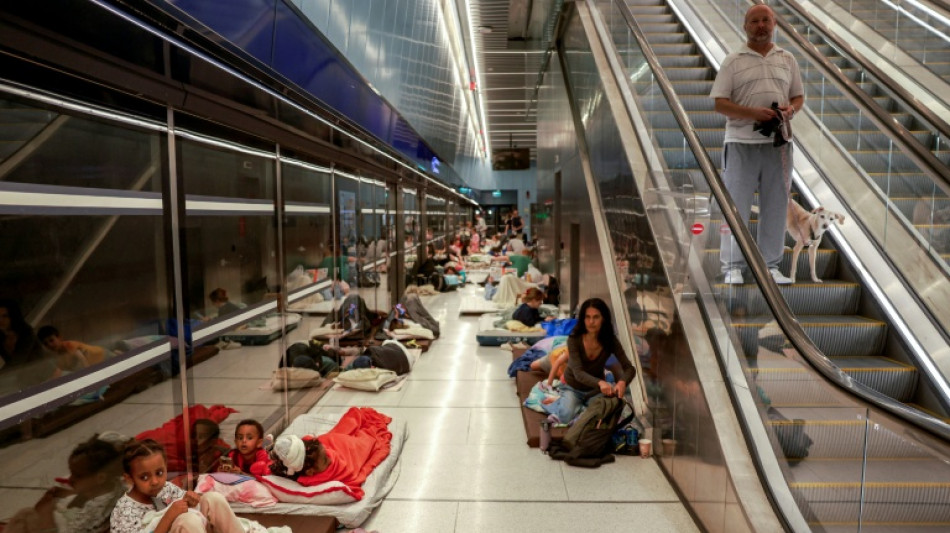
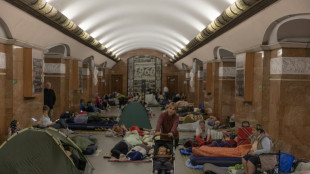
With missiles overhead, Tel Aviv residents huddle underground / Photo: © AFP

 Budding chefs cook up new career at China's BBQ academy

 One stitch at a time: Artist's mission to recreate the Bayeux Tapestry

 Deadly Russian barrage pounds Ukraine capital

 Belgium coach salutes Tielemans after World Cup rescue act
 Cracking open a can of cannabis -- America's new pastime (for now)

 Russia strikes Ukraine capital with missiles and drones, wounds five

 Belgium late show floors Senegal at World Cup

 Harry Kane: England's World Cup saviour

 US actor Danny Glover says he has Alzheimer's

 Trump sees progress as US, Iran hold Qatar talks

 Djokovic, Sinner into Wimbledon third round, Andreeva stunned

 Spurs agree club record £100 mn move for Newcastle's Tonali - reports

 Rain has final say in 1st England-India T20 as Sooryavanshi still awaits debut
 England refused to accept defeat in 'beautiful' DR Congo win, says Tuchel

 'Let the dogs in': Sabalenka wants Wimbledon to lift ban

 Oppressive heat broils US during World Cup, July Fourth

 Can anyone stop France at the World Cup?
 Sinner, Sabalenka into Wimbledon third round, Andreeva stunned

 England have 'hero moments', says Kane after double downs DR Congo

 努莎·奧貝爾:為市民實施時速10公里限速,波茨坦的「坑洞政策」——是漠不關心還是無能為力?

 US refuses to extend North America trade pact in current form
 Mixed US auto sales in 2nd quarter amid high gas prices

 Swiatek, Zverev hoping to lay down Wimbledon markers
 Spray-painted letters spell tragedy for Venezuela quake victims
 'Everybody's profiting': Trump defends $1bn crypto earnings

As night falls in Israel's coastal city of Tel Aviv, hundreds make the familiar descent into the depths of the metro to escape the latest salvo of Iranian missiles.
For those with no safe shelters near their homes, the city's underground stations and car parks have become vital refuges since the war began on June 13.
Despite nightly missile barrages, Israel's casualty toll has remained relatively low, with authorities repeatedly stressing the importance of taking cover in life-saving protected spaces.
"The day after the Israeli intervention in Iran began, there was an explosion, a bomb not far from my home, and the entire shelter I was in shock," Muriel Azria, 58, who works in tourism, told AFP in a Tel Aviv metro station.
She arrives prepared every evening with her suitcase and her dog, ready for a night on her council-provided mattress set up on the platform.
"From the moment I enter the subway, which is magnificent, I calm down," she said. "It's not very comfortable, but at least I'm not afraid, we hear much less booming."
"There are people, everyone is generally very nice," she told AFP.
Israeli residents receive blaring phone alerts via SMS to warn them of incoming Iranian missiles, often in the early hours of the morning. These are often followed by the wail of overhead air raid sirens.
Among the haphazardly placed mattresses on the platforms of the metro stations, some people clutch phones while others play cards, do crosswords or chat to pass the time underground.
For 86-year-old retiree Yudit Kamara, who does not have a shelter at home, the daily journey to the underground station has become an ordeal.
"It's too much, I don't have the strength anymore to go through this. It's really difficult," she told AFP.
"All these children here, all this mess, and it's really cold and not so comfortable. But what other choice do we have? Where will we go?" she asked, stifling a sob.
More than 60 percent of Israelis do not have a safe shelter at home, according to the NGO Latet, which distributes emergency kits, food parcels and children's games to the most vulnerable families.
- 'Need to be strong' -
"I'm very nervous but I need to be strong for my child," said 48-year-old Erlenn Solomon, who has slept every night in an underground station since the start of the conflict.
"As a mom, you need to be strong."
Israel's economic hub Tel Aviv has been particularly targeted by Iran's missiles since the start of the conflict on June 13.
The full extent of the damage from Iran's attacks on Israel is not known due to military censorship rules, but at least 50 impacts have been acknowledged nationwide and 24 people have died, according to official figures.
Once a rare sight in a country with highly sophisticated air defences, Israelis have now become somewhat used to waking up to images of blown-out buildings and rubble-strewn streets.
As well as the metro, some have sought shelter from the bombing in the depths of underground car parks.
"It's terrible. I've had some moments where I've told my parents I don't want to do this anymore, I want to go home, back to the apartment where we live close," said Maya Papirany, 27, speaking four storeys below ground.
"Then they remind me of the dangers of not being down here," she added.
Some sit in plastic chairs while others lie in sleeping bags with their eyes glued to their phones to follow the situation above ground.
Papirany now sleeps alongside her mother and children on a mattress on the floor of a car park lined with tents. Beside her, a young girl sleeps soundly.
"They're not scared of the bombs. I think they're too young to really understand what's going on, and they don't really understand the seriousness of it, so they think it's, like, a fun game," she said.
M.Schneider--VB