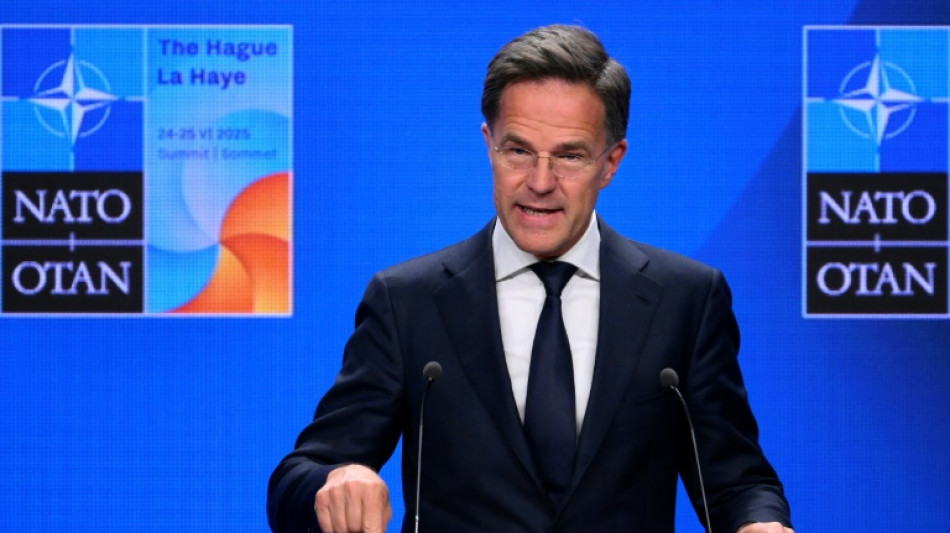
NATO to take 'quantum leap' with 5% summit pledge: Rutte / Photo: © AFP

 South African election results renew debate over identity-based voting

 South African voters report smoother local election but declining IEC trust

 Dolly Parton museum and Nashville hotel open after singer’s death

 George and Amal Clooney attend New York political-comedy reading

 British buyers pay substantial premiums for period-home appearance

 Thomas Markle released to house arrest after child-abuse-image charge

 Dawn of War 4 developers chose Adeptus Mechanicus for tactical variety

 Italy face unbeaten South Africa in Turin Nations Championship match

 ChatGPT interactive interface feature tested across six custom tools

 Freshways milk-price cut deepens pressure on UK dairy farms

 Labour and National remain virtually tied as New Zealand vote count advances

 The Good Daughter adapts Karin Slaughter thriller with Rose Byrne and Meghann Fahy

 Heavy-lift drone evacuates wounded Ukrainian soldier from frontline kill zone

 Morrison says West Brom recovered after pressure from successive derby losses

 Britain considers 2027 state visit for Ukraine’s Zelensky

 Arizona Democrats Secure Historic Trifecta with New Legislative Leadership

 Carney Welcomes U.S. Trade Reversal After Democratic Midterm Victory

 Armenian FM Discusses EU Accountability for Palestinian Rights in Madrid
NATO allies are poised to take a "quantum leap" by hiking defence spending to counter the threat of Russia, Secretary General Mark Rutte said on Monday, on the eve of a two-day summit.
The 32 members of the alliance will pledge to boost defence expenditure to five percent of gross domestic product, a key demand of President Donald Trump, who has long grumbled that the US pays too much for NATO.
NATO's members have thrashed out a compromise deal to dedicate at least 3.5 percent of GDP to core military needs by 2035, and 1.5 percent to broader security-related items like cybersecurity and infrastructure.
"The defence investment plan that allies will agree in The Hague introduces a new baseline, five percent of GDP to be invested in defence," Rutte told reporters at a pre-summit news conference.
"This is a quantum leap that is ambitious, historic and fundamental to securing our future."
The focus at the summit in the Hague will be on keeping Trump happy after his return to power sparked fears he could blow a hole in the seven-decade-old alliance.
In the run-up to the meeting, Spain had sparked fears of undermining a carefully choreographed unity by refusing to commit to the headline figure of five percent.
But Rutte stressed that Spain had not been granted an "opt-out" from the pledge.
"NATO does not have as an alliance opt-outs, side deals, etcetera, because we all have to chip in," Rutte said.
The NATO chief said that the increase in spending would see the alliance boost its air defences five-fold and add thousands more tanks and armoured vehicles to its arsenals.
"Our focus is ensuring that we have all we need to deter and defend against any threat," he said.
"Of course, the most significant and direct threat facing this alliance remains the Russian Federation."
- Iranian 'stranglehold' -
Rutte insisted that the summit would also send a strong signal of support to Ukraine -- despite Trump upending the West's stance towards Russia's war on Kyiv.
Ukraine's President Volodymyr Zelensky will attend a state dinner with the Dutch king but he has largely been sidelined from the summit's main event.
Rutte said that Europe was stepping up already to fill the gap left by Washington pulling back from supporting Ukraine.
He said that Europe and Canada had already pledged 35 billion euros ($40 billion) to help arm Kyiv so far this year.
Dismissing the idea that the fresh conflict between Israel and Iran could deflect attention from the summit, Rutte stressed that Tehran should not be permitted to possess a nuclear weapon.
He said his "greatest fear" was that Iran would secure access to a nuclear bomb, giving it a "stranglehold" over Israel, the region, and the wider world.
Over the weekend, Trump said that US warplanes had used "bunker buster" bombs that had "obliterated" Iran's nuclear capabilities.
Other officials said it was too soon to assess the true impact on Iran's nuclear programme, which Israel and some Western states consider an existential threat.
Pressed over the legality of Washington's strikes against Iran, the NATO chief replied: "I would not agree that this is against international law, what the US did."
M.Vogt--VB