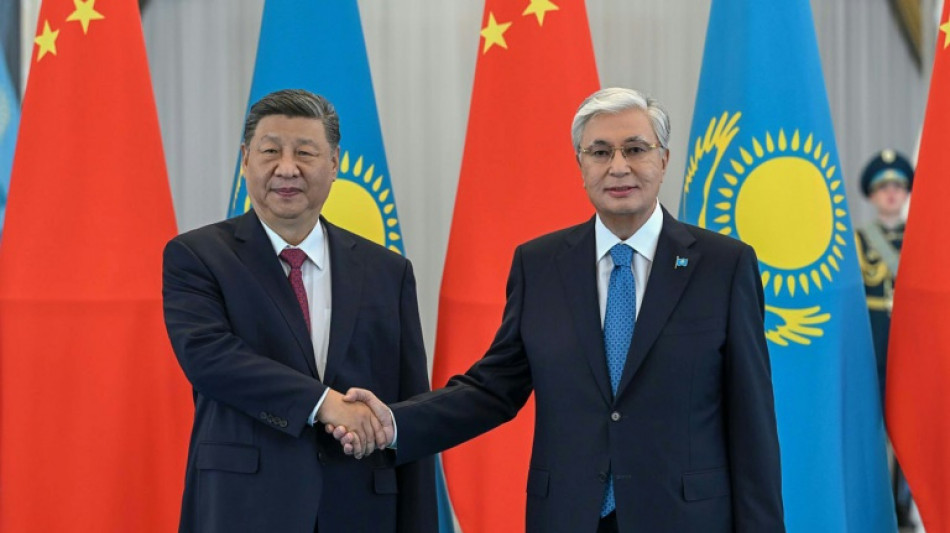
China's Xi in Kazakhstan to cement 'eternal' Central Asia ties / Photo: © KAZAKHSTAN'S PRESIDENTIAL PRESS SERVICE/AFP

 South African election results renew debate over identity-based voting

 South African voters report smoother local election but declining IEC trust

 Dolly Parton museum and Nashville hotel open after singer’s death

 George and Amal Clooney attend New York political-comedy reading

 British buyers pay substantial premiums for period-home appearance

 Thomas Markle released to house arrest after child-abuse-image charge

 Dawn of War 4 developers chose Adeptus Mechanicus for tactical variety

 Italy face unbeaten South Africa in Turin Nations Championship match

 ChatGPT interactive interface feature tested across six custom tools

 Freshways milk-price cut deepens pressure on UK dairy farms

 Labour and National remain virtually tied as New Zealand vote count advances

 The Good Daughter adapts Karin Slaughter thriller with Rose Byrne and Meghann Fahy

 Heavy-lift drone evacuates wounded Ukrainian soldier from frontline kill zone

 Morrison says West Brom recovered after pressure from successive derby losses

 Britain considers 2027 state visit for Ukraine’s Zelensky

 Arizona Democrats Secure Historic Trifecta with New Legislative Leadership

 Carney Welcomes U.S. Trade Reversal After Democratic Midterm Victory
Xi Jinping celebrated China's "eternal friendship" with Central Asia at a summit in Kazakhstan on Tuesday, as the Chinese leader blasted tariffs and sought to assert Beijing's influence in a region historically dominated by Russia.
The summit in Astana brought together Xi with the leaders of Kazakhstan, Kyrgyzstan, Uzbekistan, Tajikistan and Turkmenistan.
Under Russia's orbit until the fall of the Soviet Union in 1991, the five Central Asian states have courted interest from major powers including China, the European Union and the United States since becoming independent.
At the summit, the group signed a pact of "eternal" friendship as Xi called for closer ties with the resource-rich region.
"We should... strengthen cooperation with a more enterprising attitude and more practical measures," said Xi in comments carried by state news agency Xinhua.
Central Asia is also seen as a key logistics hub, given its strategic location between China, Russia, the Middle East and Europe.
- 'No winners' -
Speaking as Western leaders gathered on the other side of the world for the G7 in Canada, Xi refreshed his criticism of US President Donald Trump's trade policies.
"Tariff wars and trade wars have no winners," Xinhua quoted him as saying.
While Central Asian leaders continue to view Russia as a strategic partner, ties with Moscow have loosened since the war in Ukraine.
China has also shown willingness to invest in massive infrastructure projects in the region, part of its Belt and Road initiative that uses such financing as a political and diplomatic lever.
In a meeting with Kyrgyzstan's president, Xi called for moves to "advance high-quality construction of the China-Kyrgyzstan-Uzbekistan railway and foster new drivers of growth in clean energy, green minerals and artificial intelligence".
The five Central Asian nations are trying to take advantage of the growing interest in their region and are coordinating their foreign policies accordingly.
They regularly hold summits with China and Russia to present the region as a unified bloc and attract investment.
High-level "5+1" format talks have also been organised with the European Union, the United States, Turkey and other Western countries.
"The countries of the region are balancing between different centres of power, wanting to protect themselves from excessive dependence on one partner," Kyrgyz political scientist Nargiza Muratalieva told AFP.
- Biggest trade partner -
Russia says China's growing influence in the region does not pose a threat.
"There is no reason for such fears. China is our privileged strategic partner, and the countries of Central Asia, naturally, are our natural historical partners," Kremlin spokesman Dmitry Peskov told reporters on Monday.
But China has now established itself as Central Asia's leading trading partner, far outstripping the EU and Russia.
Construction of the Uzbekistan-Kyrgyzstan-China railway and the China-Tajikistan highway, which runs through the Pamir Mountains to Afghanistan, are among its planned investments.
New border crossings and "dry ports" have already been built to process trade, such as Khorgos in Kazakhstan, one of the largest logistics hubs in the world.
"Neither Russia nor Western institutions are capable of allocating financial resources for infrastructure so quickly and on such a large scale, sometimes bypassing transparent procedures," said Muratalieva.
Kazakhstan said last week that Russia would lead the construction of its first nuclear power plant but that it wanted China to build the second.
"Central Asia is rich in natural resources such as oil, gas, uranium, gold and other minerals that the rapidly developing Chinese economy needs," Muratalieva said.
"Ensuring uninterrupted supplies of these resources, bypassing unstable sea routes, is an important goal of Beijing," the analyst added.
- Human rights -
China also positions itself as a supporter of the predominantly authoritarian Central Asian leaderships.
At the last Central Asia-China summit, Xi called for "resisting external interference" that might provoke "colour revolutions" that could overthrow the current leaders in the region.
"Beijing sees the stability of the Central Asian states as a guarantee of the security of its western borders," Muratalieva said.
Central Asia border's China's northwestern Xinjiang region, where Beijing is accused of having detained more than a million Uyghurs and other Muslims, part of a campaign the UN has said could constitute crimes against humanity.
burs/bk-mmp/jc/rlp
A.Ammann--VB