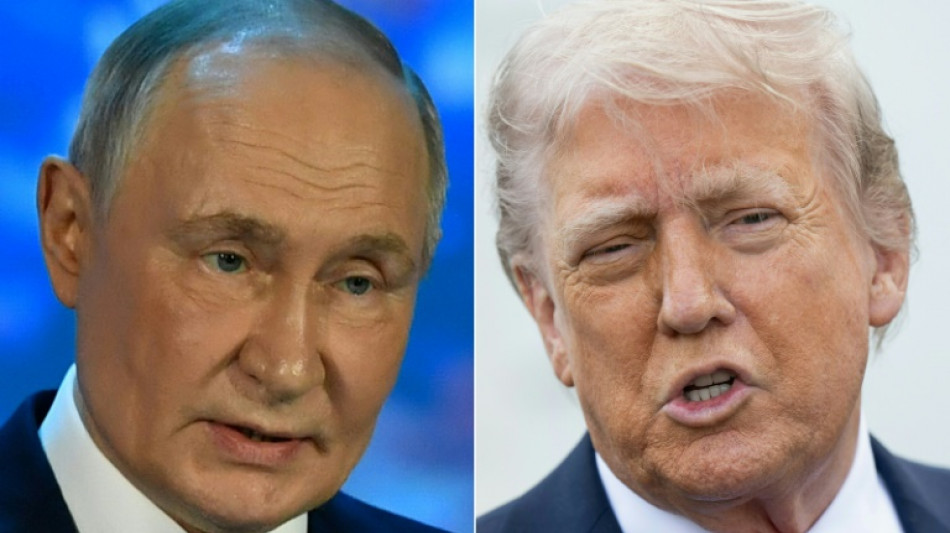
Trump to call Putin in push for Ukraine ceasefire / Photo: © AFP/File

 South African election results renew debate over identity-based voting

 South African voters report smoother local election but declining IEC trust

 Dolly Parton museum and Nashville hotel open after singer’s death

 George and Amal Clooney attend New York political-comedy reading

 British buyers pay substantial premiums for period-home appearance

 Thomas Markle released to house arrest after child-abuse-image charge

 Dawn of War 4 developers chose Adeptus Mechanicus for tactical variety

 Italy face unbeaten South Africa in Turin Nations Championship match

 ChatGPT interactive interface feature tested across six custom tools

 Freshways milk-price cut deepens pressure on UK dairy farms

 Labour and National remain virtually tied as New Zealand vote count advances

 The Good Daughter adapts Karin Slaughter thriller with Rose Byrne and Meghann Fahy

 Heavy-lift drone evacuates wounded Ukrainian soldier from frontline kill zone

 Morrison says West Brom recovered after pressure from successive derby losses

 Britain considers 2027 state visit for Ukraine’s Zelensky

Donald Trump will speak by phone Monday with Russia's Vladimir Putin as part of the US leader's effort to end the grinding war set off by Moscow's 2022 invasion of Ukraine.
Trump had vowed during his US election campaign to halt the conflict within a day of taking office, but his diplomatic efforts have so far yielded little progress.
Russia, which launched what Kyiv called a "record" drone attack on Ukraine at the weekend, said Monday it would prefer to end the conflict through diplomacy and described the upcoming call as "important".
"It is preferable to achieve our goals through political and diplomatic means, of course," Kremlin spokesman Dmitry Peskov told state media, adding that Russia "highly valued" Washington's attempts to end the fighting.
Delegations from Russia and Ukraine held direct negotiations in Istanbul last week for the first time about three years, but the talks ended without a commitment to a ceasefire.
Both sides traded insults, with Ukraine accusing Moscow of sending a "dummy" delegation of low-ranking officials.
After the negotiations, Trump announced that he would speak by phone with the Russian president in a bid to end the "BLOODBATH" in Ukraine, which has destroyed large swathes of the country and displaced millions of people.
Trump also said he would speak to Ukrainian President Volodymyr Zelensky and NATO officials, expressing hope that a "ceasefire will take place, and this very violent war... will end".
Trump has directed much of his frustration towards Ukraine while abstaining from extensively criticising Putin.
The US president has also argued that "nothing's going to happen" on the conflict until he meets Putin face-to-face.
- Push for sanctions -
At the talks in Istanbul, which were also attended by US officials, Russia and Ukraine agreed to exchange 1,000 prisoners each and trade ideas on a possible truce, but with no concrete commitment.
Ukraine's Western allies have since accused Putin of deliberately ignoring calls for a ceasefire and pushed for fresh sanctions against Russia.
The leaders of Britain, France, Germany and Italy held a phone call with Trump on Sunday.
"The leaders discussed the need for an unconditional ceasefire and for President Putin to take peace talks seriously," said a spokesman for British Prime Minister Keir Starmer.
"They also discussed the use of sanctions if Russia failed to engage seriously in a ceasefire and peace talks," the spokesman said.
"Putin must agree to a ceasefire and peace talks," German Chancellor Friedrich Merz, who also took part in the call, wrote on X, adding that the European leaders aimed to talk to the US president once again on Monday.
Zelensky also discussed possible sanctions with US Vice President JD Vance when they met after Pope Leo's inaugural mass at the Vatican on Sunday.
A senior Ukrainian official from the president's office, who spoke on condition of anonymity, told AFP that they had also discussed preparations for Monday's telephone conversation between Trump and Putin.
- 'Root causes' -
It was the first meeting between Zelensky and Vance since their heated White House exchange in February.
In the Oval Office, Vance publicly accused Zelensky of being "disrespectful" towards Trump, who told the Ukrainian leader he should be more grateful and that he had no "cards" to play in negotiations with Russia.
On the ground, the Russian army claimed to capture two villages in Ukraine's eastern Sumy and Donetsk regions.
Russia also fired 112 drones on Ukraine overnight, 76 of which were repelled, the Ukrainian air force said.
In an interview with Russian state TV broadcast on Sunday, Putin said that Moscow's aim was to "eliminate the causes that triggered this crisis, create the conditions for a lasting peace and guarantee Russia's security", without elaborating further.
Russia's references to the "root causes" of the conflict typically refer to grievances with Kyiv and the West that Moscow has put forward as justification for launching the invasion in February 2022.
They include pledges to "de-Nazify" and demilitarise Ukraine, protect Russian speakers in the country's east, push back against NATO expansion and stop Ukraine's westward geopolitical drift.
Kyiv and the West deny Moscow's claims and say that Russia's invasion is an imperial-style land grab.
P.Staeheli--VB