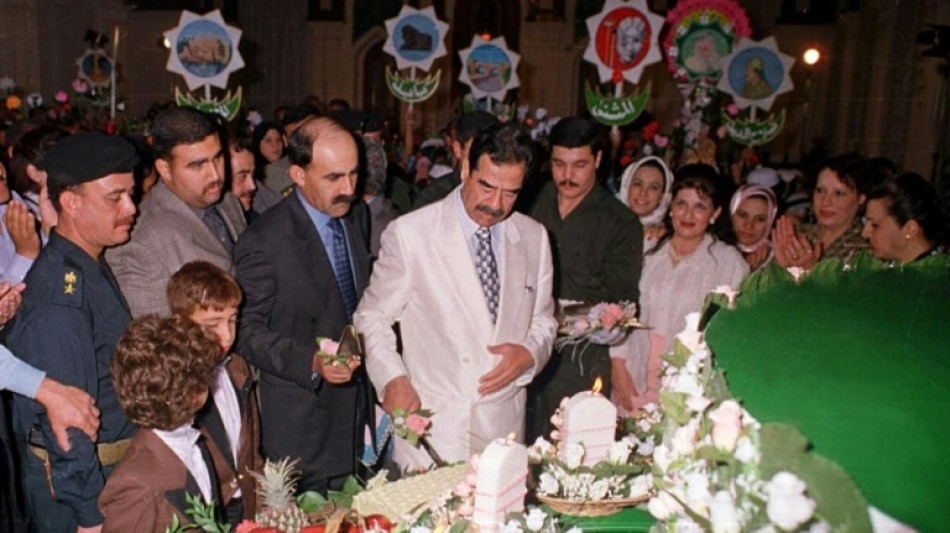
Iraq's first filmmaker in Cannes says sanctions no piece of cake / Photo: © INA/AFP

 South African election results renew debate over identity-based voting

 South African voters report smoother local election but declining IEC trust

 Dolly Parton museum and Nashville hotel open after singer’s death

 George and Amal Clooney attend New York political-comedy reading

 British buyers pay substantial premiums for period-home appearance

 Thomas Markle released to house arrest after child-abuse-image charge

 Dawn of War 4 developers chose Adeptus Mechanicus for tactical variety

 Italy face unbeaten South Africa in Turin Nations Championship match

 ChatGPT interactive interface feature tested across six custom tools

 Freshways milk-price cut deepens pressure on UK dairy farms

 Labour and National remain virtually tied as New Zealand vote count advances

 The Good Daughter adapts Karin Slaughter thriller with Rose Byrne and Meghann Fahy

 Heavy-lift drone evacuates wounded Ukrainian soldier from frontline kill zone

 Morrison says West Brom recovered after pressure from successive derby losses

 Britain considers 2027 state visit for Ukraine’s Zelensky

Hasan Hadi, the first filmmaker from Iraq to be selected for the prestigious Cannes Festival, said economic embargoes like those imposed in his childhood under Saddam Hussein did not work.
"Sanctions empower dictators," he told AFP, as they concentrate scant resources in their hands and only make them "more brutal".
"In the history of the world, there was no one time when they (imposed) sanctions and the president couldn't eat."
Hadi's first feature film, "The President's Cake", has received very good reviews since premiering Friday in the Directors' Fortnight section.
Cinema publication Deadline said it was "head and shoulders above" some of the films in the running for the festival's Palme d'Or top prize, and "could turn out to be Iraq's first nominee for an Oscar".
The film follows nine-year-old Lamia after she has the misfortune of being picked by her school teacher to bake the class a cake for the president's birthday, or be denounced for disloyalty.
It is the early 1990s, the country is under crippling UN sanctions. She and her grandmother -- with whom she shares a reed home in Iraq's southern marshlands -- can barely afford to eat.
As they set off into town to hunt down unaffordable ingredients, with Lamia's pet cockerel and their last meagre belongings to sell, the film plunges into the social reality -- and everyday petty corruption -- of 1990s Iraq.
The near-total trade and financial embargo imposed on Iraq after it invaded Kuwait "demolished the moral fabric of society", Hadi said.
It sent the country "hundreds of years back".
- 'Selling their door frames' -
The filmmaker said he did not taste cake until he was in his early teens, after the US-led invasion in 2003 toppled Saddam and sanctions were lifted.
Instead, with processed sugar and eggs out of reach, there was "date cake" -- whose main ingredient was squished dates, sometimes with a candle on top.
"As a kid you're sad that you're not getting your cake," he said. But as you grow up, you realise what your parents must have gone through to put food on the table.
"Not only my family, but all of these people had to sell literally everything," he said. "There were people that were even selling their door frames."
Hadi and his team shot the film entirely in Iraq.
It beautifully captures the ancient wetlands in the south of the country, listed as a World Heritage Site since 2016 and reputedly the home of the biblical Garden of Eden.
Saddam drained them in the 1990s, trying to flush out rebels hiding in the reeds.
But after the US-led invasion, authorities opened up the valves and the wetlands flourished again -- even if they are now threatened by climate change.
Hadi said he chose the location partly to make the point that "the marshes stayed and Saddam went away".
- Infamous eatery -
To re-create the Iraq of his youth, Hadi and his crew paid close attention to detail, amassing vintage clothes and bringing a barber on set to trim the hair and moustaches of everyone down to the extras.
They scouted out the best locations, shooting one scene in a small eatery reputed to have been frequented by Saddam himself.
They chose non-actors to play ordinary Iraqis under the ever-present eyes of the president in posters, pictures frames and murals.
Hadi said hearing US President Donald Trump say recently that he planned to lift sanctions on Syria after Islamists toppled president Bashar al-Assad last year was "amazing".
"I don't think the sanctions helped in any way to get rid of Bashar, but definitely empowered him to kill more people, and torture more people," he said.
A.Ammann--VB