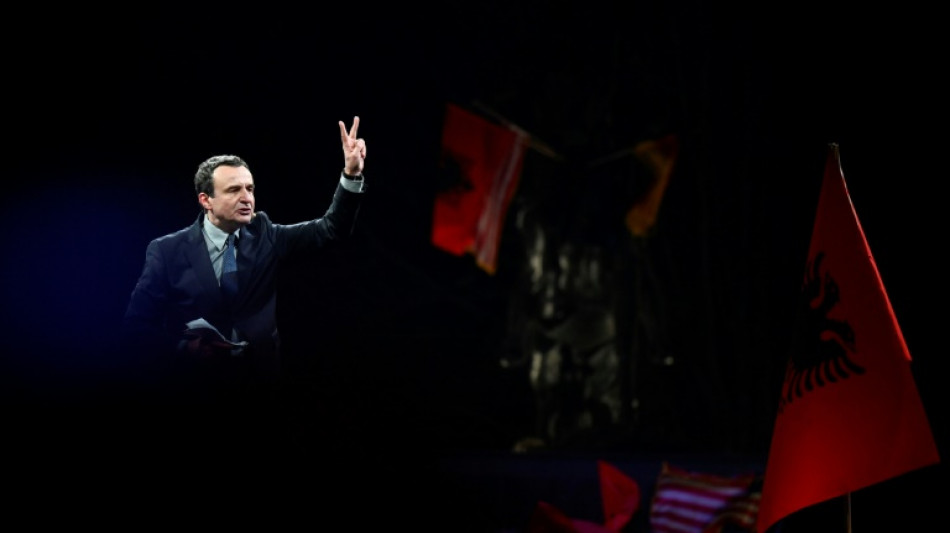
Stand-off leaves Kosovo unable again to elect speaker / Photo: © AFP

 South African election results renew debate over identity-based voting

 South African voters report smoother local election but declining IEC trust

 Dolly Parton museum and Nashville hotel open after singer’s death

 George and Amal Clooney attend New York political-comedy reading

 British buyers pay substantial premiums for period-home appearance

 Thomas Markle released to house arrest after child-abuse-image charge

 Dawn of War 4 developers chose Adeptus Mechanicus for tactical variety

 Italy face unbeaten South Africa in Turin Nations Championship match

 ChatGPT interactive interface feature tested across six custom tools

 Freshways milk-price cut deepens pressure on UK dairy farms

 Labour and National remain virtually tied as New Zealand vote count advances

 The Good Daughter adapts Karin Slaughter thriller with Rose Byrne and Meghann Fahy

 Heavy-lift drone evacuates wounded Ukrainian soldier from frontline kill zone

 Morrison says West Brom recovered after pressure from successive derby losses

 Britain considers 2027 state visit for Ukraine’s Zelensky

Lawmakers in Kosovo on Tuesday again failed to elect a new parliamentary speaker, after 14 previous unsuccessful attempts that have plunged Europe's youngest state into unprecedented political deadlock.
Political life has been at a standstill since February 9 elections, in which Prime Minister Albin Kurti's Self-Determination (VV) party win only 48 out of 120 seats -- not enough to form a majority government.
Opposition parties have, since mid-April, refused to vote for VV's candidate for the post of speaker, former justice minister Albulena Haxhiu.
Her appointment had been expected to be a formality but it has now turned into an impasse, with repeated votes -- and failures -- on the issue.
Several political leaders are now hinting at the possibility of fresh elections.
According to parliamentary rules, the parliament cannot be considered inaugurated without a speaker, and without its inauguration a new government cannot be formed.
- 'Hostage' -
Several opposition parties now accuse VV of deliberately blocking progress by refusing to propose an alternative candidate.
"VV is keeping Kosovo in an institutional crisis at all costs," said Memli Krasniqi, president of the right-wing Democratic Party of Kosovo (PDK), whose party came second with 20.95 percent of the vote.
Krasniqi on Tuesday suggested that the VV consider another candidate, pointing to the last US election when the Democratic Party ditched then president Joe Biden for Kamala Harris.
"That wasn't considered anything extraordinary," he added.
The centre-right Democratic League of Kosovo (LDK), which finished third on 18.27 percent, said the current crisis was down to the "failure of the party that came first in the vote to create political partnerships for a new majority".
For Ramush Haradinaj, leader of the right-wing Alliance for the Future of Kosovo (AAK), a potential solution could involve the intervention of President Vjosa Osmani.
She is seen as more pragmatic and diplomatic than her prime minister and could turn to the judiciary for an interpretation of the constitution.
Osmani's office on Tuesday said she was launching "a series of consultations" with political parties from Thursday.
University of Pristina sociology professor Fadil Maloku said he believed that the "crisis is the result of shameful hostilities between leaders".
"Kosovo has been their hostage for three months," he added.
Political analyst Arben Qirezi, writing for the online newspaper Koha Ditore, said the young country lacks a "culture of political compromise".
He believes that this is essential for maintaining the political system's stability, legitimacy, and democratic representation of the citizens.
- Economic consequences -
The current deadlock could be costly for Kosovo, which declared independence from Serbia in February 2008. Serbia refuses to recognise Kosovo's independence.
The parliamentary stand-off has delayed the ratification of agreements under the European Union's Growth Plan for the Western Balkans, depriving the country of access to 882.6 million euros ($981.5 million) in loans and grants.
"If ratification does not occur by June it could end into delays in fund disbursement and potentially a redistribution of funds," to other countries, warned Besar Gergi, from the Group for Legal and Political Studies, a Pristina-based think-tank.
Even if parties agree to new elections, the current legislature must still vote to ratify the Growth Plan agreement, added Blerina Istrefi, a researcher at the same think-tank.
The parliamentary session that began on April 15 can only be concluded with the election of a president, three vice-presidents and the formation of parliamentary groups.
However, the Constitution does not specify a strict deadline for this process, meaning it could, in theory, continue indefinitely.
"The parties have locked themselves into their camps... the political schizophrenia continues," said Maloku.
As for Kurti, asked by a journalist about a possible solution to the crisis, he replied: "I am the prime minister, let's move on."
G.Haefliger--VB