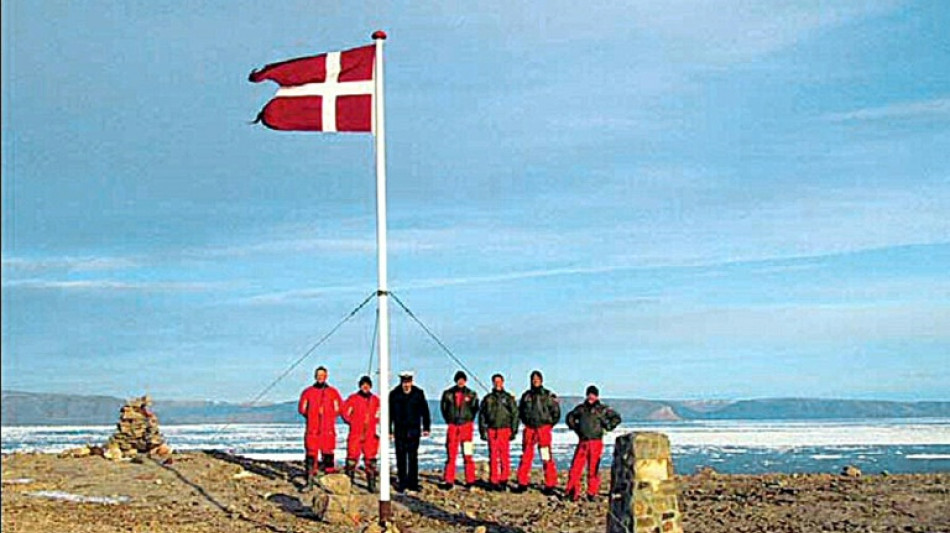
Canada, Denmark settle 'whiskey war' over Arctic island / Photo: © SCANPIX/AFP/File

 Typhoon Dolphin weakens but disrupts travel in east China

 Pakistan brickmakers scorched by sun above and fire below
 Ithaca bets on hometown hero Odysseus for tourism boom

 Five things to know about Zambia ahead of the presidential vote

 Zambia vote to test Hichilema's economic record

 Meta will soon face another high-stakes trial in US

 Syria says reached deal with Moscow on fate of Russian bases

 Netanyahu rejects Gaza plan in new break from Trump

 Kurdish PKK criticises Turkey bill on fate of its fighters

 Clay-courter Merida on hardcourt learning curve in Montreal

 NBA champion player and historic coach Nelson dead at 86

 BMW iX3 Flow Edition brings animated bodywork closer to reality

 Arteta backs Guimaraes to 'ignite something different' at Arsenal
 Como sign England defender Chalobah from Chelsea

 Demi Vollering wins Tour de France Femmes

 Iraola's first Anfield match as Liverpool manager ends in Monaco defeat

 Bodies hanging from bridge revive violence in once-calm town in Mexico
 Lionel Messi bids farewell to father who guided his glittering career

 Raul Fernandez wins British MotoGP Grand Prix

 Tesla FSD secrecy puts Europe’s safety oversight under scrutiny

 Mercedes-AMG GT 53 balances speed, range and daily usability

 Lion queen Werro focused on Euro medal, not 800m world record

 Changan uses FILDA 2026 to accelerate its African expansion

 Honda plots a profitable European comeback without a price war

 Iran Guards say won't reopen Hormuz without US meeting all Tehran's conditions

Canada and Denmark on Tuesday finally settled the largely good-natured "whiskey war" that was fought for decades with weapons such as flags and bottles of alcohol over a tiny, barren, and uninhabited outcrop in the Arctic.
The two sides formally announced a deal to split Hans Island and effectively create the first land border between Canada and Europe at a signing ceremony in Ottawa with Canadian and Danish foreign ministers.
Dividing up the kidney-shaped island and resolving the 49-year-old benign impasse was held up as a model for peacefully resolving territorial disputes -- contrasted with Russia's invasion of Ukraine.
"The Arctic is a beacon for international cooperation, where the rule of law prevails," Canadian Foreign Minister Melanie Joly told AFP.
"As global security is being threatened, it's more important than ever for democracies like Canada and Denmark to work together, alongside Indigenous peoples, to resolve our differences in accordance with international law."
The waggish row over the 1.3 square kilometer (0.5 square mile) Hans Island, which sits between Ellesmere and Greenland, dated back to 1973, when a marine boundary was drawn between Canada and Greenland, part of the Danish kingdom.
Danes and Canadians have visited the rock by helicopter over the past decades to lay claim to it, leading to diplomatic protests, online campaigns and even a Canadian call to boycott Danish pastries.
During those ministerial visits, each side would plant a flag and leave behind a bottle of whiskey or schnapps for the other to enjoy, along with comical notes.
"Many have called it the whiskey war. I think it was the friendliest of all wars," Joly said of the territorial dispute -- which had drawn in no less than 26 foreign ministers over the decades -- at a news conference with her Danish counterpart Jeppe Kofod.
Kofod said that its resolution, however, comes at a time when "the ruled-based international order is under pressure" and democratic values "are under attack."
- 'Playing by the rules' -
"We see gross violations of international rules unfold in another part of the world," he said, alluding to the war in Ukraine.
"In contrast, we have demonstrated how longstanding disputes can be resolved peacefully by playing by the rules," Kofod said, adding that he hoped Canada and Denmark's experience will "inspire other countries to follow the same path."
"This sends a strong signal: diplomacy and the rule of law actually works, and that great result can be achieved by following the rules."
As they exchanged bottles on Tuesday, Joly and Kofod laughed off suggestions that Canada might join the EU now that the two share a land border.
Joly quipped that a Canadian singer would surely enter the next Eurovision Song Contest, while Kofod offered: "Welcome Canada to the European continent!"
Snow-covered Hans Island is uninhabitable, but the onset of global warming is bringing more ship traffic to the Arctic, and opening it up to fishing and resources exploration -- although maybe not in the area of the island.
Arctic expert Michael Byers noted that "the island is so incredibly remote as to make it uneconomical to contemplate any serious activity there."
Putting off resolution of this unusual territorial dispute, however, made for good political theater in both countries, flaring up ahead of elections.
"It was an entirely risk-free sovereignty dispute between two NATO allies over an insignificant, tiny island," Byers said.
Denmark had also feared that losing the ownership battle would undermine relations with Greenland, while Canada worried that a loss would weaken its negotiating position in a more consequential dispute with the United States over the Beaufort Sea, in far northwestern Canada, believed to be rich in hydrocarbons.
More recently, Canadian Prime Minister Justin Trudeau "has not made Arctic sovereignty part of his brand," in contrast to his predecessor, Byers said. "So that reduced the temperature, at least from our side."
"But most importantly, Russia invaded Ukraine, and that created an opportune moment to tell the world that responsible countries settle territorial disputes in a peaceful way," he said.
P.Anderson--BTB