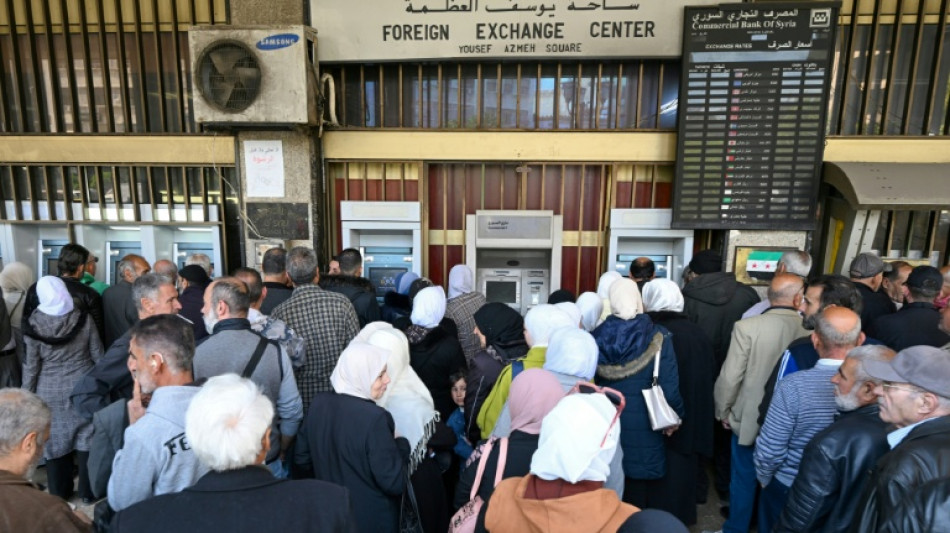
Cash crunch leaves Syrians queueing for hours to collect salaries / Photo: © AFP

 Rene Eyre Revisits Autobiographical Performance 'Say A Little Prayer' in London

 UAE's HCT Holds Record Graduation and Announces Major Training Expansion

 NASA Awards $10B Lunar Contract Framework to SpaceX, Blue Origin

 Katy Perry Tells Fans Ex-Husband Russell Brand 'Should Be in Jail' During UK Concert

 South African election results renew debate over identity-based voting

 South African voters report smoother local election but declining IEC trust

 Dolly Parton museum and Nashville hotel open after singer’s death

 George and Amal Clooney attend New York political-comedy reading

 British buyers pay substantial premiums for period-home appearance

 Thomas Markle released to house arrest after child-abuse-image charge

 Dawn of War 4 developers chose Adeptus Mechanicus for tactical variety

 Italy face unbeaten South Africa in Turin Nations Championship match

 ChatGPT interactive interface feature tested across six custom tools

 Freshways milk-price cut deepens pressure on UK dairy farms

 Labour and National remain virtually tied as New Zealand vote count advances

 The Good Daughter adapts Karin Slaughter thriller with Rose Byrne and Meghann Fahy

 Heavy-lift drone evacuates wounded Ukrainian soldier from frontline kill zone

 Morrison says West Brom recovered after pressure from successive derby losses
Seated on the pavement outside a bank in central Damascus, Abu Fares's face is worn with exhaustion as he waits to collect a small portion of his pension.
"I've been here for four hours and I haven't so much as touched my pension," said the 77-year-old, who did not wish to give his full name.
"The cash dispensers are under-stocked and the queues are long," he continued.
Since the overthrow of president Bashar al-Assad last December, Syria has been struggling to emerge from the wake of nearly 14 years of civil war, and its banking sector is no exception.
Decades of punishing sanctions imposed on the Assad dynasty -- which the new authorities are seeking to have lifted -- have left about 90 percent of Syrians under the poverty line, according to the United Nations.
The liquidity crisis has forced authorities to drastically limit cash withdrawals, leaving much of the population struggling to make ends meet.
Prior to his ousting, Assad's key ally Russia held a monopoly on printing banknotes. The new authorities have only announced once that they have received a shipment of banknotes from Moscow since Assad's overthrow.
In a country with about 1.25 million public sector employees, civil servants must queue at one of two state banks or affiliated ATMs to make withdrawals, capped at about 200,000 Syrian pounds, the equivalent on the black market of $20 per day.
In some cases, they have to take a day off just to wait for the cash.
"There are sick people, elderly... we can't continue like this," said Abu Fares.
- 'Meagre sums' -
"There is a clear lack of cash, and for that reason we deactivate the ATMs at the end of the workday," an employee at a private bank told AFP, preferring not to give her name.
A haphazard queue of about 300 people stretches outside the Commercial Bank of Syria. Some are sitting on the ground.
Afraa Jumaa, a civil servant, said she spends most of the money she withdraws on the travel fare to get to and from the bank.
"The conditions are difficult and we need to withdraw our salaries as quickly as possible," said the 43-year-old.
"It's not acceptable that we have to spend days to withdraw meagre sums."
The local currency has plunged in value since the civil war erupted in 2011, prior to which the dollar was valued at 50 pounds.
Economist Georges Khouzam explained that foreign exchange vendors -- whose work was outlawed under Assad -- "deliberately reduced cash flows in Syrian pounds to provoke rapid fluctuations in the market and turn a profit".
Muntaha Abbas, a 37-year-old civil servant, had to return three times to withdraw her entire salary of 500,000 pounds.
"There are a lot of ATMs in Damascus, but very few of them work," she said.
After a five-hour wait, she was finally able to withdraw 200,000 pounds.
"Queues and more queues... our lives have become a series of queues," she lamented.
E.Gasser--VB