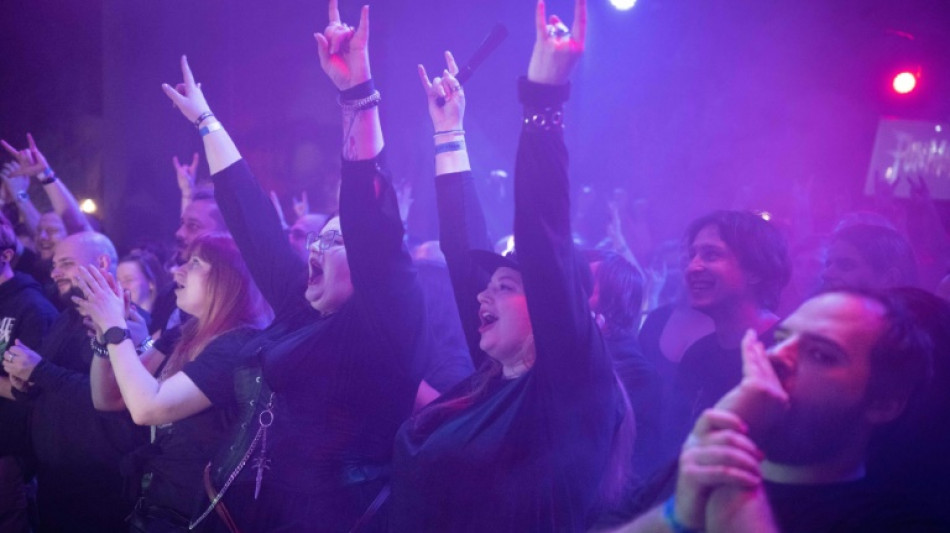
Music scene offers release for stifled Belarus youth / Photo: © AFP

 Rene Eyre Revisits Autobiographical Performance 'Say A Little Prayer' in London

 UAE's HCT Holds Record Graduation and Announces Major Training Expansion

 NASA Awards $10B Lunar Contract Framework to SpaceX, Blue Origin

 Katy Perry Tells Fans Ex-Husband Russell Brand 'Should Be in Jail' During UK Concert

 South African election results renew debate over identity-based voting

 South African voters report smoother local election but declining IEC trust

 Dolly Parton museum and Nashville hotel open after singer’s death

 George and Amal Clooney attend New York political-comedy reading

 British buyers pay substantial premiums for period-home appearance

 Thomas Markle released to house arrest after child-abuse-image charge

 Dawn of War 4 developers chose Adeptus Mechanicus for tactical variety

 Italy face unbeaten South Africa in Turin Nations Championship match

 ChatGPT interactive interface feature tested across six custom tools
Gleb Gurami believes the parties he organises in a Minsk nightclub are an outlet for young Belarusians, reeling from the exodus that followed mass protests and a political crackdown in 2020.
"I think this mission of underground culture, raves, electronic music... helps a lot of people," the 39-year-old promoter told AFP at the Modul Art Platform club near the Svislach River in the Belarus capital.
Minsk was once renowned for its punk scene, dating back to the last years of the Soviet Union and the artistic and cultural flourishing after independence in the early 1990s.
But the landscape has changed radically over the past five years.
Major demonstrations against autocratic President Alexander Lukashenko in 2020 were put down by force and hundreds of thousands of Belarusians -- many of them young people -- fled abroad, particularly to neighbouring Poland.
The country's most famous band, Bi-2, can de facto no longer perform in Belarus or Russia and tours internationally to audiences of exiles.
In Belarus, many musicians have been persecuted for their support of the anti-Lukashenko protests or their opposition to Russia's invasion of Ukraine in 2022, which the Minsk government backed.
Additional Western sanctions have further isolated the country.
Gurami said he wants his wild club nights to "give people a chance to relax" so as to avoid "depression".
"People should not have to suffer because of stories that do not depend on them, their opinions, their points of view or their preferences, especially in art and music," he said.
- 'Censorship' -
"A lot of bands split up after 2020," said singer Vadim Shulga said.
His band PlemYA was founded 10 years ago and used to play in "Poland, Romania... just about everywhere".
The 46-year-old said that of its original seven members, only two remain.
"Now we only perform in Belarus or Russia," he said bitterly.
With fewer touring opportunities, it is hard to make a living.
"Abroad, we used to earn 1,000 euros ($1,800) or more" in fees per concert, compared to just "$100 to $150" now.
He said the music scene in Belarus "has not disappeared" but it is hard not to be affected by the tensions in a tightly controlled society where the authorities can decide whether bands are allowed to perform or not.
"There is a certain amount of censorship," said Svetlana Ramonka, a concert organiser in Minsk.
"Before, it was easier. Now it's a bit more complicated," she said.
- Invisible wall -
At a concert by a Russian alternative rock band in Minsk in January, organisers sold 260 tickets priced between 25 and 40 euros each.
"We're delighted to see you," the singer told the crowd in the trendy bar.
The youthful audience members, many with beer in hand, swayed to the music.
They jumped, sang and hugged each other during an hour-and-a-half of respite from an oppressive reality.
After the gig, Artyom Golovaty, a 21-year-old geography teacher and "big fan" of music, said he was pleased that "more gigs are being organised".
"Those who wanted to leave have left. In any case, if there's a gap, we can always fill it," he said.
Gurami said he wants to face the future with "hope", imagining a world in which Belarusian artists can once again perform in Europe and vice versa.
"I hope we will manage to break down this invisible wall," he said.
T.Germann--VB