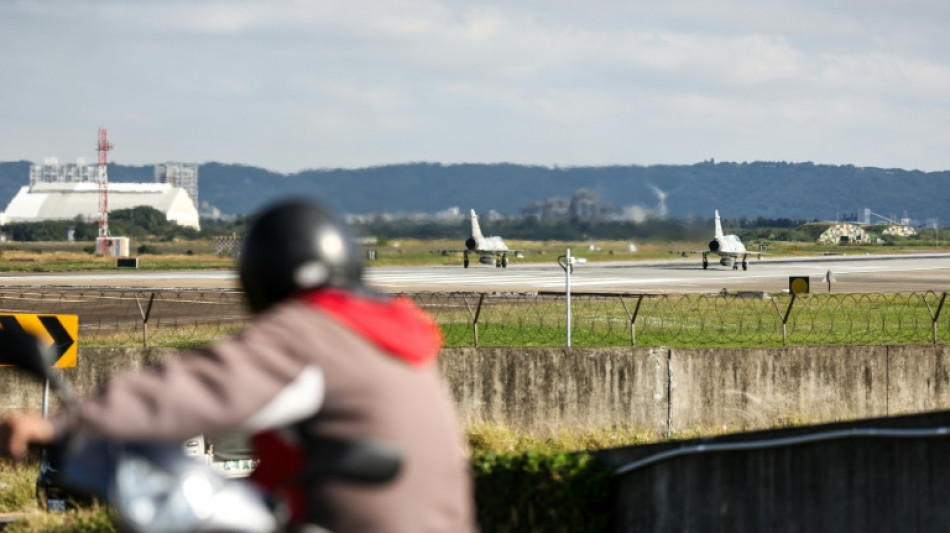
Taiwan's existential battle against Chinese spies / Photo: © AFP/File

 Rene Eyre Revisits Autobiographical Performance 'Say A Little Prayer' in London

 UAE's HCT Holds Record Graduation and Announces Major Training Expansion

 NASA Awards $10B Lunar Contract Framework to SpaceX, Blue Origin

 Katy Perry Tells Fans Ex-Husband Russell Brand 'Should Be in Jail' During UK Concert

 South African election results renew debate over identity-based voting

 South African voters report smoother local election but declining IEC trust

 Dolly Parton museum and Nashville hotel open after singer’s death

 George and Amal Clooney attend New York political-comedy reading

 British buyers pay substantial premiums for period-home appearance

 Thomas Markle released to house arrest after child-abuse-image charge

 Dawn of War 4 developers chose Adeptus Mechanicus for tactical variety

 Italy face unbeaten South Africa in Turin Nations Championship match

 ChatGPT interactive interface feature tested across six custom tools
Taiwan faces a growing existential threat from its own people spying for China, experts warn, as the government seeks to toughen measures to stop Beijing's infiltration efforts and deter Taiwanese turncoats.
While Beijing and Taipei have been spying on each other for years, experts told AFP that espionage posed a bigger threat to Taiwan due to the risk of a Chinese attack.
Taiwan's intelligence agency has said China used "diverse channels and tactics" to infiltrate the island's military, government agencies and pro-China organisations.
The main targets were retired and active members of the military, persuaded by money, blackmail or pro-China ideology to steal defence secrets, make vows to surrender to the Chinese military, and set up armed groups to help invading forces.
China claims Taiwan as part of its territory and has long threatened to use force to seize it -- which the Taipei government opposes.
While espionage operations were conducted by governments around the world, Jamestown Foundation president Peter Mattis said the threat to Taiwan was far greater.
"It's not practiced at this kind of scale, with this kind of malign purpose, and with the ultimate goal being annexation, and as a result, that makes this different," said Mattis, a former CIA counterintelligence analyst.
"This is something more fundamental... to the survival of a nation state or a country."
The number of people prosecuted in Taiwan for spying for Beijing has risen sharply in recent years, official data show.
Taiwan's National Security Bureau said 64 people were prosecuted for Chinese espionage last year, compared with 48 in 2023 and 10 in 2022.
In 2024, they included 15 veterans and 28 active service members, with prison sentences reaching as high as 20 years.
"In general violations of the National Security Act, the prosecution rate for military personnel is relatively high," said Prosecutor General Hsing Tai-chao, from the Supreme Prosecutors Office.
"This is because the military is held to stricter standards due to its duty to safeguard national security and its access to weapons," Hsing told AFP.
"This does not mean that ordinary people do not engage in similar activities. The difference is that such actions may not always constitute a criminal offence for ordinary people."
- Soldiers and singers -
Taiwan and China have a history of political, cultural and educational exchanges due to a shared language, serving up opportunities for Chinese recruiters to cultivate spies.
As these exchanges dwindled in recent years due to cross-strait tensions and the Covid-19 pandemic, Beijing has found other ways to infiltrate the island, experts said.
China has harnessed criminals, religious temples and online platforms to access Taiwanese retired and active service members, using money and even political propaganda to lure them into spying.
Informal banks have offered loans to those in financial difficulty and then wiped their debts in return for information.
Others have been recruited through online games.
Spies have been asked to share military intelligence, such as the location of bases and stockpiles, or set up armed groups.
Taiwan's intelligence agency said China has used "gangsters to recruit retired servicemembers to organise their former military comrades in establishing 'sniper teams' and to plot sniper missions against Taiwan's military units and foreign embassies".
Singers, social media influencers and politicians also have been coerced into doing Beijing's bidding, spreading disinformation, expressing pro-China views or obtaining intel, said Puma Shen, a Democratic Progressive Party (DPP) lawmaker.
China's spy network was "growing and growing", said Shen, who has studied Chinese influence operations and was last year sanctioned by Beijing over alleged "separatism".
"They're trying to weaken, not just our defence, but the whole democratic system," he said.
- Raising awareness -
President Lai Ching-te, who also belongs to the DPP, last week branded China a "foreign hostile force", as he proposed measures to combat Chinese espionage and infiltration.
Among them were ensuring the transparency of cross-strait exchanges involving elected officials and reinstating military trials during peacetime -- a sensitive issue in Taiwan where martial law was imposed for nearly 40 years.
Recent surveys show most Taiwanese people are not in favour of unification with China.
But more needs to be done to raise public awareness about the threat Chinese espionage posed to Taiwan, said Jakub Janda of the think tank European Values Center for Security Policy in Taipei.
"If you betray your country, this needs to become completely unacceptable," said Janda, who advocates for tougher penalties.
"If you have this moodin the society, then it's much harder for Chinese intelligence to actually recruit people."
K.Hofmann--VB