Battle for Khartoum wrecks key Sudan oil refinery / Photo: © AFP

 Man Utd's Fernandes crowned PFA player of the year

 Dolly Parton: quotes on life, love and music

 Brazil fines TikTok $30 mn in 'powerful signal' over child safety

 Cameroon's Baleba joins as Man Utd boost midfield options
 US country music legend Dolly Parton dies at 80

 Kolisi fit to captain South Africa against New Zealand

 Volkswagen workers boo boss during speech on job cuts

 Djokovic, Sabalenka tumble out of US Open mixed doubles

 CIA director Ratcliffe visits Moscow: US media

 Trump threatens to rename Lake Ontario as 'Lake America'
 'Here to win': Xavi vows to restore pride to Dutch football
 Canada unveils counter tariffs of 15% to 50% on US goods
 Spain moves to speed up return of migrants stranded in Ceuta

 At least a quarter of NFL players may get brain disease: study

 Iranians queue for petrol after US announces new sanctions

 Blockchain Infrastructure Firm tZERO Integrates with Sui for Institutional-Grade Digital Asset Securities

 Oil down as traders weigh US sanctions threat against Iran

 Canada to unveil response to Trump's steep tariffs
 Curling attracts curious Romans under Colosseum's shadow

 World must rein in autonomous weapons: UN, Red Cross
 'Wartime situation': tornado ravages French village

 Germany's Merz addresses critics with climate action pledge
 Stocks rise, oil down as traders weigh Iran sanctions threat

 Europe's gaming bash kicks off as industry eyes 'Grand Theft' boost
 Welsh rugby league great Boston dies, aged 92

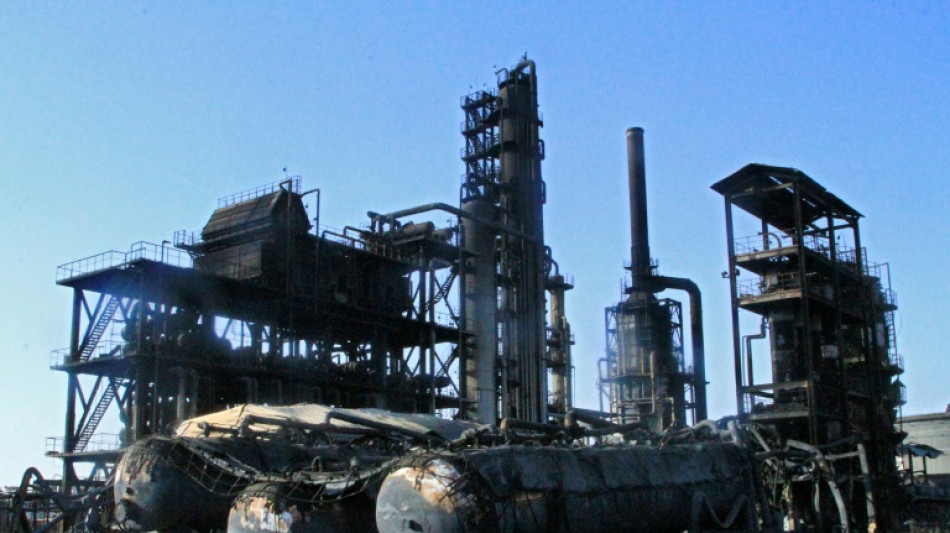
The once-pristine white oil tanks of Sudan's largest refinery have been blackened by nearly two years of devastating war, leaving the country heavily dependent on fuel imports it can ill afford.
The Chinese-built Al-Jaili refinery, some 70 kilometres (45 miles) north of Khartoum, was captured by the paramilitary Rapid Support Forces (RSF), just days after fighting with the regular army erupted in April 2023.
For months, artillery exchanges battered the facility, forcing a complete shutdown in July 2023.
The regular army finally recaptured the refinery in January as part of a wider offensive to retake greater Khartoum but operations remain at a standstill, with vast sections of the plant lying in ruins.
Towering storage tanks, which once gleamed under the sun, are now cloaked in soot and the ground is littered with twisted pipes and pools of leaked oil.
"Some units have been completely destroyed and are now out of service," the refinery's deputy director, Sirajuddin Muhammad, told AFP. "Other sections need to be entirely replaced."
Before the war, Al-Jaili processed up to 100,000 barrels per day of crude, meeting nearly half of Sudan's fuel needs.
"The refinery was crucial for Sudan, covering 50 percent of the country's petrol needs, 40 percent of its diesel and 50 percent of its cooking gas," economist Khalid el-Tigani told AFP.
"With its closure, Sudan has been forced to rely on imports to fill the gap, with fuel now being brought in by the private sector using foreign currency."
And hard currency is in desperately short supply in Sudan after the deepening conflict between Sudan's rival generals uprooted more than 12 million people, devastating the nation's economy.
The Sudanese pound now trades at around 2,400 to the dollar, compared to 600 before the war, leaving imported goods beyond the means of most people.
During the army's recapture of the refinery in January, what remained of it was gutted by a massive fire.
The RSF blamed the blaze on "barrel bombs" dropped by the air force.
The regular army accused the RSF of deliberately torching it in a "desperate attempt to destroy the country's infrastructure".
- '$1.3bn repair bill' -
An AFP team visited the refinery under military escort on Tuesday. Burnt out vehicles lined the roadside as the convoy passed through abandoned neighbourhoods.
As the refinery grew nearer, the blackened skeletons of storage tanks loomed in the distance and the acrid smell of burnt oil grew stronger.
The control rooms, where engineers once monitored operations, had been completely gutted.
Pools of water left over from the firefighting effort in January had yet to drain away.
Built in two phases, in 2000 and 2006, the plant cost $2.7 billion to build, with China taking the lead role.
Beijing still retains a 10 percent stake, while the Sudanese state controls the remaining 90 percent.
Refinery officials estimate it will cost at least $1.3 billion to get the refinery working again.
"Some parts must be manufactured in their country of origin, which determines the timeline of repairs," Muhammad said.
An engineer at the refinery, speaking on condition of anonymity because he was not authorised to speak to the media, said that even if Sudan secured the necessary financing, "it would still take at least three years to get this place running again".
The discovery of large domestic oil reserves in the 1970s and 1980s transformed the Sudanese economy.
But when South Sudan seceded in 2011, the fledgling nation took with it about three-quarters of the formerly united country's oil output.
South Sudan remains dependent on Sudanese pipelines to export its oil, paying transit fees to the rump country that are one of its few remaining sources of hard currency.
But the war has put that arrangement at risk.
In February last year, the pipeline used to export South Sudanese oil through Port Sudan on the country's Red Sea coast was knocked out by fighting between the army and the RSF.
Exports were halted for nearly a year, resuming only in January.
C.Bruderer--VB