Violent crime wave beleaguers Israel's Arab youth / Photo: © AFP

 Colombian judge bans strikes on guerrillas if minors are present
 Khachanov shocks ailing Auger-Aliassime, Swiatek and Osaka advance at US Open

 Lone juror blocking verdict in US mother's child murder trial: defense

 'Kinda chic' - Williams sisters set to launch US Open doubles bid

 Volkswagen says cutting 100,000 jobs by end of decade

 Russia slaps curfew on charity director over army criticism
 Ailing Auger-Aliassime upset by Khachanov at US Open

 Richarlison omitted from Tottenham's Premier League squad
 How El Nino is choking the Panama Canal

 Hamilton drives his Ferrari dream at Monza

 Senegal has an IMF loan, now what?

 Auger-Aliassime upset by Khachanov at US Open

 Hugging Face, the French start-up that became AI's warehouse
 World Cup winner Llorente retires from Spain team at 31

 Osaka squeezes into US Open third round

 Apple faces £2 bn lawsuit in UK over app privacy feature

 Former champ Swiatek eases into US Open third round

 DR Congo latest to promise moving Israel embassy to Jerusalem

 War criminal Mladic's body returns to Serbia with military honours

 Pierre Cardin museum brings designer's futurist style to Venice

 Slovenian rookie Omrzel triumphs as Mas extends Vuelta lead
 British, French leaders talk migrants, EU relations
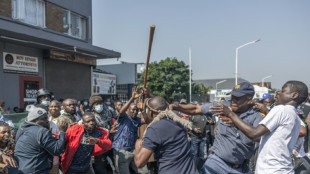
 Heading for Ferrari's home race, Leclerc still dreams of world title

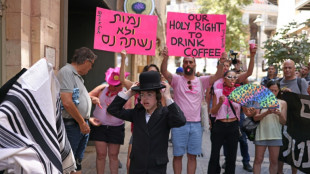 Cafe at centre of Israel culture clash agrees to shut on Sabbath

 Spacecraft bound for Mercury begins 'tricky' arrival
In the four years since her father was fatally stabbed near the entrance of their home in northern Israel, 10-year-old Shireen has carried the burden of grief on her tiny shoulders.
"I loved him so much, I felt safe with him," Shireen, whose name has been changed, told AFP in the seaside town of Jisr al-Zarqa.
"When I found out that I lost him, I was very sad because he was a part of me. It was very difficult for me," the eldest of four siblings said.
Shireen is one of scores of young people grappling with the devastating impact of spiralling violent crime in Israel's Arab minority community -- driven predominantly by criminal gangs, family feuds, easy access to firearms and what the community decries as a lack of police enforcement.
So far this year, more than 140 Arab citizens of Israel have been killed in such violence according to the Abraham Initiatives coexistence organisation -- a 12 percent rise over the same period last year.
If that rate continues, the community will surpass the unprecedented 252 killings recorded in 2025.
The assailant who killed Shireen's father in what the family described as a drunken random attack was a minor and not previously known to them. He was arrested and sentenced to prison.
For young people, the consequences of losing a parent are profound and long-lasting.
"Unfortunately, there's over 232 children who lost a parent in the Arab society only last year because of the crime and the violence," said Hadar Kess, the founder and CEO of Sunflowers, an Israeli organisation supporting young people who have lost parents like Shireen.
In Jewish Israeli society, Kess said that children who had lost a parent were four times more likely to get arrested, and 13 times more likely to drop out of school.
In Arab society, she said, the risk of falling into crime was much higher, with communities generally poorer and the particularly high murder rate driving cycles of revenge.
- Three days, three murders -
Most of Israel's Arab minority identify as Palestinians who remained in what is now Israel after its creation in 1948. They represent about 21 percent of the country's 10.2 million people.
Many in the community say they are discriminated against by the Jewish majority and accuse Israeli authorities of failing to properly investigate the violence.
In the killings that occurred between January and June 26, only 16 indictments were filed, amounting to just 12.3 percent of cases, according to the Abraham Initiatives.
When contacted by AFP, the Israeli police said it was "treating every one of these incidents with the utmost seriousness", including setting up "specialised joint task forces" and meeting with local community leaders.
"It is critical to understand that complex criminal investigations take time," it added, urging "a coordinated national effort" to tackle the issue.
Police said car bombs and gun attacks killed five Arab-Israelis last Sunday alone, in what authorities described as a mixture of criminal incidents and family disputes.
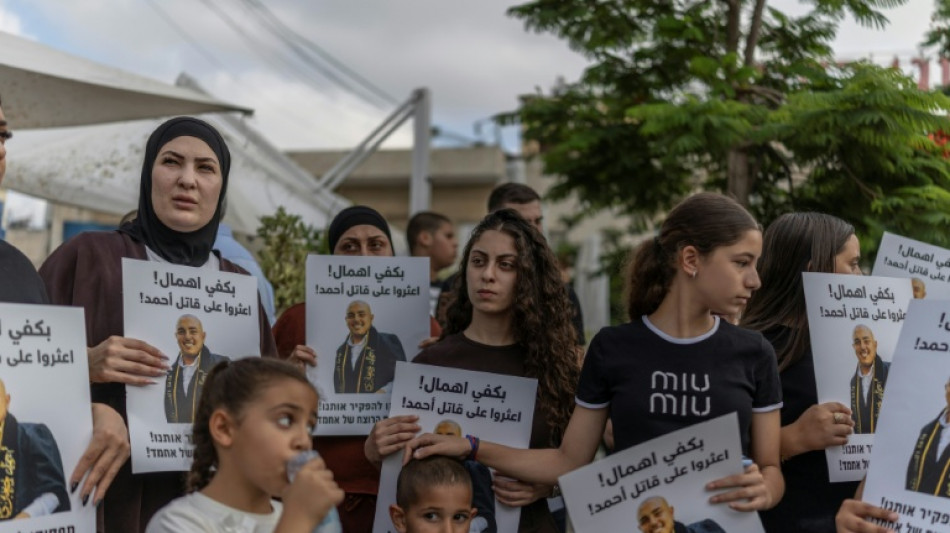
The bloodshed followed the fatal shooting of Ahmed Jabari, 17, just days earlier as he was working at his after-school job in a supermarket in the coastal city of Jaffa.
At a vigil last weekend, community members held placards in solidarity and wept.
"In the last three days in Jaffa, there have been three murders," the chairman of the city's Muslim Council, Abed Abu Shehadeh, said last Sunday.
"We understand perfectly well that these events did not happen by chance but rather they are part of Israeli policies toward our community."
- 'Not who we are' -
For AJEEC -- a Jewish-Arab coexistence organisation promoting youth engagement and professional development -- building a brighter future is key to stopping the cycle of violence.
Through youth programmes, they encourage participants to become active members of their communities and access opportunities such as higher education.
"I believe that it is the circumstances and the environment that have made violence and crime part of our reality -- but this is not who we are," said 19-year-old Bayan, an AJEEC participant from the Arab city of Kafr Qasim in central Israel.
Bayan, whose 30-year-old relative was killed last year, told AFP she felt the violence in her community was rooted in a sense of not belonging, as well as rising costs of living and unemployment.
"It made me ask: Is it worth being in this country, studying here, and in the end dying?" she said.
Najeb Abu Bnaeh, 56, a community organiser with AJEEC in Bedouin villages in southern Israel's Negev, said the people being drawn into crime were only getting younger.
"If we used to talk about 16, today we're talking about 14 or 13," he said.
"The state must make a decision that enough is enough. The violence must stop."
H.Weber--VB