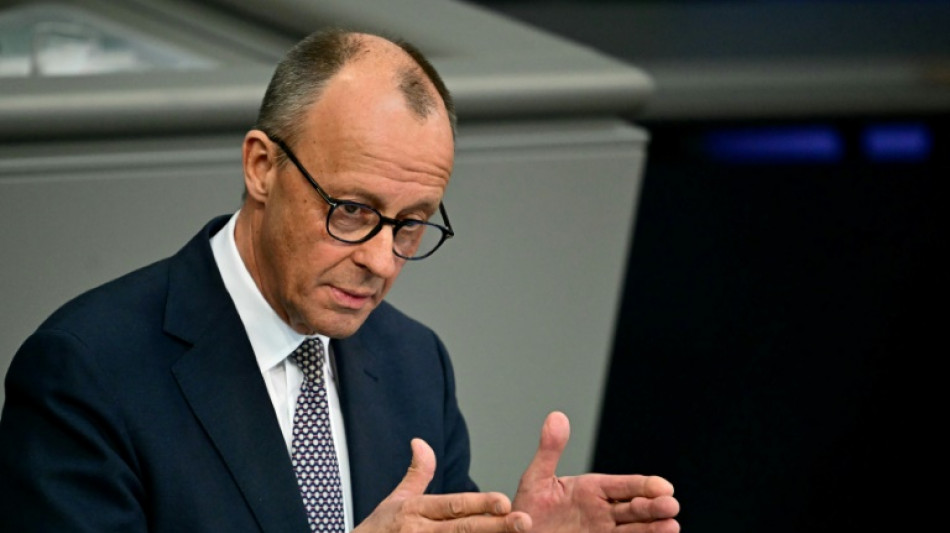
German MPs approve fiscal 'bazooka' for defence, infrastructure / Photo: © AFP

 Fave or flop? A guide to gauging video game success
 Williams-Alcaraz fall in US Open mixed quarter-finals

 Mark Carney, the former central banker who said 'no' to Trump
 Segner out of South Africa tour as New Zealand injuries pile up
 Meta knew teen safety tools were ineffective, witnesses testify
 Williams and Alcaraz win opener at US Open mixed doubles
 Man Utd's Fernandes crowned PFA player of the year
 Dolly Parton: quotes on life, love and music

 Brazil fines TikTok $30 mn in 'powerful signal' over child safety

 Cameroon's Baleba joins as Man Utd boost midfield options
 US country music legend Dolly Parton dies at 80
 Kolisi fit to captain South Africa against New Zealand
 Volkswagen workers boo boss during speech on job cuts
 Djokovic, Sabalenka tumble out of US Open mixed doubles
 CIA director Ratcliffe visits Moscow: US media
 Trump threatens to rename Lake Ontario as 'Lake America'
 'Here to win': Xavi vows to restore pride to Dutch football
 Canada unveils counter tariffs of 15% to 50% on US goods
 Spain moves to speed up return of migrants stranded in Ceuta

 At least a quarter of NFL players may get brain disease: study

 Iranians queue for petrol after US announces new sanctions
 Blockchain Infrastructure Firm tZERO Integrates with Sui for Institutional-Grade Digital Asset Securities
 Oil down as traders weigh US sanctions threat against Iran
 Canada to unveil response to Trump's steep tariffs
 Curling attracts curious Romans under Colosseum's shadow
German lawmakers gave the green light Tuesday for a colossal spending boost for defence and infrastructure pushed by chancellor-in-waiting Friedrich Merz amid deep fears in Europe over the future strength of the transatlantic alliance.
The unprecedented fiscal package -- dubbed an "XXL-sized" cash "bazooka" by German media -- could pave the way for more than one trillion euros (dollars) in spending over the next decade in Europe's top economy.
The historic parliament vote signalled a radical departure for a country famously reluctant to take on large state debt -- or to spend heavily on the armed forces, given its dark World War II history.
Merz, who is expected to become Germany's next chancellor after his CDU/CSU alliance won last month's elections, argued that dramatic steps are needed at a time of geopolitical turmoil sparked by Russia's invasion of Ukraine.
European countries have been further unsettled by US President Donald Trump's outreach to Russia and signals of an uncertain commitment to NATO and Europe's defence.
Speaking to parliament, Merz cited Russia's "war of aggression against Europe" and said the funding boost would spell "the first major step towards a new European defence community".
Merz's centre-right alliance and their likely future coalition partners, the centre-left Social Democrats (SPD) of outgoing Chancellor Olaf Scholz, have hammered out the package over recent weeks.
The plan would exempt defence spending above one percent of GDP from Germany's strict debt rules and set up a 500-billion-euro ($545-billion) fund for infrastructure investments over 12 years.
In the short term, Berlin looked set to soon approve an additional three billion euros in military aid for Ukraine.
- 'New era' -
After heated debate in parliament -- where the plan was opposed by the far right, far left and a small liberal party -- it cleared the two-thirds majority needed and passed by a margin of 513 to 207 votes.
It still requires approval by the upper house on Friday, but the future partners in a so-called grand coalition government have voiced confidence it will also clear the final hurdle.
Ahead of the Bundestag vote, European stocks rose Tuesday in anticipation of the huge spending boost for Germany's recession-hit economy, and German investor sentiment posted its biggest increase in over two years.
Merz, 69, had urged lawmakers to approve the measures at a time when Trump's contacts with Russia and hostility towards Ukraine have shaken Europe.
He argued that Russia's war "is a war against Europe and not just a war against the territorial integrity of Ukraine," citing cyber- and arson attacks as well as disinformation campaigns blamed on Moscow.
Merz said strong relations with the United States remained "indispensable" but that Europe needed to do more to ensure its own security and Germany should play a leading role.
The spending boost is "nothing less than the first major step towards a new European defence community" that could include non-EU members like Britain and Norway, he added.
Defence Minister Boris Pistorius from the SPD justified the mega-spending by saying that "we are facing a new era for Europe, for Germany, for NATO and for future generations".
He argued that boosting defence on the continent would strengthen the transatlantic alliance "and place it on two legs, namely North America and Europe".
- 'Peace in Europe' -
European Commission chief Ursula von der Leyen warned on Tuesday that Europe must build a "credible" deterrence capability within five years as it faces an aggressive Russia and the potential loss of US security protections.
"If Europe wants to avoid war, Europe must get ready for war," she told cadets at the Royal Danish Military Academy in Copenhagen.
Germany's two big-tent parties -- which hope to form a government by late April -- rushed the package through the outgoing parliament with support from the Greens, who had demanded several key amendments.
The ecologist party had negotiated that 100 billion of the infrastructure spending be earmarked for climate-protection measures.
In the next parliament, the far-right and Moscow-friendly Alternative for Germany (AfD) and the far-left Die Linke -- which both opposed the plans -- would have had the numbers needed to block the package.
Before the vote, Bernd Baumann of the AfD accused Merz of ignoring the will of voters by seeking to push the vote through the outgoing parliament.
"The new Bundestag is the legitimate one", Baumann said, charging that Merz "wants to buy himself the chancellorship from the SPD and the Greens, like in a banana republic".
Lars Klingbeil of the SPD said that the new spending aimed to "maintain peace in Europe" but also "invest in advancing the economy and strengthening social cohesion" and therefore help counter "division and polarisation".
G.Haefliger--VB