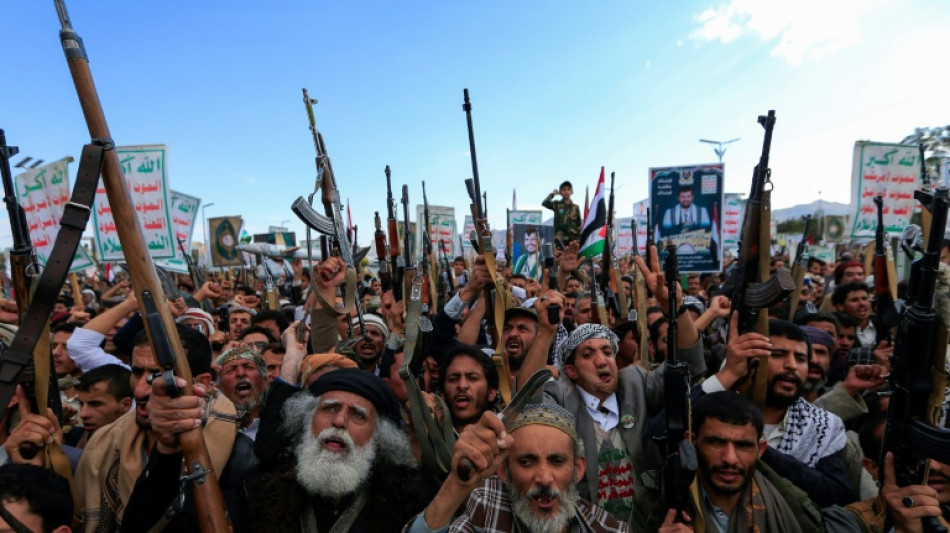
'Resilent fighters': why Yemen's Huthis are no pushover for US / Photo: © AFP

 Too small for fries: drought shrinks Belgian potatoes

 Drought-hit Danube gives way to fossil hunt in Bulgaria

 Julia Curlee, CIA officer fired by White House for being transgender

 Fave or flop? A guide to gauging video game success

 Williams-Alcaraz fall in US Open mixed quarter-finals

 Mark Carney, the former central banker who said 'no' to Trump
 Segner out of South Africa tour as New Zealand injuries pile up
 Meta knew teen safety tools were ineffective, witnesses testify

 Williams and Alcaraz win opener at US Open mixed doubles

 Man Utd's Fernandes crowned PFA player of the year

 Dolly Parton: quotes on life, love and music

 Brazil fines TikTok $30 mn in 'powerful signal' over child safety

 Cameroon's Baleba joins as Man Utd boost midfield options

 US country music legend Dolly Parton dies at 80

 Kolisi fit to captain South Africa against New Zealand

 Volkswagen workers boo boss during speech on job cuts

 Djokovic, Sabalenka tumble out of US Open mixed doubles

 CIA director Ratcliffe visits Moscow: US media

 Trump threatens to rename Lake Ontario as 'Lake America'

 'Here to win': Xavi vows to restore pride to Dutch football

 Canada unveils counter tariffs of 15% to 50% on US goods

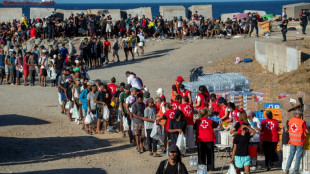 Spain moves to speed up return of migrants stranded in Ceuta

 At least a quarter of NFL players may get brain disease: study

 Iranians queue for petrol after US announces new sanctions

 Blockchain Infrastructure Firm tZERO Integrates with Sui for Institutional-Grade Digital Asset Securities

US military, be warned: after years of fighting in rugged terrain and weathering thousands of air strikes, Yemen's Huthi rebels are not to be taken lightly, experts say.
Despite a heavy US bombardment announced by President Donald Trump that left dozens dead, the battle-hardened, Iran-backed Huthis remain defiant, and with good reason.
The group from the mountainous north, which controls swathes of impoverished Yemen, has withstood a decade of war against a well-armed, Saudi-led international coalition.
If anything, the Huthis, from the Zaidi branch of Shia Islam, are now even more entrenched, and were moving towards a peace process with Riyadh before the Gaza war put talks on hold.
"The challenge of defeating the Huthis should not be underestimated," said Elisabeth Kendall, director of Girton College at the University of Cambridge, calling them "resilient fighters".
Saturday's US attacks killed 53 people and wounded 98, according to Huthi authorities, who said they hit back with multiple strikes on a US aircraft carrier group.
The US action was aimed at ending Huthi threats to Red Sea shipping after the rebels warned they would resume their months-long campaign, which they say is in solidarity with Palestinians in Gaza.
On Monday, tens of thousands of people joined Huthi-organised rallies to protest the US strikes.
"They will not be easy to defeat," Kendall said.
- 'Dispersal of weapons' -
After the rebels seized the capital, Sanaa, in 2014, ousting the internationally recognised government, the Saudi-led coalition -- which includes the United Arab Emirates, and is aided by Western weaponry -- declared war the following March.
Since then, Kendall said, more than 25,000 coalition air strikes have rained down on Huthi-held Yemen, which encompasses most of the 38 million plus population of the Arabian Peninsula's poorest country.
For more than a year, the Huthis have also faced American, British and Israeli strikes aimed at curbing the Red Sea harassment campaign that has choked the vital trade route.
According to Alex Plitsas of the Atlantic Council, Yemen's weaponry, including mobile missile launchers, is hard to find and destroy.
"The Huthis' ability to persist stems from their dispersal of weapons across Yemen's rugged terrain, complicating targeting efforts," Plitsas wrote on the think tank's website.
And while intelligence operations badly weakened Iran-allied Hamas and Hezbollah -- both hobbled by Israeli assassinations -- the Huthis are not infiltrated in the same way.
Long thought to be "a regional problem" for Riyadh and Abu Dhabi, Yemen "was not the main priority for intelligence collection", said Fabian Hinz, research fellow at the London-based International Institute for Strategic Studies.
Yemen is strategically located on the main maritime route connecting Europe and Asia, with the rebels operating out of hard-to-access mountain strongholds.
Their attacks, often with home-assembled drones and missiles, are simple but effective, dramatically reducing Red Sea shipping volumes as cargo companies stay away.
In the past, the Huthis repeatedly hit neighbouring Saudi Arabia, including its oil facilities, and in early 2022 they launched deadly strikes on the UAE.
- 'Powerful military' -
A United Nations report in November 2024 found that the Huthis had become a "powerful military organisation" due to "unprecedented" foreign support, particularly from Iran and Hezbollah.
The report said the Huthis had carried out a vast recruitment project, resulting in a force that numbered 350,000 in mid-2024, up from 220,000 in 2022.
According to Hinz, Iran has been key to upgrading the Huthis' anti-ship missile capabilities and is its main source of weapons.
The rebels have ballistic and cruise missiles with ranges of up to 2,000 kilometres (1,240 miles), and drones that can travel even further, he told AFP.
Despite their high failure rate, Hinz warned: "There is always a chance something gets through."
While the Huthis cannot compete with the might of the US military, they "stand to benefit from the asymmetric nature of the conflict", Kendall said.
"The mere fact of continuing to launch missiles and drones into the Red Sea, however primitive, will disrupt global maritime trade and freedom of navigation," she told AFP.
- No ground offensive -
Washington has been ramping up pressure on Iran and its allies, sanctioning Huthi leaders and redesignating the group as a foreign terrorist organisation.
But Kendall said that crushing the Huthis, who control territory about 20 times the size of Lebanon and 500 times that of Gaza, is another matter.
And although Hamas and Hezbollah are badly weakened, the fight against them involved a ground offensive, Hinz said.
"This is not going to happen in Yemen. The Americans are not going to send ground troops," he said.
For Maged Al-Madhaji, co-founder of the Sanaa Centre for Strategic Studies think tank, substantially weakening the Huthis requires depriving them of access to the Red Sea -- their main source of revenue and weapons.
An air campaign alone "will not pose an existential threat to the Huthis", he said.
M.Schneider--VB