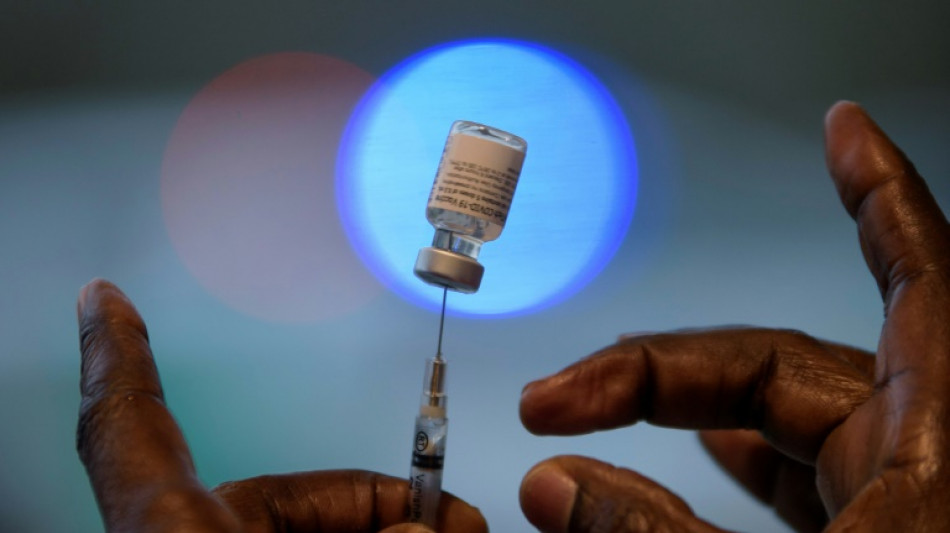
Conspiracy theories cloud pandemic treaty push / Photo: © AFP/File

 Eighth day of wildfires in Indonesian national park

 One woman confirmed dead in western Canada wildfire
 Energy transition threatens to wipe Dutch village from map

 Self-taught Turkish 'linguist' keeps dead language alive
 Asian stocks track Wall St higher after US job losses ease rate fears

 Western Europe experienced hottest June-July on record: EU monitor
 Shelton sweeps Fonseca to reach Montreal quarter-final
 Who are the main contenders in Zambia's presidential vote?
 Rybakina survives scare as Gauff, Osaka race into Toronto quarters
 Thirty years on, a trial finally opens in Tupac Shakur's killing
 Shelton sweeps Fonseca to reach another Montreal quarter-final

 Brennan captures Wyndham crown for second PGA win
 Rybakina, Gauff advance to Toronto quarter-finals
 Rahm three-peats as LIV Golf season champ while Niemann wins at New York
 Vollering wins Tour de France Femmes after war of nerves

 BMW’s next chapter accelerates with New Class rollout

 Five dead in new Russia, Ukraine strikes
 PSG sign France full-back Digne from Villa
 Sinner withdraws from Cincinnati Open with knee injury

 Fernandez's 'perfect' race earns him British MotoGP Grand Prix win

 Iran Guards say won't reopen Hormuz without US meeting Tehran's demands
 Hogh's hat-trick inspires Celtic to 5-1 victory over Kilmarnock

 London grants first licences for supervised Uber robotaxis

 Erasmus hopeful Kolisi hamstring injury not 'too bad'

 Luxury car buyers trade prestige for mainstream value

The World Health Organization is battling a barrage of disinformation alleging it is scheming to take over health policy in sovereign nations, as it tries to chart a way forward towards averting future pandemics.
Although used to being in the crosshairs of conspiracy theorists especially over Covid-19, high-profile attempts in countries around the world to discredit the WHO's efforts are casting a shadow over talks in Geneva this week.
Country representatives are discussing how to pave the way for a global agreement that could eventually regulate how nations prepare for and respond to future pandemic threats.
"We may face more severe pandemics in the future and we need to be a hell of a lot better prepared than we are now," the WHO's emergencies director Michael Ryan told reporters recently.
"That's going to require countries to work together."
It is still far from clear what any future agreement would contain and whether countries will decide they want it to be a treaty or some other "legal instrument".
The negotiations -- involving member states, not the WHO -- are set to last at least two years.
However, that has not stopped conspiracy theories suggesting that the UN health body is out for a power-grab.
Fox News anchor Tucker Carlson, in a segment last month on the pandemic treaty, warned his millions of viewers that US President Joe Biden's administration was close to "handing the World Health Organization power over every aspect, the intimate aspects of your life."
- 'Disconnected from reality' -
Christine Anderson, a German member of the European Parliament, has warned that the agreement would grant "the WHO de facto governing power over member states".
British comedian-turned-YouTuber Russell Brand, meanwhile, told his more than 5.5 million subscribers that the future treaty meant "your democracy is... finished".
The WHO and experts say such theories, which have also popped up in Germany, Australia, Russia and other countries, have nothing to do with what is being discussed.
"I am frankly baffled by the degree of disinformation," Suerie Moon, co-director of the Global Health Centre at the Geneva Graduate Institute, told AFP, stressing that the agreement "is really in the embryonic stage."
Many of the claims, she said, are "completely disconnected from the reality of what is being proposed and potentially negotiated".
- 'Distorting facts' -
WHO chief Tedros Adhanom Ghebreyesus also recently lamented that "unfortunately, there has been a small minority of groups making misleading statements and purposefully distorting facts".
He stressed that the "WHO's agenda is public, open and transparent".
The pandemic agreement is solely about establishing "the playbook for how we're going to prepare together" for future pandemic threats, Ryan said.
"That's not about sovereignty. That's about responsibility."
But they are struggling to make such arguments heard over the din of disinformation.
The WHO is used to being the focus of conspiracy theorists, even coining the term "infodemic" amid the deluge of disinformation surrounding its efforts to rein in the coronavirus pandemic, and especially on the Covid-19 vaccines.
And now observers suggest the WHO and the pandemic agreement it is pushing for have become targets of a well-organised disinformation campaign across multiple countries, although the exact goal and who is behind it remain unclear.
- 'A trigger' -
Just the name WHO "is like a trigger", Tristan Mendes France, a French conspiracy theory expert, told AFP, suggesting it was easy to "reactivate" the "huge conspiracy theory audience that has been growing during Covid."
Sebastian Dieguez, a neuroscientist and disinformation expert at Switzerland's University of Fribourg, pointed to how social media groups dedicated to one form of extremist thought or conspiracy theory often switch names and topics, bringing hundreds of thousands of followers along.
"When you have a solid network on something, it can be used for other things," he said.
But the most outlandish disinformation can still negatively impact efforts to deal with real-world issues.
"Even though some of it is absurd, you still have to deal with it, you still have to explain, and this cuts out resources," Dieguez said.
Moon acknowledged there "are limits to what WHO can do", pointing to rampant misinformation -- when faulty information is shared due to honest misunderstandings -- and mistrust in authorities across the board in "this post-truth era, where people live in different information universes."
"Can WHO change that? Can anybody?"
D.Schneider--BTB