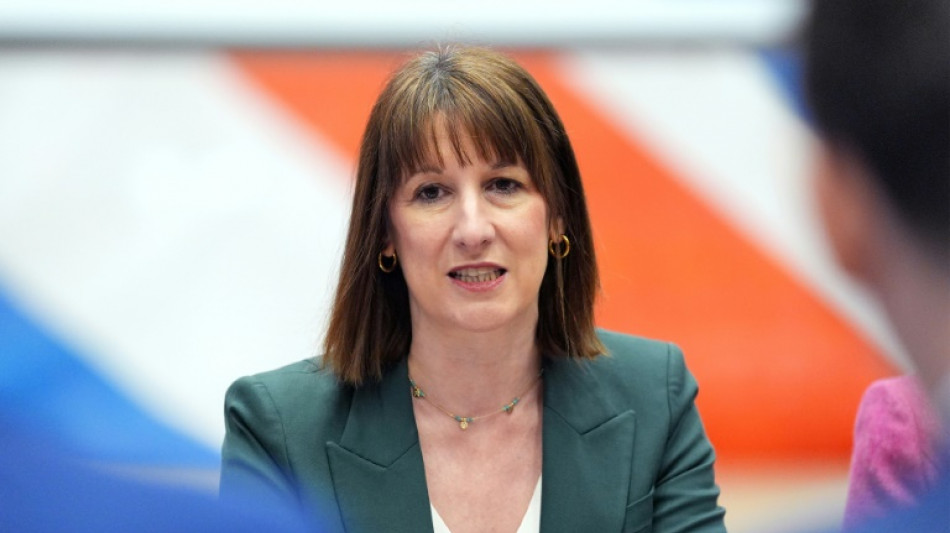
UK economy unexpectedly shrinks in January in blow to govt / Photo: © POOL/AFP

 Rene Eyre Revisits Autobiographical Performance 'Say A Little Prayer' in London

 UAE's HCT Holds Record Graduation and Announces Major Training Expansion

 NASA Awards $10B Lunar Contract Framework to SpaceX, Blue Origin

 Katy Perry Tells Fans Ex-Husband Russell Brand 'Should Be in Jail' During UK Concert

 South African election results renew debate over identity-based voting

 South African voters report smoother local election but declining IEC trust

 Dolly Parton museum and Nashville hotel open after singer’s death

 George and Amal Clooney attend New York political-comedy reading

 British buyers pay substantial premiums for period-home appearance

 Thomas Markle released to house arrest after child-abuse-image charge

Britain's economy unexpectedly shrank in January, official data showed Friday, piling more pressure on the Labour government ahead of its Spring Statement on the economy.
Gross domestic product contracted 0.1 percent in the month after GDP rose 0.4 percent in December, the Office for National Statistics (ONS) said in a statement.
Britain's finance minister Rachel Reeves is expected to make billions of pounds of spending cuts, including to welfare, in the government's Spring Statement on March 26, a follow-up to her inaugural budget last October, as public finances struggle under high inflation and borrowing.
Uncertainty over the fallout from President Donald Trump's tariffs on imports into the United States have also added to economic headwinds.
"The world has changed and across the globe we are feeling the consequences," Reeves said in a statement on Friday's figures.
Many analysts had forecast for the UK economy to have grown slightly in January, but the month was hit by a surprisingly sharp decline in the production sector.
The data provides a fresh blow to the government and Prime Minister Keir Starmer, who has put growing the UK economy at the top of his mission since Labour won a general election in July.
- 'Sea of uncertainty' -
The government has pinned its hopes on big spending on infrastructure to boost economic growth, with Reeves setting out to ease regulations on the sector.
"On a monthly basis, economic growth can appear to be quite choppy, but the bigger picture shows a stagnant economy," said Richard Carter, an analyst at investment management service Quilter Cheviot.
"With hope, the UK economy should see some improvement as we move through 2025, but the impacts of US tariffs are only just beginning to unfold, so we will be wading through a sea of uncertainty for some time yet," he added.
Heightened global risks including over US tariffs and the war in Ukraine have added to the UK's economic woes, chipping away at the Labour government's £9.9 billion ($12.8 billion) fiscal cushion.
That has led to reports that the UK may have to make spending cuts, including to GB Energy -- Labour's flagship green energy infrastructure plan -- and to welfare in order to save costs.
Contrasting with the cuts, Starmer has pledged to boost UK defence spending to 2.5 percent of the nation's economy by 2027 amid uncertainty over US commitment to Ukraine and NATO.
"The fall in January was driven by a notable slowdown in manufacturing, with oil and gas extraction and construction also having weak months," noted Liz McKeown, director of economics at the ONS.
"However, services continued to grow in January led by a strong month for retail, especially food stores, as people ate and drank at home more," she added.
O.Schlaepfer--VB