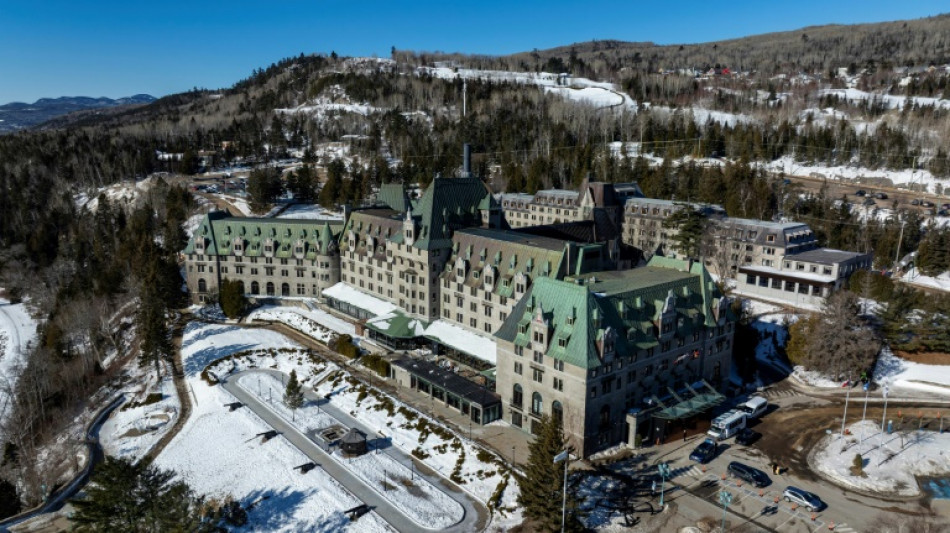
Ukraine ceasefire bid, trade war to dominate as G7 diplomats meet / Photo: © AFP

 Rene Eyre Revisits Autobiographical Performance 'Say A Little Prayer' in London

 UAE's HCT Holds Record Graduation and Announces Major Training Expansion

 NASA Awards $10B Lunar Contract Framework to SpaceX, Blue Origin

 Katy Perry Tells Fans Ex-Husband Russell Brand 'Should Be in Jail' During UK Concert

 South African election results renew debate over identity-based voting

 South African voters report smoother local election but declining IEC trust

 Dolly Parton museum and Nashville hotel open after singer’s death

 George and Amal Clooney attend New York political-comedy reading

 British buyers pay substantial premiums for period-home appearance

 Thomas Markle released to house arrest after child-abuse-image charge

US Secretary of State Marco Rubio is set to meet his Canadian counterpart at a G7 gathering Thursday, but discussion of American annexation threats has been ruled off-limits at talks expected to be dominated by efforts to agree a ceasefire in Ukraine.
Rubio arrived in the town of Charlevoix on the banks of the St. Lawrence River on Wednesday for meetings with foreign ministers from the club of the world's industrialized democracies.
He is expected to brief on the US-led effort to pause three years of bloodshed in the Russia-Ukraine war, after meeting envoys from Kyiv in the Saudi port town of Jeddah earlier in the week.
President Donald Trump has voiced hope that US negotiators in Moscow will be able to secure a ceasefire, with officials saying the United States wants Russia to agree to an unconditional halt to hostilities.
The Kremlin has said it was awaiting details of a proposed truce, while Ukraine's President Volodymyr Zelensky said his country was ready to embrace a deal, and the United States had indicated it would issue a "strong" response if Russia refuses an accord.
British Foreign Minister David Lammy said the G7 needs to focus on "ensuring Ukraine is in the strongest possible position to secure a just and lasting peace."
Canadian Foreign Minister Melanie Joly said she expected her talks with Rubio will be centered on "Ukraine and the ceasefire that's on the table."
- Canadian sovereignty 'not negotiable' -
But when asked about Trump's repeated comments about his desire to absorb Canada into the United States, Joly told reporters "Canadian sovereignty is not negotiable."
During a stop in Ireland en route to Canada, Rubio said the G7 "isn't a meeting about how we're going to take over Canada."
Trump's actions since returning to power in January have shaken US relations with traditional allies.
His sweeping 25 percent tariffs on all steel and aluminum imports came into effect Wednesday, prompting immediate retaliation from major US trading partners.
The European Union swiftly unveiled counter-tariffs hitting about $28 billion of US goods in stages from April, while Canada announced additional levies on $20.7 billion of American products from Thursday.
Canada has previously imposed 25 percent tariffs on $20.8 billion of American goods in response to US levies on certain Canadian imports.
Joly said she intends to raise the issue of tariffs in "every single meeting" at the G7.
Rubio said he expected his counterparts from Britain, Canada, France, Germany, Italy and Japan to set aside any frustration over Trump's trade policies to work on shared goals.
The steel and aluminum tariffs are anchored to national security concerns, he said Wednesday.
"Every country in the world we expect will act in their national interest," he added.
"I think it is quite possible that we could do these things and at the same time deal in a constructive way with our allies and friends," Rubio said.
"That's what I expect out of the G7 and Canada."
The three-day meeting in Charlevoix will also touch on the G7's role in dealing with China and the Middle East, among other subjects.
It comes ahead of a G7 leaders' summit in the Canadian province of Alberta in June.
R.Fischer--VB