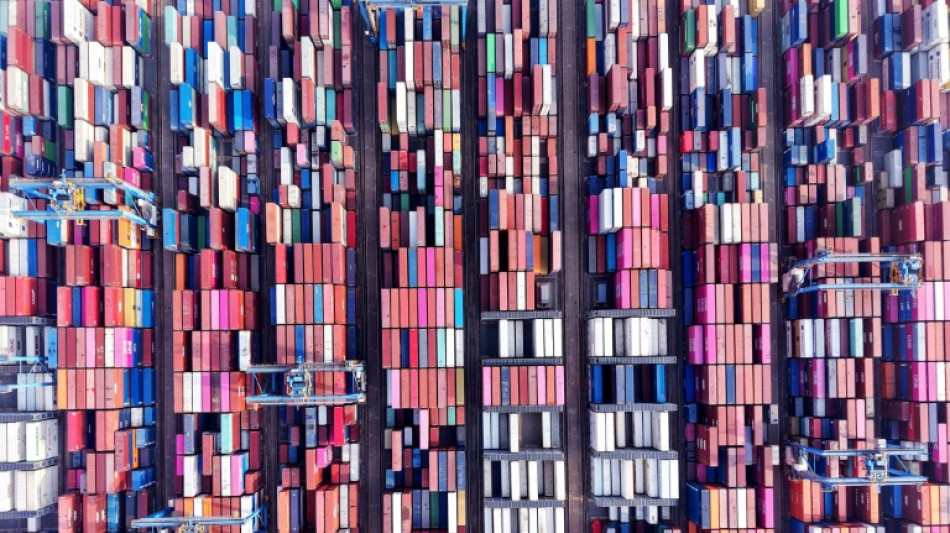
China, EU vow countermeasures against sweeping US steel tariffs / Photo: © AFP/File

 Rene Eyre Revisits Autobiographical Performance 'Say A Little Prayer' in London

 UAE's HCT Holds Record Graduation and Announces Major Training Expansion

 NASA Awards $10B Lunar Contract Framework to SpaceX, Blue Origin

 Katy Perry Tells Fans Ex-Husband Russell Brand 'Should Be in Jail' During UK Concert

 South African election results renew debate over identity-based voting

 South African voters report smoother local election but declining IEC trust

 Dolly Parton museum and Nashville hotel open after singer’s death

 George and Amal Clooney attend New York political-comedy reading

 British buyers pay substantial premiums for period-home appearance

 Thomas Markle released to house arrest after child-abuse-image charge

China and the EU vowed Wednesday to strike back and defend their economic interests against sweeping new US steel and aluminium tariffs, moving Washington closer to an all-out trade war with two major partners.
The levies took effect just after midnight on Wednesday "with no exceptions or exemptions", as promised by the White House -- despite countries' efforts to avert them.
The European Commission said it would impose "a series of countermeasures" from April 1 in response to the "unjustified trade restrictions" from the United States.
"We deeply regret this measure," European Commission chief Ursula von der Leyen said in a statement, adding that "the countermeasures we take today are strong but proportionate".
"As the US are applying tariffs worth $28 billion, we are responding with countermeasures worth" the equivalent in euros, she said.
And China, the world's leading steel manufacturer -- though not a major exporter of the product to the United States -- vowed "all necessary measures" in response.
"There are no winners in trade wars," foreign ministry spokeswoman Mao Ning said.
Washington's tariffs would "seriously damage the rules-based multilateral trading system", she warned.
US President Donald Trump's 25 percent duties on both metals will likely add to the cost of producing various goods from home appliances to automobiles and cans used for drinks, threatening to raise consumer prices down the road, experts say.
"It wouldn't surprise me to see the tariffs pretty quickly show up in prices," Cato Institute research fellow Clark Packard told AFP.
He added that auto manufacturing and construction -- spanning both residential and commercial buildings -- are among the biggest users of steel in the country.
- Trade turmoil -
Trump has imposed steep tariffs on major US trading partners Canada, Mexico and China since returning to office, allowing only a partial rollback for his country's neighbours while vowing fresh levies from April 2.
The latest duties will again impact Canada heavily, with the country supplying about half of US aluminium imports and 20 percent of its steel imports, according to a recent note by EY chief economist Gregory Daco.
Besides Canada, Brazil and Mexico are also key US suppliers of steel, while the United Arab Emirates and South Korea are among the major providers of aluminium.
Wednesday's levies stack atop earlier ones.
This means some Canada and Mexico steel and aluminium products likely face a 50 percent tariff rate unless they are compliant with the US-Mexico-Canada Agreement (USMCA).
Uncertainty over Trump's trade plans and worries that they could tip the world's biggest economy into a recession have roiled financial markets, with Wall Street indexes tumbling for a second straight day on Tuesday.
Markets in Asia followed suit Wednesday, with Hong Kong and Shanghai both down.
- 'Massive uncertainty' -
Washington has framed the tariff moves as a bid to protect US steel and American workers as the sector declines and faces fierce overseas competition, especially from Asia.
And it's not the first time Trump has slapped tariffs on the metals.
During his first presidency, he imposed duties on steel and aluminium exports in 2018 -- forcing the EU to respond with its own higher duties that are frozen until the end of March.
As part of the EU's two-pronged approach to Trump's actions, von der Leyen said Brussels will also allow those previous higher levies to be reinstated.
The EU's countermeasures would be fully in place by mid-April unless Trump reverses course.
Even before the latest US tariffs took effect, manufacturers moved to find cost-effective domestic suppliers.
The mere threat of protectionism, said the Cato Institute's Packard, has allowed US steel and aluminium firms to raise their prices.
"It's creating massive amounts of uncertainty," he added.
Some US manufacturers using American steel consider the tariffs a positive development as these have boosted their business.
But others warn that tariffs merely add to the cost of imports while allowing US-made goods to become equally expensive.
Daco of EY also noted that the new steel and aluminium levies go further than measures Trump imposed in 2018 -- covering a range of finished products atop of raw steel and aluminium.
There is also a higher rate on aluminium imports this time and with duties layering onto existing restrictions this is "likely to make foreign sourcing more expensive across multiple industries".
The lack of exemptions Wednesday also comes despite US partners like Australia and Japan visiting Washington in recent days to push for exclusions.
Top Japanese government spokesman Yoshimasa Hayashi said Wednesday it was "regrettable" that it had not succeeded.
And Australian Prime Minister Anthony Albanese said the tariffs were "entirely unjustified" but that his country would not retaliate.
The UK government called the new US tariffs "disappointing", but stopped short of retaliating as it seeks a wider economic agreement with Washington.
burs-oho/sco
S.Spengler--VB