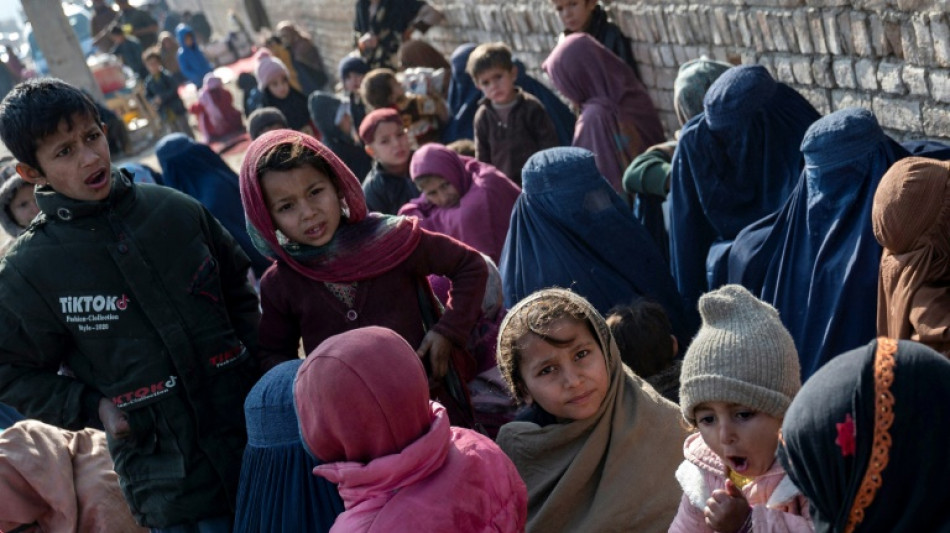
US-bound Afghans left 'without options' as Trump travel ban looms / Photo: © AFP

 Rene Eyre Revisits Autobiographical Performance 'Say A Little Prayer' in London

 UAE's HCT Holds Record Graduation and Announces Major Training Expansion

 NASA Awards $10B Lunar Contract Framework to SpaceX, Blue Origin

 Katy Perry Tells Fans Ex-Husband Russell Brand 'Should Be in Jail' During UK Concert

 South African election results renew debate over identity-based voting

 South African voters report smoother local election but declining IEC trust

 Dolly Parton museum and Nashville hotel open after singer’s death

 George and Amal Clooney attend New York political-comedy reading

 British buyers pay substantial premiums for period-home appearance

 Thomas Markle released to house arrest after child-abuse-image charge

As a young man, Muhammad Ilyas stood side-by-side with US soldiers as they took on the Taliban in his native Afghanistan, working as an interpreter and driven by a need for "revenge" for attacks on his family.
Now, with his sister stranded in Qatar ahead of an expected ban on the entry of Afghan nationals by the administration of President Donald Trump, he wonders what it was all for.
"When I first heard it, you cannot explain the kind of thoughts that go through your head and the emotions that you have after so much hard work, back and forth, this lengthy and exhausting process of vetting and screening," he said, of the almost three years it took his sister to get a US visa.
The 22-year-old mother of three is among about 2,000 Afghans at a US-run center in Qatar, where those in the final stage of their arduous journey to a new life in the United States are housed.
"She had a ticket in her hand to fly to the States. They had a ticket and on the 25th they got hit with the executive order and everything just stopped," said Ilyas, who has lived in Colorado for several years.
As one of his first acts in office, Trump froze the United States' refugee admission program and almost all foreign aid.
Trump ordered the US government to identify countries whose nationals should be banned from entering on security grounds, a move akin to the so-called "Muslim ban" of his first term.
Speaking on condition of anonymity, a US government official told AFP an executive order banning the entry of all nationals from Afghanistan, among other countries, is expected this week.
There are estimated to be up to 15,000 Afghan US-visa holders awaiting resettlement under a strict program designed to provide protection to those Afghans who worked with the United States during its 20-year war.
Another 200,000 are awaiting visa application processing, many still living in hiding in Afghanistan.
If the travel ban goes into place, many fear those en route would be forced to return to a home that is no longer safe.
"For them to go back is our biggest fear," said Ilyas. "I wish that they had not left the country at all."
- 'Extremely unsafe' -
After Trump's orders, US "relocation operations are essentially paused," the US official said.
"We have to drastically curtail the services we provide. We are only providing food and emergency medical services."
Asrar Umed, who received a Special Immigrant Visa (SIV) in 2022 for his years of service on narcotics and migration programs, was given 20 days to vacate his US-funded housing in Kabul.
"The Taliban is aware of my work on US projects... it is extremely unsafe for me to be in public or to work in Kabul," said the father of five. "I fear for my life and the lives of my family members every day."
"We have no clear plan on where to move."
- 'Most robustly vetted' -
Trump's move cites national security, but US officials say the 200,000 Afghans who have gone through the resettlement process, and those being processed, face rigorous screening.
"We have more information about Afghans than we do about most Americans," said Shawn VanDiver, a US military veteran who runs the non-profit #AfghanEvac.
"We had a massive intelligence operation there for years. We know who they are."
The US government official said Afghans undergoing the years-long process for SIVs or other visas "are the most robustly vetted immigrant population in our history."
Hamida Halimi, a 26-year-old midwife who fled to neighboring Pakistan after the Taliban came to power, said it took more than two years for her visa.
She was cleared for travel to the United States, with a flight booked for February 3.
"When we found out that our flight is canceled due to Trump's executive order, I felt so lonely and horrible I can't explain my feelings in words," she said.
"That was... the worst point of my life."
Halimi now feels trapped, with no path forward to the United States, and Pakistani authorities threatening Afghan migrants with deportation.
"We are constantly being harassed by Pakistani police," she said. "Also finding a home and accessing basic needs of life has become very challenging."
Pakistani authorities say they are enforcing the law by removing "undocumented" Afghan migrants.
For many, however, going back -- or staying in Afghanistan any longer -- is not an option.
"Our future looks very uncertain, and we may be left without options," said Umed.
All of the Afghans who spoke to AFP did so on condition of using pseudonyms, fearing reprisals.
The Taliban says there is an amnesty for those who fled, but the UN says it has documented reports of summary executions and enforced disappearances targeting such people.
VanDiver described the situation in more stark terms: "These are death sentences that President Trump is carrying out."
R.Braegger--VB