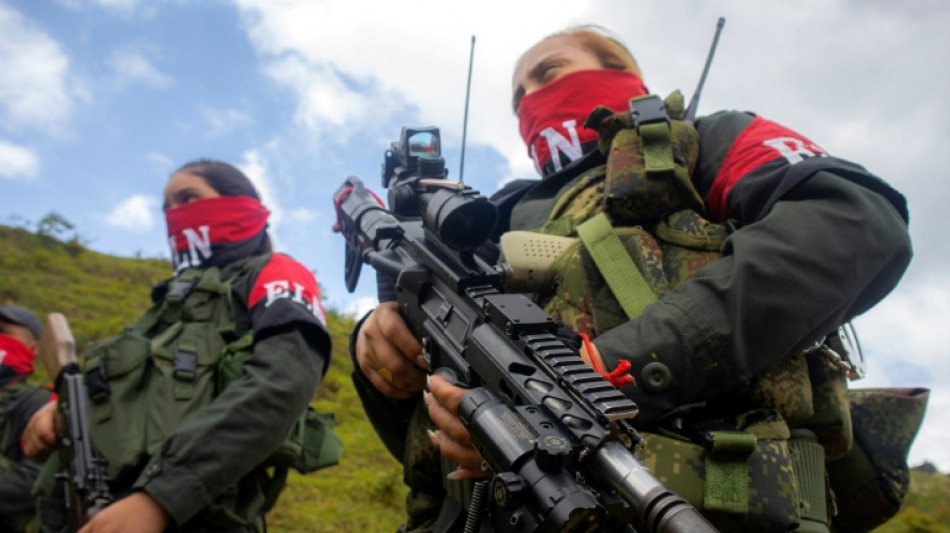
Colombian guerrillas warn of 'total war' as peace plan falters / Photo: © AFP

 Rene Eyre Revisits Autobiographical Performance 'Say A Little Prayer' in London

 UAE's HCT Holds Record Graduation and Announces Major Training Expansion

 NASA Awards $10B Lunar Contract Framework to SpaceX, Blue Origin

 Katy Perry Tells Fans Ex-Husband Russell Brand 'Should Be in Jail' During UK Concert

 South African election results renew debate over identity-based voting

 South African voters report smoother local election but declining IEC trust

 Dolly Parton museum and Nashville hotel open after singer’s death

 George and Amal Clooney attend New York political-comedy reading

 British buyers pay substantial premiums for period-home appearance

 Thomas Markle released to house arrest after child-abuse-image charge

Commanders from Colombia's National Liberation Army guerrilla group have vowed to repel a government counteroffensive in the country's northeast, warning that years of "total peace" risk turning into "total war."
In a rare interview, carried out at a secret mountain location near the Venezuelan border, two senior guerrilla commanders told AFP that they would not hesitate to fight 10,000 government troops amassed nearby.
The thousands-strong guerrilla group, better known by its Spanish initials ELN, has waged a 60-year leftwing insurgency against the Colombian state, seizing swathes of territory and becoming a major player in the global cocaine trade.
Since January, ELN clashes with a rival guerrilla group in the Catatumbo border region have displaced almost 56,000 people and left at least 76 dead, according to government estimates.
It is some of the worst violence Colombia has seen since peace accords were agreed in 2016.
The government has responded by declaring a state of emergency and deploying thousands of troops to the region.
President Gustavo Petro has vowed to reimpose state control by force if necessary. "The ELN has chosen the path of war, and that's what they will get," he said.
Guarded by some 30 heavily-armed fighters, ELN Commander "Ricardo" and Commander "Silvana Guerrero" –- sitting with rifles in hand -- indicated they were open to dialogue but ready for war.
"Petro has declared war. We are not afraid of that," said Ricardo, a leader of the ELN's northeastern war front.
"If the military continues to arrive, most likely we will have a confrontation, because we are going to defend ourselves as an insurgent force," he said.
"This total peace that Petro has been talking about, in the end, it is becoming total war."
- Turf war -
Analysts believe recent clashes between the ELN and the 33rd Front, another armed leftist group, were prompted by a turf war over territory and lucrative cocaine trafficking routes into Venezuela.
The ELN's territory is an important source of coca and a gateway to the Caribbean coast -- where Colombian cocaine begins its journey to the rest of the world.
The government has alleged that the ELN has close ties to Mexico's powerful Sinaloa Cartel.
Commander Silvana denied direct involvement in narcotrafficking but admitted the group does levy taxes on cocaine produced in the area.
"We impose a tax per kilo in the territory because we need an economy," she said. "That does not put us in league with narcotraffickers as the Colombian state alleges."
"Our rifles are never aimed at the people. These weapons we carry to defend the people" she said.
Silvana, whose real name is Luz Amanda Payares, is wanted by Colombia's government and is the subject of a US$25,000 bounty for her capture.
- 'The struggle continues' -
Whatever the cause of the recent violence, the crisis has been a major embarrassment for Petro's government.
He has staked his political fortunes on a policy of "total peace" -- limiting military operations against groups that did not sign the 2016 peace deal, in the hope of reaching new accords.
Critics allege that dissident groups have used the government's near-unilateral truce to regroup and grow in strength.
An alphabet soup of armed groups now vie for control of territory, extortion rackets, illegal mining and illicit trade routes across the country.
As a result, the amount of land used for cocaine production has increased by 420 percent since 2012, according to United Nations estimates.
Many Colombians fear ever-stronger armed groups could return the country to the decades of an internecine war that has killed 1.1 million people since the 1960s, according to a government estimate.
Despite the ELN's insistence that it is open to a "political solution," more violence looks likely.
Commander Silvana predicted that "in a short time," the Catatumbo region would see "a counteroffensive of a different magnitude."
Against that backdrop, Commander Ricardo dismissed calls for demobilization as "pacification" and insisted the ELN's revolution was needed "today more than ever."
"The State must be transformed. If not, the war will continue," he said.
"We, together with the Colombian people, will continue our resistance until we achieve our objective."
G.Frei--VB