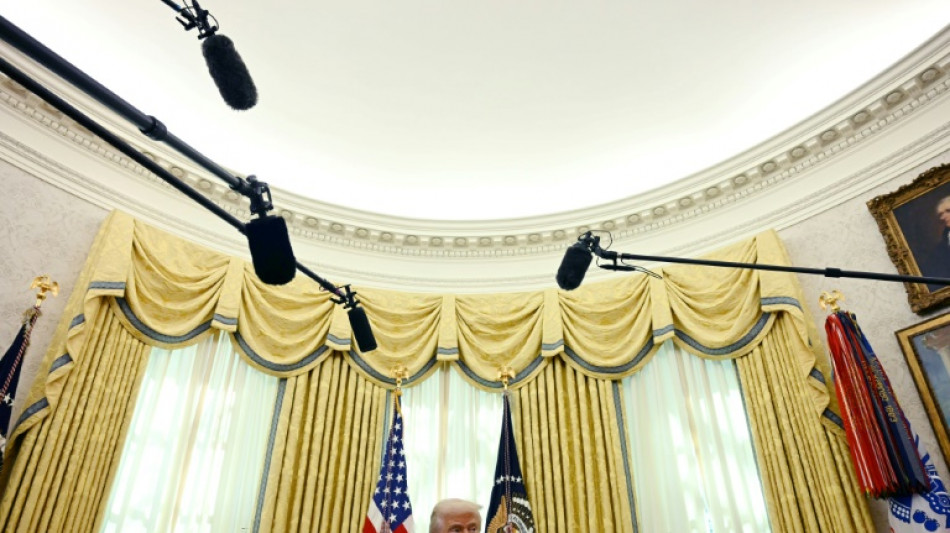
Trump declines to rule out 2025 US recession / Photo: © AFP

 Rene Eyre Revisits Autobiographical Performance 'Say A Little Prayer' in London

 UAE's HCT Holds Record Graduation and Announces Major Training Expansion

 NASA Awards $10B Lunar Contract Framework to SpaceX, Blue Origin

 Katy Perry Tells Fans Ex-Husband Russell Brand 'Should Be in Jail' During UK Concert

 South African election results renew debate over identity-based voting

 South African voters report smoother local election but declining IEC trust

 Dolly Parton museum and Nashville hotel open after singer’s death

 George and Amal Clooney attend New York political-comedy reading

 British buyers pay substantial premiums for period-home appearance

 Thomas Markle released to house arrest after child-abuse-image charge

President Donald Trump declined in an interview aired Sunday to rule out the possibility that the United States might enter a recession this year.
"I hate to predict things like that," he told a Fox News interviewer when asked directly about a possible recession in 2025.
"There is a period of transition, because what we're doing is very big -- we're bringing wealth back to America," he said, adding, "It takes a little time."
But Trump's commerce secretary, Howard Lutnick, was more definitive when asked Sunday about the possibility of a recession.
"Absolutely not," he told NBC's "Meet the Press" when asked whether Americans should brace for a downturn.
Trump's on-again, off-again tariff threats against Canada, Mexico, China and others have left the US financial markets in turmoil and consumers unsure what the year might bring.
Stock markets just ended their worst week since the November election.
Measures of consumer confidence are down, as shoppers -- already battered by years of inflation -- brace for the higher prices that tariffs can bring.
And widespread government layoffs being engineered by Trump's billionaire advisor Elon Musk add further concern.
Some signs are mixed.
A widely watched Atlanta Federal Reserve index now predicts a 2.4 percent contraction of real GDP growth in the year's first quarter, which would be the worst result since the height of the Covid-19 pandemic.
Much of the uncertainty stems from Trump's shifting tariff policy -- effective dates have changed, as have the sectors being targeted -- as businesses and investors try to puzzle out what will come next.
Kevin Hassett, Trump's chief economic advisor, was asked on ABC whether tariffs were primarily temporary or might become permanent.
Hassett said that depended on the behavior of the countries targeted. If they failed to respond positively, he said, the result could be a "new equilibrium" of continuing tariffs.
The administration has insisted that while the economy will pass through a possibly bumpy "transition," things are headed in a positive direction.
In his State of the Union message on Tuesday, Trump told Americans to expect "a little disturbance" as tariffs take hold, while adding: "We're okay with that. It won't be much."
And his Treasury Secretary Scott Bessent has warned of a "detox period" as the economy cuts government spending.
Given the uncertainties, economists have been wary of making firm predictions.
Economists at Goldman Sachs, citing Trump's policies, have raised their odds of a recession over the next 12 months from 15 percent to 20 percent.
And Morgan Stanley predicted "softer growth this year" than earlier expected.
Recessions are generally defined as two consecutive quarters of weak or negative GDP growth.
The US was briefly in recession in early 2020 as the Covid pandemic spread. Millions of people lost jobs.
N.Schaad--VB