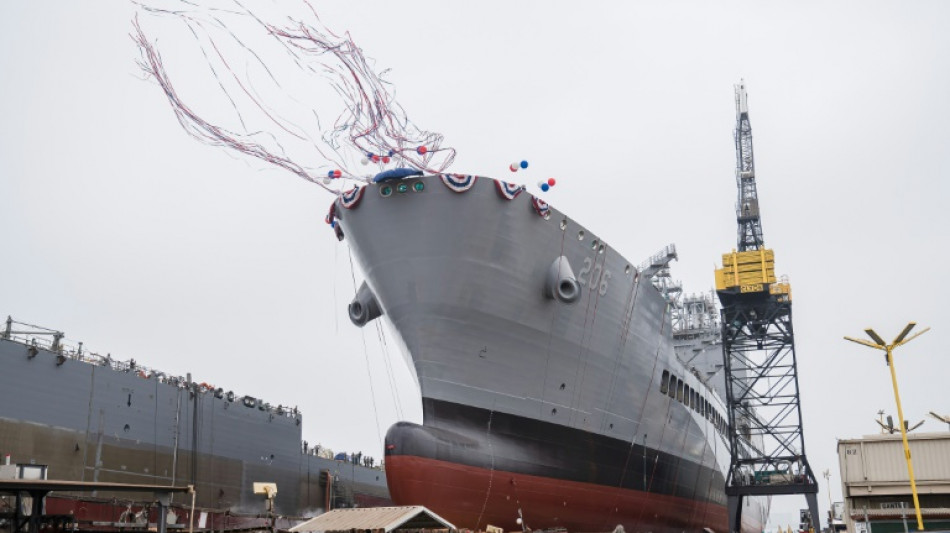
US shipbuilders, a shadow of what they were, welcome Trump's support / Photo: © AFP/File

 Once a top export, prized Kashmir carpet fades

 Search for 1,000 missing after deadly Nepal-Tibet floods

 Park So-yeon first woman to play for eSports powerhouse South Korea

 Yayoi Kusama: Japan's kaleidoscopic, troubled 'polka dot queen'

 Euro champ Hunt 'on her toes' against world's best in Zurich 100m

 Asian chip firms lifted by Nvidia forecast but broader markets struggle

 Search for missing after Nepal-Tibet floods kill 165

 Qantas says profits slump as fuel costs surge
 Lofty bond yields, Bessent's intervention pose challenge to Fed's Warsh
 The foreigners missing in Nepal's flash floods

 Bond yields are surging: Here's why that could spell trouble

 Fed's Cook rejects Trump mortgage fraud claims

 Police probe 'assault allegations' after Carse's nightclub incident

 How we might hear new Dolly Parton music in the future

 Nvidia doubles revenue, forecasts even more AI spending

 Canada renews push to boycott US products

 Savio scores on debut as Spurs set-up League Cup tie with Liverpool

 Brazil sues Discord over child safety measures, demands $100 mln in damages

 Alberta NDP Urges Smith to Postpone Separation Vote Amid Trade War

 Fenerbahce stun Lyon in Champions League as AEK crush Levski

 Why Global Finance Still Relies on Wall Street Despite Diversification Trends

 Bethlehem Father Seeks Aid for Special Needs Children Amid Health Crisis

 LIV Golf to lay off majority of staff

 How narwhal 'scientists' track Arctic warming

 Iran says US sanctions will achieve nothing

Shipbuilding has been in steady decline in the US since the end of the Cold War but some in the industry now hope for a revival of the sector, as was promised last week by President Donald Trump.
The United States was once a world leader in both commercial and naval construction, but has fallen far behind its main rival China.
Trump has now promised to reverse this, declaring in an address to Congress on Tuesday that he would "resurrect" the sector and create an Office of Shipbuilding in the White House.
"We used to make so many ships," Trump said, promising tax breaks. "We're going to make them very fast, very soon."
American shipbuilders say they are ready to seize the moment, but experts warn that even a concerted effort to respond to China's overwhelming dominance of the sector will take years -- and cost many billions of dollars.
"This is a historic moment," said Matt Paxton, president of the Shipbuilders Council of America (SCA), which represents more than 150 US shipbuilding companies.
The US Navy, when asked for comment, referred AFP to the White House.
"We are waiting to learn more," Cynthia Cook, who heads the defense-industrial group at the Center for Strategic and International Studies (CSIS), told AFP. "It is clear that shipbuilding is an industrial weakness of the United States."
But, she added: "You cannot immediately get more ships by throwing money at the problem."
US ship production is down 85 percent from the 1950s, and the number of naval shipyards capable of building the largest vessels has fallen by 80 percent, according to the McKinsey consultancy.
- 'Not what it was' -
In the 1970s, five percent of commercial ships built in the world (in gross tonnage) came from American shipyards.
That share has since plunged to a scant one percent, a drop in the water compared to China (50 percent), South Korea (26 percent) or Japan (14 percent).
"We need some solutions to our shipbuilding gaps," said the CSIS's Cook, while noting that Seoul and Tokyo, at least, are US allies.
"I absolutely admit that US shipyard capacity is not what it once was," Paxton said last month before a congressional committee.
"Our market has changed dramatically since World War II, when shifting administrative priorities, from Republican and Democratic administrations, curbed programs to support our industry," he said.
The US naval fleet has shrunk from 471 vessels after the Cold War in 1992 to 295 today, Paxton said.
According to the Congressional Budget Office (CBO), the US Navy's current plan to build a fleet of 390 vessels by 2054 -- with the purchase of 364 new vessels because of the decommissioning of older models -- would cost an average $40 billion a year.
Paxton said the Trump administration needs a comprehensive strategy for the industry -- including ways to reduce administrative and regulatory obstacles -- if it is to achieve its shipbuilding goals.
Republican Senator Roger Wicker painted a dire picture during a confirmation hearing last month for businessman John Phelan as navy secretary.
"Just about every major US shipbuilding program is behind schedule, over budget or irreparably off track," said Wicker, who chairs the Armed Services Committee.
- Worker shortage -
Shipbuilders say their work is regularly complicated by last-minute changes requested by the navy, which cause delays and budget overages.
Another problem is a severe worker shortage.
The Covid-19 pandemic prompted a wave of early retirements and career-switching, while slowing training. And amid historically low US unemployment, industry wages have had trouble competing.
Still, naval shipbuilding contributes, directly or indirectly, more than $40 billion to the country's GDP.
The industry continues to build "lots of ships," mainly for the domestic market, said Paxton, while adding that Trump probably wants a much larger US share of the global market.
US shipyards not only produce and maintain ships for governmental bodies -- from the US Navy to agencies like the National Oceanic and Atmospheric Administration (NOAA) -- they also produce and maintain the roughly 40,000 commercial vessels.
But competition is fierce, with the industry in many countries -- notably China -- enjoying extensive subsidies and tax breaks, sources say.
A spokesman for Huntington Ingalls Industries said HII, one of the largest US shipbuilders, was "grateful" for Trump's comments and was working with the government to help "meet a generational increase in demand."
S.Gantenbein--VB