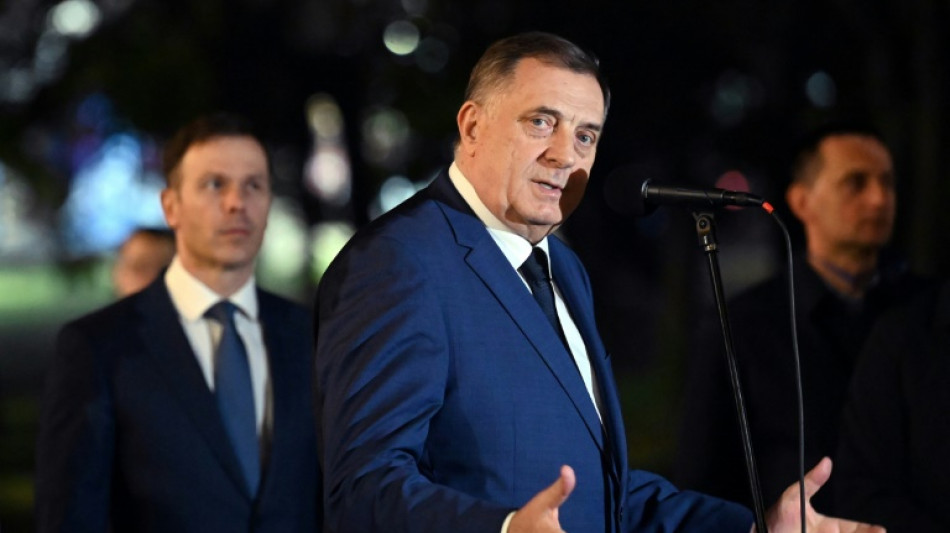
Bosnian Serb leader rejects prosecutor summons as crisis deepens / Photo: © AFP/File

 Rene Eyre Revisits Autobiographical Performance 'Say A Little Prayer' in London

 UAE's HCT Holds Record Graduation and Announces Major Training Expansion

 NASA Awards $10B Lunar Contract Framework to SpaceX, Blue Origin

 Katy Perry Tells Fans Ex-Husband Russell Brand 'Should Be in Jail' During UK Concert

 South African election results renew debate over identity-based voting

 South African voters report smoother local election but declining IEC trust

 Dolly Parton museum and Nashville hotel open after singer’s death

 George and Amal Clooney attend New York political-comedy reading

 British buyers pay substantial premiums for period-home appearance

 Thomas Markle released to house arrest after child-abuse-image charge

Bosnian Serb leader Milorad Dodik said Thursday he would ignore a summons from the country's central prosecutor who is investigating him for undermining the constitution.
The refusal was all but certain to plunge Bosnia into greater uncertainty a week after Dodik was convicted for defying the envoy charged with overseeing its peace accords triggered a fresh political crisis.
"The Prosecutor's Office of [Bosnia] has summoned me to give a statement tomorrow as a suspect for undermining the constitutional order," Dodik -- who is the president of Bosnia's Serb-dominated statelet Republika Srpska (RS) -- wrote on social media.
"I will not go to their political court, because Serbs no longer submit to inquisitions!" he added.
The comment came just hours after Dodik insisted that he was not a threat to Bosnia after signing laws Wednesday evening that banned the country's central police and judiciary from his statelet.
The legislation has escalated tensions in the deeply divided Balkan country and is proving to be a key test for its fragile, post-war institutions.
Since the end of Bosnia's inter-ethnic conflict in the 1990s, the country has consisted of two autonomous halves -- the Serb-dominated RS and a Muslim-Croat federation.
The two are linked by weak central institutions, while each has its own government and parliament.
"Neither the Republika Srpska nor I are a threat to Bosnia and Herzegovina," Dodik said in a message to the "people of the RS, Serbs, Bosniaks (Muslims) and Croats".
Late Wednesday, Dodik signed several controversial laws adopted in February by the Bosnian Serb lawmakers.
One of them bans Bosnia's state court, the state prosecutor's office and the central police force (SIPA) from operating in RS.
Dodik pushed the legislation through the RS parliament last week, after he was sentenced to a year in prison and banned from office for six years for refusing to comply with decisions made by Christian Schmidt -- the international envoy charged with overseeing Bosnia's peace accords.
- 'Coup' -
Several Bosnian Muslim political leaders slammed the adoption of the laws by Dodik, calling it a "coup".
The Bosnian Muslim member of the country's joint presidency Denis Becirovic said an appeal was made in Bosnia's Constitutional Court to annul the legislation.
"Brutal attacks on the Dayton peace agreement and constitutional order... must be stopped," he said earlier, referring to the 1995 accord that put an end to the years of bloodshed.
On Thursday, Becirovic met with the head of the European Union delegation in Bosnia and ambassadors from the bloc to discuss the crisis.
Analysts meanwhile warned that Dodik's actions risked unleashing more chaos in Bosnia.
"With these new laws that have been adopted, the situation seems even more dangerous," Veldin Kadic, a professor of political science in Sarajevo, told a local broadcaster.
In a seeming bid to calm tensions, Dodik called for political talks within the country without interference from "foreigners".
"I hope we have understood that our future lies solely in our agreement, in the agreement of our peoples... That's all I ask," he said.
Dodik, a Kremlin ally, is set to meet with Serbian President Aleksandar Vucic in Belgrade later Thursday, the Serbian leader's office said in a statement.
Dodik, 65, has the right to appeal last week's verdict, which he said was the result of a "political trial" intended to "eliminate him from the political arena".
For years, Dodik has pursued a relentless separatist agenda that has put him on collision course with Bosnia's institutions.
The RS president has repeatedly threatened to pull the Serb statelet out of Bosnia's central institutions -- including its army, judiciary and tax system, which has led to sanctions from the United States.
L.Stucki--VB