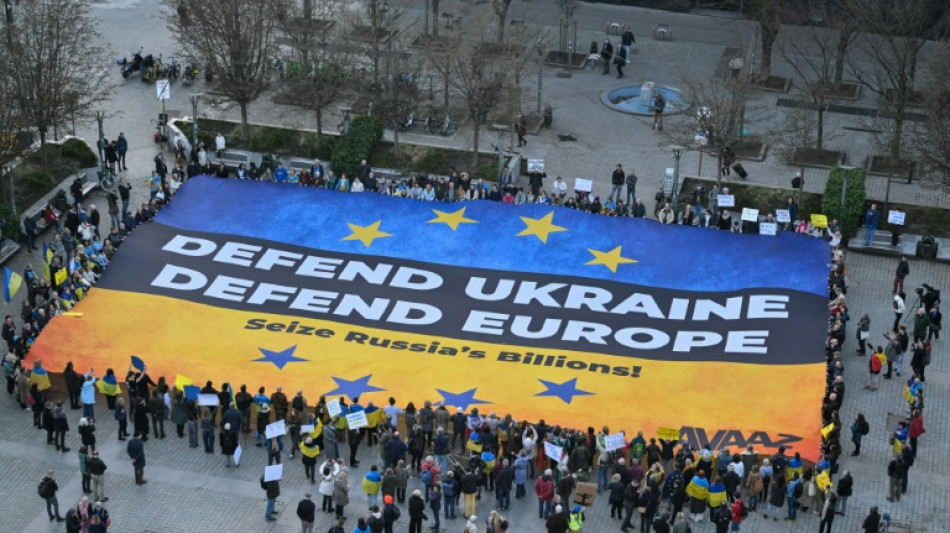
EU seeks unity on Ukraine and defence boost as Trump pivots from allies / Photo: © AFP

 Rene Eyre Revisits Autobiographical Performance 'Say A Little Prayer' in London

 UAE's HCT Holds Record Graduation and Announces Major Training Expansion

 NASA Awards $10B Lunar Contract Framework to SpaceX, Blue Origin

 Katy Perry Tells Fans Ex-Husband Russell Brand 'Should Be in Jail' During UK Concert

 South African election results renew debate over identity-based voting

 South African voters report smoother local election but declining IEC trust

 Dolly Parton museum and Nashville hotel open after singer’s death

 George and Amal Clooney attend New York political-comedy reading

 British buyers pay substantial premiums for period-home appearance

 Thomas Markle released to house arrest after child-abuse-image charge

EU leaders gather with Volodymyr Zelensky Thursday in Brussels in search of unity on bolstering Ukraine and Europe's defences after Donald Trump upended traditional US alliances and retracted wartime backing of Kyiv.
Thursday's summit brings all 27 EU leaders together for the first time since last week's explosive meeting between presidents Trump and Zelensky, with Washington since suspending military aid and intelligence sharing to help Kyiv fight off Russia's invasion.
This has sent Ukraine's allies scrambling, with EU leaders openly questioning Washington's reliability as a security partner going forward.
While the Brussels meeting will aim to cement European support for Kyiv, it is unlikely to yield any major announcements of aid beyond the 30 billion euros ($32 billion) the bloc has already committed for this year.
The prospect of the United States pivoting from its European partners in NATO has fuelled a growing consensus on the summit's other major topic: the need to strengthen Europe's defences against Russia.
European Commission chief Ursula von der Leyen has laid out a plan aimed at mobilising 800 billion euros to "re-arm Europe" -- largely by freeing states to spend much more -- which leaders are expected to greenlight Thursday.
"Europe faces a clear and present danger on a scale that none of us has seen in our adult lifetime," she wrote to leaders, urging Europe to "act as decisively as the situation dictates."
France's President Emmanuel Macron doubled down in a sombre address to the nation on the summit's eve, calling for a defence spending surge to confront a "new era" and saying he would discuss extending France's nuclear deterrent to European partners.
"Who can believe that this Russia of today will stop at Ukraine?" Macron asked. "I want to believe that the United States will stay by our side, but we have to be prepared for that not to be the case."
Germany's chancellor-in-waiting Friedrich Merz, who conferred with EU chiefs in Brussels ahead of the talks, has likewise declared himself ready for "the worst-case scenario" and embraced radical reforms to ramp up Germany defence spending.
- 'Coalition of the willing' -
Bolstering European defences has taken on acute urgency as Trump makes clear his desire to swiftly end the three-year war through direct negotiations with Moscow.
His embrace of Russian President Vladimir Putin, while expressing contempt toward Zelensky, has cemented fears that Kyiv and Europe's interests will be overlooked in any deal to end the biggest conflict on the continent since World War II.
British Prime Minister Keir Starmer has called for a "coalition of the willing" to come together to draw up a peace plan and present it to the United States.
Starmer and other European leaders made a show of embracing Zelensky and reaffirming support for Ukraine at weekend talks in London. EU chiefs will be briefing Starmer on the Brussels talks on Friday.
France and Britain have pitched a one-month truce "in the air, at sea and on energy infrastructure", though not initially on the ground. Leaders are expected to raise that proposal in Brussels, but not formally decide on it.
- Security guarantees -
EU leaders are also expected to start thrashing out what "security guarantees" the bloc might provide for a peace deal, including the possible deployment of European troops which several states support.
While Zelensky can expect strong words of support in Brussels, it was unclear if a deal would be reached on a new package of key weaponry, with several states arguing Europe currently has enough money committed to meet Kyiv's needs.
Forging a united front on Ukraine has been a headache for the EU, with Hungary's Viktor Orban -- who is friendly with both Trump and Putin -- again signalling his reluctance to endorse a proposed joint statement on support for Ukraine.
Zelensky is still scrambling to contain the fallout from the blow-up with Trump, which saw the US leader berate him for a lack of gratitude.
Trump acknowledged Tuesday that Zelensky has told him Kyiv was ready for talks with Russia and to finalise an agreement on control of Ukrainian mineral resources.
The US leader has demanded a deal granting Washington preferential access to Ukraine's rare-earth and other natural resources as the price for any continued backing -- even though he has refused to commit to giving Kyiv security guarantees as part of a truce with Russia.
burs-ec/raz/ach
G.Frei--VB