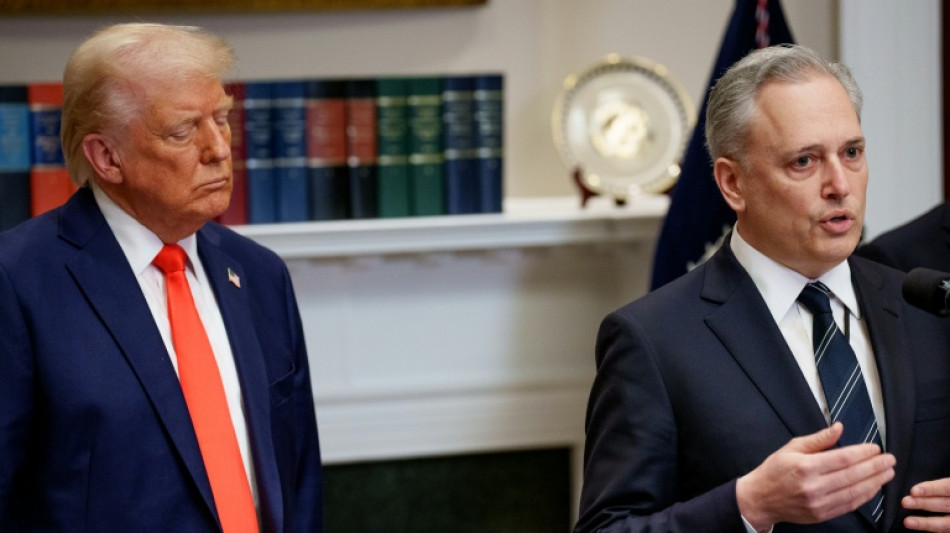
Trump to welcome crypto elite at White House / Photo: © GETTY IMAGES NORTH AMERICA/AFP/File

 Rene Eyre Revisits Autobiographical Performance 'Say A Little Prayer' in London

 UAE's HCT Holds Record Graduation and Announces Major Training Expansion

 NASA Awards $10B Lunar Contract Framework to SpaceX, Blue Origin

 Katy Perry Tells Fans Ex-Husband Russell Brand 'Should Be in Jail' During UK Concert

 South African election results renew debate over identity-based voting

 South African voters report smoother local election but declining IEC trust

 Dolly Parton museum and Nashville hotel open after singer’s death

 George and Amal Clooney attend New York political-comedy reading

 British buyers pay substantial premiums for period-home appearance

 Thomas Markle released to house arrest after child-abuse-image charge

US President Donald Trump, who has multiple ties to the crypto industry, will host the sector's top players at a White House summit on Friday, as the field enjoys renewed momentum following his election.
The US crypto community rallied behind Trump's campaign, contributing millions of dollars towards his victory over Joe Biden, whose administration tightened regulations and expressed skepticism toward digital currencies. Now, they're seeing their support pay dividends.
Trump has waded into the space personally as well, partnering with exchange platform World Liberty Financial and launching his own "Trump" memecoin in January as his wife Melania did the same -- moves that have prompted conflict of interest accusations.
The president's "crypto czar," Silicon Valley investor David Sacks, will convene prominent founders, CEOs, and investors with members of a Trump working group to craft policies aimed at accelerating crypto growth and providing the legitimacy the industry has long wanted.
Guests will include twins Cameron and Tyler Winklevoss, founders of platform Gemini, with reports that Brad Armstrong of Coinbase and Michael Saylor, the boss of major bitcoin investor MicroStrategy, will also be in attendance.
Hanging over the crypto resurgence is the fate of FTX, the once-leading crypto exchange that collapsed spectacularly when its CEO Sam Bankman-Fried was found to have defrauded clients massively. He is now serving a 25-year term in a US jail.
For believers, cryptocurrencies represent a financial revolution that reduces dependence on centralized authorities while offering individuals freedom from traditional banking systems.
Bitcoin, the world's most traded cryptocurrency, is heralded as an alternative to gold or as a hedge against currency devaluation and political instability.
- Crypto warnings -
Critics maintain these assets function primarily as speculative investments with questionable real-world utility, warning that excessive deregulation could leave taxpayers on the hook for cleaning up market crashes.
Law enforcement agencies see digital assets as a means to launder ill-gotten money.
The proliferation of "memecoins" -- cryptocurrencies based on celebrities, internet memes, or pop culture rather than technical utility -- presents another challenge.
Much of the crypto industry frowns upon this practice because they fear it tarnishes the business, amid reports of quick pump-and-dump schemes that leave unwitting buyers paying for assets that end up worthless.
Despite his previous hostility toward cryptocurrencies, Trump has embraced the technology, declaring his intention to make the United States a crypto world power.
His administration has already taken significant steps to clear regulatory hurdles.
On Sunday, Trump confirmed plans for a strategic cryptocurrency reserve where the US government would deposit digital currency holdings acquired mainly from judicial seizures.
Jacob Phillips of Lombard Finance called this potential move "one of the strongest endorsements the industry has ever seen," noting that several founders and teams have already relocated to the United States in response to the improving regulatory climate.
Trump also appointed crypto advocate Paul Atkins to head the Securities and Exchange Commission (SEC).
Under Atkins, the SEC has dropped legal proceedings against major platforms like Coinbase and Kraken that were initiated during Biden's term.
The previous administration had implemented restrictions on banks holding cryptocurrencies (since lifted) and allowed former SEC chairman Gary Gensler to pursue aggressive enforcement despite the absence of clear legal frameworks.
- 'Pivotal moment' -
Addressing ethics concerns, Sacks announced on X that he has divested from his substantial crypto holdings and investments, with industry figures quickly vouching for his integrity.
Friday's summit "marks a pivotal moment for the digital asset industry," according to Elitsa Taskova of Nexo, a cryptocurrency financial services platform.
However, meaningful change will likely require congressional action, where crypto legislation has remained stalled despite intense lobbying efforts by investors including Trump ally Marc Andreessen, an influential venture capitalist.
Some lawmakers remain hesitant, troubled by scandals and recurring reports of market crashes, theft and scams.
The recent $1.5 billion theft from the Bybit platform underscores the risks cryptocurrencies still present.
Nevertheless, Dante Disparte of Circle, which issues the dollar-pegged USDC stablecoin, sees growing bipartisan support for crypto legislation.
He attributed this emerging consensus to proposals that include strong transparency and anti-money laundering requirements alongside consumer and market protections.
P.Staeheli--VB