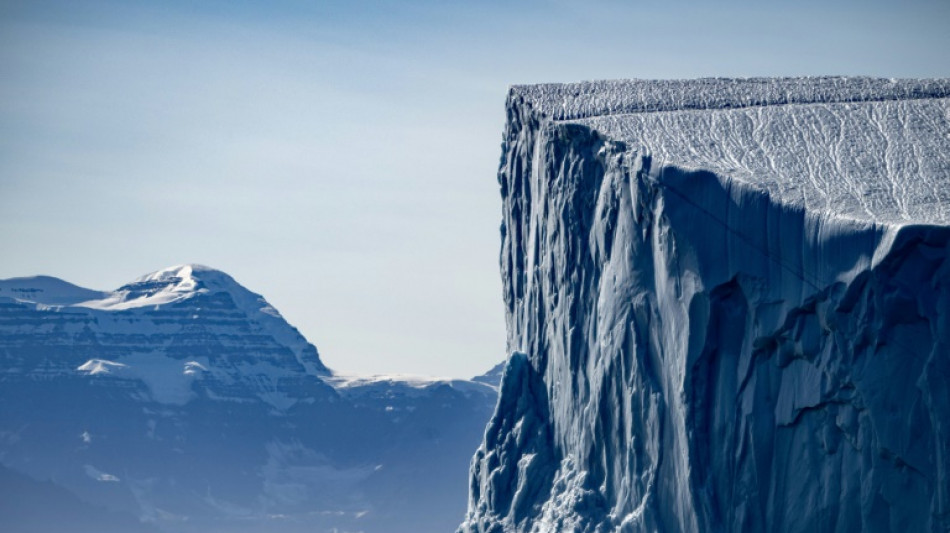
Minerals, mines, hydrocarbons: Greenland's key but limited resources / Photo: © AFP/File

 Rene Eyre Revisits Autobiographical Performance 'Say A Little Prayer' in London

 UAE's HCT Holds Record Graduation and Announces Major Training Expansion

 NASA Awards $10B Lunar Contract Framework to SpaceX, Blue Origin

 Katy Perry Tells Fans Ex-Husband Russell Brand 'Should Be in Jail' During UK Concert

 South African election results renew debate over identity-based voting

 South African voters report smoother local election but declining IEC trust

 Dolly Parton museum and Nashville hotel open after singer’s death

 George and Amal Clooney attend New York political-comedy reading

 British buyers pay substantial premiums for period-home appearance

 Thomas Markle released to house arrest after child-abuse-image charge

The vast autonomous Danish territory of Greenland, coveted by US President Donald Trump, is believed to hold untapped mineral and oil reserves, but on a global scale these amounts are modest and offer only minor potential for exploitation.
- Rare earths -
Greenland's rare earths are estimated at 36.1 billion tonnes by the Geological Survey of Denmark and Greenland (GEUS).
Demand for these 17 metals vital for the tech industry is expected to surge in the future, and they are also needed for drones, wind turbines, hard drives, electric cars, telescope lenses and fighter jets.
But the territory's rare earths reserves -- that is those that are economically and technically recoverable -- amount to about 1.5 million tonnes, according to the latest report from the US Geological Survey (USGS).
This is modest compared to the reserves held by China (44 million tonnes) or Brazil (21 million tonnes), but sufficient enough to attract manufacturers looking to diversify from China's dominance over supply.
- Lithium, graphite, uranium -
According to GEUS, Greenland's soils also contain graphite, lithium, and copper, three minerals defined by the International Energy Agency (IEA) as critical for the energy transition.
The National Geological Survey has estimated graphite resources in Greenland at six million tons, or 0.75 percent of the global total calculated by USGS.
According to a May 2024 IEA report, China "dominates the entire production chain" of this mineral, which is used in both batteries and the nuclear industry.
For lithium, also a component in batteries and whose demand the IEA says could increase eightfold by 2040, Greenland's resources have been estimated at 235,000 tonnes, or 0.20 percent of the global figure.
Greenland's copper resources meanwhile are insignificant on a global scale, but its uranium reserves, a coveted nuclear fuel, could be of greater strategic interest. However, its exploitation on the island has been banned since 2021.
- One active mine, one restarting -
There is only one operational mine in Greenland -- an anorthosite deposit on the west coast of the territory run by Lumina Sustainable Materials.
Production there is very limited and activity intermittent, with its ownership having changed many times over the years.
The Nalunaq gold mine on the south of the island, owned by the Canadian company Amaroq Minerals, is in a restarting phase.
"Several other projects are under development and some of these have been advanced to a feasibility stage and have been granted exploitation licences," Jakob Klove Keiding, senior consultant at GEUS told AFP.
But, he added, these "still need significant additional investments and the final approvals to go into production."
The European Union, which identified 25 of the 34 minerals on its official list of critical raw materials in Greenland, signed a memorandum of understanding with Greenland's government in 2023 supporting the development of the island's mineral resources.
This strategic partnership could offer new prospects in maritime transport and resource exploration, with the Arctic warming up four times faster than the rest of the world.
- Hydrocarbons -
The island could also hold hydrocarbons roughly equivalent to 28.43 billion barrels of oil, according to GEUS, Greenland's National Oil Company (Nunaoil), and Greenland's Mineral Resources Authority, based on industry data.
Although seemingly abundant, this has to be put in context. No industrial drilling for oil or gas has ever been exploited in Greenland, although three oil exploration licenses are active in the east of the territory.
The US, for example, consumed 7.39 billion barrels of petrol in 2023 alone, according to the US Energy Information Administration.
H.Gerber--VB