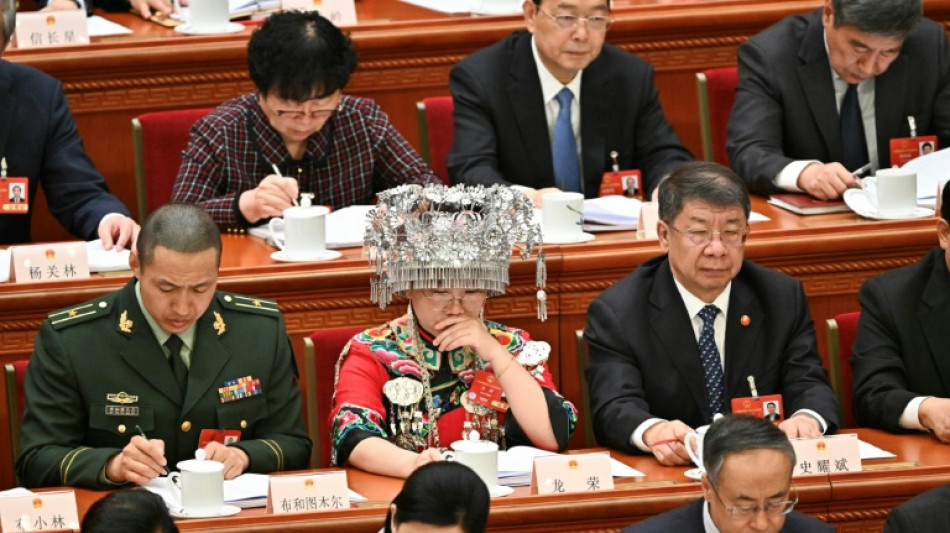
China's goals for 2025: five things to know / Photo: © AFP

 Piracy attacks off Somalia surge in 2026: AFP analysis of IMO data

 Tottenham land Marmoush from Manchester City

 YZi Labs Backs TermMax to Advance On-Chain Bond Market Infrastructure

 Nvidia boosts tech stocks but caution dominates ahead of Fed speech

 Pogacar holds off Mas to claim Vuelta stage six victory

 A lasting Dolly Parton legacy: childhood literacy

 S.Africa sounds alarm as infant vaccinations plummet

 Toulouse have salary cap fine reduced on appeal

 Tech stocks lifted by Nvidia but caution dominates ahead of Fed speech

 'Smart cricketer' Dinusha helps Sri Lanka draw second India Test

 Zambia opposition leader surrenders to police: state media

 Alleged 9/11 mastermind to go on trial in June 2028
 Abbas's treble strike rocks England in second Test

 'Butcher of Bosnia' Ratko Mladic dead: Serbian state media

 New Zealand make three changes for second South Africa Test

 Stocktwits Expands CME Group Alliance with the Integration of Single Stock Futures Data

 'Mature' Colapinto extends contact with Alpine through 2027

 Atletico rule out any talks with Barcelona over Alvarez

 Tech stocks lifted by Nvidia as broader markets struggle

 Delap joins Nottingham Forest in club-record deal

 ICC President Akane Warns U.S. Sanctions Threaten Court's Future

 Delays in Cancer Radiotherapy and Surgery Target Times

 Acrid stench, charred walls reveal devastation of Pakistan infant ward fire

 Norway holds its breath as King Harald's health deteriorates

 Germany reports record 15,800 heat-related deaths this summer

China laid out its economic growth goals and spending for 2025 on Wednesday.
Here are five key takeaways:
- Economic boost -
China has set an economic growth target of around five percent for 2025, broadly in line with analysts' expectations.
Beijing has struggled to sustain its recovery from the pandemic, with a property sector crisis, flagging consumption and high youth unemployment weighing on growth.
In his speech to lawmakers, Premier Li Qiang vowed to make domestic demand the "main engine and anchor" of economic growth in the country but acknowledged challenges in spurring consumption.
"Domestically, the foundation for China's sustained economic recovery and growth is not strong enough," Li told the gathered ruling party cadres, including President Xi Jinping.
"Effective demand is weak, and consumption, in particular, is sluggish," he added.
China will aim to create some 12 million new jobs in cities and push for two percent inflation this year, he announced.
The country will also issue 1.3 trillion yuan ($179 billion) in ultra-long special treasury bonds this year, an increase from one trillion yuan in 2024.
And Beijing will raise its budget deficit to around four percent of its gross domestic product -- a rare move that analysts say will give Beijing more latitude to tackle its economic slowdown.
- Military spending -
China will boost its defence spending by 7.2 percent in 2025, the same as last year, according to a budget report.
Beijing's military expenditure has been rising for decades, broadly in line with economic growth, as its armed forces undergo rapid modernisation in the face of deepening strategic competition with the United States.
China's expanding defence budget has been viewed with suspicion by Washington and regional powers such as Japan, with whom it has a territorial dispute in the East China Sea.
Beijing has also asserted its claims in the South China Sea, despite an international ruling declaring its stance baseless.
- Ageing population -
China will increase the minimum basic old-age benefits for rural and non-working urban residents by 20 yuan ($2.75) per person per month, the budget report said.
Basic pension benefits for retirees will also be raised "as appropriate" and elderly care services, especially in more rural areas, will be developed.
China's rapidly ageing population has presented fresh challenges for authorities, which have long relied on its vast workforce as a driver of economic growth.
The government will also "prudently advance the reform to gradually raise" the statutory retirement age, Li said.
China announced in September that it would gradually raise the statutory retirement age, which -- at 60 -- had been among the lowest in the world.
The country will issue childcare subsidies and also "gradually" make preschool education free, Li added.
High costs -- especially for education and childcare -- and the challenging employment market are among the factors discouraging young people from becoming parents.
- Private enterprises -
In addition, Li pledged stronger support for private enterprises.
"We will take solid steps to implement policies and measures designed to spur the growth of the private sector, effectively protect the lawful rights and interests of private enterprises and entrepreneurs," Li said.
Investors have been keeping an eye out for signs of further support for the private sector, following Xi's recent talks with Chinese tech tycoons.
Li said on Wednesday that China will encourage private enterprises with "appropriate conditions to institute and refine modern corporate systems with distinctive Chinese features".
But analysts say a private-sector boom will only be encouraged as long as it aligns with Beijing's strategic objectives.
During the 2010s tech giants were allowed to rapidly grow, but the Communist Party has historically been wary of runaway private sector expansion.
- 'External environment' -
Li acknowledged that an "increasingly complex and severe external environment" may exert a greater impact on China in areas such as trade and technology.
"Unilateralism and protectionism are on the rise, the multilateral trading system is experiencing disruptions, and tariff barriers continue to increase," he said.
China will "oppose hegemonism and power politics", Li added, without referring to any countries by name.
China has clashed with the United States and other Western powers in recent years over technology, trade, human rights and other issues.
Its foreign ministry has previously used such language in response to acts by Washington that China deems a constraint on its development.
C.Koch--VB