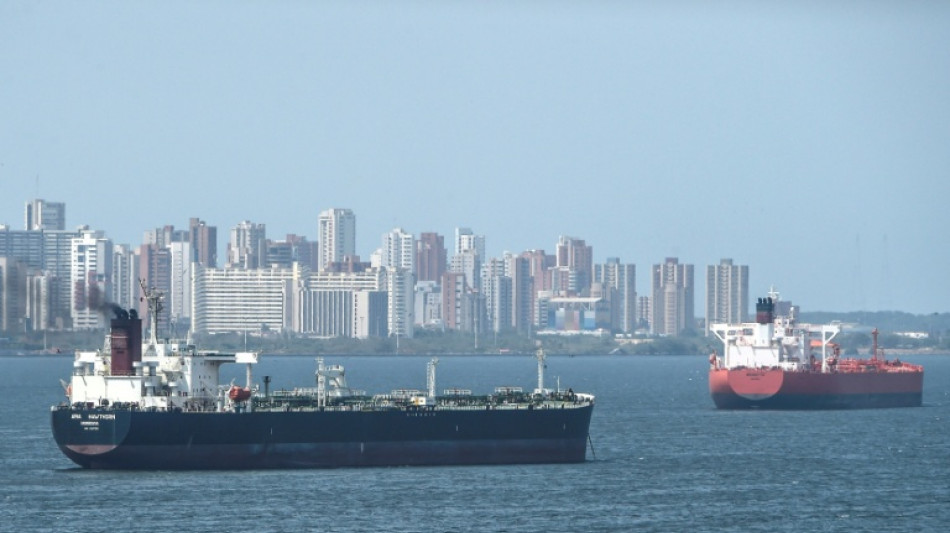
Trump gives Chevron a month to 'wind down' Venezuela operations / Photo: © AFP/File

 Rene Eyre Revisits Autobiographical Performance 'Say A Little Prayer' in London

 UAE's HCT Holds Record Graduation and Announces Major Training Expansion

 NASA Awards $10B Lunar Contract Framework to SpaceX, Blue Origin

 Katy Perry Tells Fans Ex-Husband Russell Brand 'Should Be in Jail' During UK Concert

 South African election results renew debate over identity-based voting

 South African voters report smoother local election but declining IEC trust

 Dolly Parton museum and Nashville hotel open after singer’s death

 George and Amal Clooney attend New York political-comedy reading

 British buyers pay substantial premiums for period-home appearance

 Thomas Markle released to house arrest after child-abuse-image charge

The United States on Tuesday gave energy giant Chevron just one month to stop its operations in Venezuela, delivering a heavy blow to cash-strapped authorities in Caracas.
Chevron currently produces and exports almost a quarter of the million barrels of crude each day from Venezuela, providing vital revenue for Nicolas Maduro's government.
But a Treasury Department unit said Tuesday that Chevron must stop pumping within 30 days, a timeframe industry insiders described as unrealistic.
The move nonetheless signifies a head-snapping shift in Donald Trump's policies toward Venezuela, a long-time foe of the United States.
In Trump's first term, he pursued a policy of "maximum pressure" against the leftist regime, issuing sanctions and limiting US oil companies' operations.
But coming to office for the second time, Trump initially sought to engage with Maduro.
He okayed a deal to secure the release of US citizens in return for Caracas accepting migrant deportees from the United States.
A Trump envoy even posed for photographs in Caracas with a beaming Maduro.
That move sparked fierce pressure from Florida Republicans who want to see the United States back pro-democracy parties that have been repeatedly thwarted in questionable elections.
Facing a recent tough budget vote in Congress, Trump made an abrupt about-face last month and said Venezuela had failed to hold fair elections, as promised, and was not living up to the deal.
Experts say the loss of Chevron-linked exports could spell recession for Venezuela and an even greater number of people fleeing the country.
For Maduro, it would immediately dry up already sparse foreign reserves -- a loss of some $150-200 million per month.
"The new US government is trying to hurt the Venezuelan people" said Vice President Delcy Rodriguez.
"It's a self-inflicted blow that is going to increase fuel prices."
Oil markets on Tuesday took the news in stride, as it arrived after a decision by oil cartel OPEC to increase production.
Chevron's share price, however, has fallen about 2.8 percent in the last week.
Venezuela once produced 3.5 million barrels a day, but now produces just over one million, despite having the world's largest oil reserves.
Between 2014 and 2021, Venezuela's GDP fell by 80 percent, thanks in part to low oil prices and biting US sanctions.
European firms Eni, Repsol and Shell -- which also have operations in Venezuela -- were not covered by the action.
K.Hofmann--VB