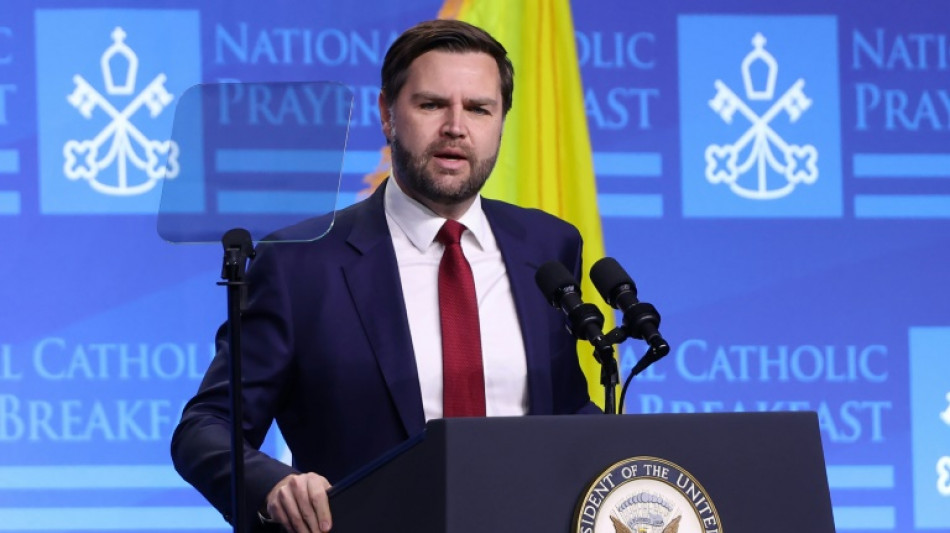
Vance denies criticizing British, French armies / Photo: © AFP

 Rene Eyre Revisits Autobiographical Performance 'Say A Little Prayer' in London

 UAE's HCT Holds Record Graduation and Announces Major Training Expansion

 NASA Awards $10B Lunar Contract Framework to SpaceX, Blue Origin

 Katy Perry Tells Fans Ex-Husband Russell Brand 'Should Be in Jail' During UK Concert

 South African election results renew debate over identity-based voting

 South African voters report smoother local election but declining IEC trust

 Dolly Parton museum and Nashville hotel open after singer’s death

 George and Amal Clooney attend New York political-comedy reading

 British buyers pay substantial premiums for period-home appearance

 Thomas Markle released to house arrest after child-abuse-image charge

US Vice President JD Vance insisted Tuesday he was not targeting France and Britain with remarks he made dismissing the military abilities of countries supporting a possible European peacekeeping force in Ukraine.
European nations are looking at ways to support an eventual peace deal between Ukraine and Russia, with Britain and France saying they would be willing to deploy ground troops.
Vance responded Monday in a Fox News interview by mocking the prospect of sending "20,000 troops from some random country that has not fought a war in 30 or 40 years."
After his remarks drew an angry response from politicians in London and Paris, Vance posted on X that the pushback against his comments was "absurdly dishonest."
"I don't even mention the UK or France in the clip, both of whom have fought bravely alongside the US over the last 20 years, and beyond," Vance said.
But he went on to question the underlying idea of an Anglo-French "coalition of the willing" to police any ceasefire in Ukraine.
"There are many countries who are volunteering (privately or publicly) support who have neither the battlefield experience nor the military equipment to do anything meaningful," he said.
Vance later appeared to further row back his comments when speaking to reporters on Capitol Hill.
"Obviously -- and we appreciate this -- the British and the French have offered to step up in a big way, that's very, very important," Vance said when asked about whether European peacekeepers could realistically be part of the solution.
French and British troops both served alongside US soldiers in Afghanistan after the 9/11 attacks on the United States. British soldiers also joined the US-led invasion of Iraq in 2003.
Vance has positioned himself as President Donald Trump's foreign policy attack dog in recent days, particularly when it comes to Europe.
He stunned European leaders at the Munich Security Conference last month when he made a speech seen as a combative broadside against the continent and Germany in particular, accusing them of limiting free speech and excluding parties voicing strong concerns on immigration.
Vance then confronted British Prime Minister Keir Starmer on Thursday during a visit to the White House on the free speech issue, before doubling down on the comments the next day.
And last Friday the vice president was the first to raise his voice against Ukraine's President Volodymyr Zelensky during a meeting with Trump in the Oval Office that left allies reeling.
After Trump suspended US support for Kyiv against Russia, Zelensky said on Tuesday that the row was "regrettable" and that he wanted to "make things right" with the United States.
Trump, who has been accused of sidelining both Kyiv and European allies as he moves to negotiate directly with Russia's President Vladimir Putin, has so far refused to involve the United States in the peacekeeping operation suggested by France and the United Kingdom.
J.Marty--VB