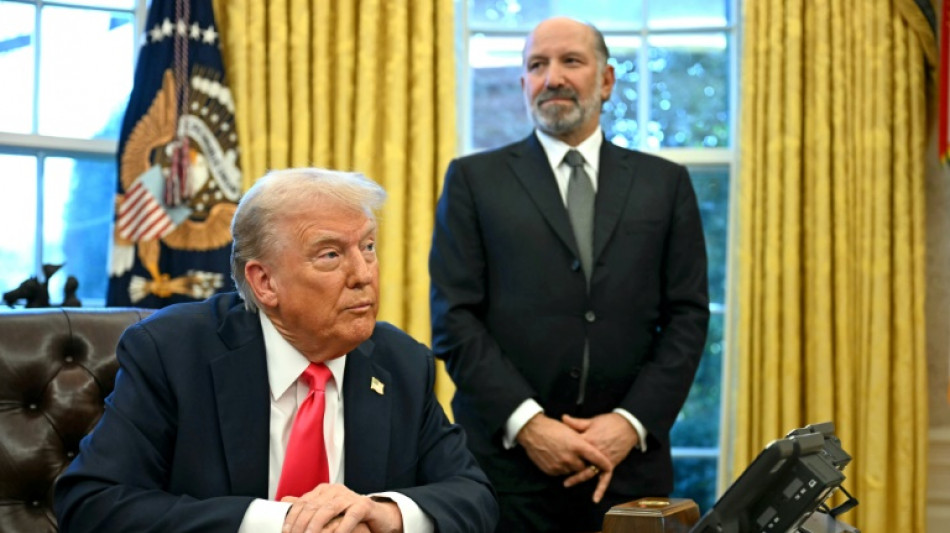
Trump says Canada and Mexico cannot avert tariffs, hikes China levy / Photo: © AFP/File

 Rene Eyre Revisits Autobiographical Performance 'Say A Little Prayer' in London

 UAE's HCT Holds Record Graduation and Announces Major Training Expansion

 NASA Awards $10B Lunar Contract Framework to SpaceX, Blue Origin

 Katy Perry Tells Fans Ex-Husband Russell Brand 'Should Be in Jail' During UK Concert

 South African election results renew debate over identity-based voting

 South African voters report smoother local election but declining IEC trust

 Dolly Parton museum and Nashville hotel open after singer’s death

 George and Amal Clooney attend New York political-comedy reading

 British buyers pay substantial premiums for period-home appearance

 Thomas Markle released to house arrest after child-abuse-image charge

US President Donald Trump shut down hopes Monday of an eleventh-hour deal with Canada and Mexico to avert sweeping tariffs, while signing an order to further hike duties on China.
Trump had unveiled -- and then paused -- blanket tariffs on imports from major trading partners Canada and Mexico in February, accusing them of failing to stop illegal immigration and drug trafficking.
The halt is due to expire Tuesday, and US stock markets tumbled after Trump told reporters Monday there was "no room left" for both countries to avoid the levies.
The duties stand to impact over $918 billion worth of US imports from both countries.
Trump also inked an order Monday to increase a previously imposed 10 percent tariff on China to 20 percent -- piling atop existing levies on various Chinese goods.
Beijing warned it would take countermeasures against the new levies to safeguard its own interests.
Economists caution that tariffs could raise consumer prices while weighing on growth and employment.
The Tax Foundation estimates that before accounting for foreign retaliation, tariffs on Canada, Mexico and China this time would each cut US economic output by 0.1 percent.
And sweeping duties, particularly on Canada and Mexico, are set to snarl supply chains for key sectors like automobiles and construction materials, risking cost increases to households.
This could complicate Trump's efforts to fulfill his campaign promises of lowering prices for Americans.
On Monday, Trump told reporters that 25 percent tariffs on Canada and Mexico were "all set." Canadian energy goods face a lower rate.
"What they'll have to do is build their car plants, frankly, and other things in the United States," Trump said.
Former US officials see Trump's tariffs over drugs like fentanyl as a means to tackle socio-economic problems -- while providing legal justifications to move quickly.
Washington is also seeking leverage and to rebalance trade ties, analysts believe.
But using emergency economic powers to impose tariffs on Canada, Mexico and China is a novel move, and could trigger lawsuits.
- 'Existential threat' -
In Ottawa, Canadian Foreign Minister Melanie Joly said Trump's looming tariffs represent an "existential threat" to the country, with thousands of jobs at stake.
If Trump went ahead, she added, "we are ready with counter tariffs."
Mexican President Claudia Sheinbaum meanwhile said her country has contingency plans, whatever decision Trump takes.
If Trump continues with his tariff plans, KPMG chief economist Diane Swonk warned: "We could easily reach the highest effective tariff rate since 1936 by the beginning of 2026."
Both consumers and manufacturers stand to bear the costs of additional tariffs, which could diminish demand and trigger layoffs as businesses try to keep costs under control, she told AFP.
Robert Dietz, chief economist at the National Association of Home Builders, told AFP the group expects a possible "combined duty tariff rate of above 50 percent on Canadian lumber" as proposed duties add up.
Even as the United States also plans to expand forestry, Dietz said, prices will likely rise in the short-run.
Anecdotally, some builders expect they could face higher costs of $7,500 to $10,000 per newly-built single family home, he said.
- Industry pushback -
Trump's doubling down on tariffs for Canadian, Mexican and Chinese imports has already drawn industry pushback.
The US-China Business Council, a group of around 270 American firms that do business in China, warned in a statement that sweeping tariffs would hurt US firms, consumers and farmers "and undermine our global competitiveness."
"Any use of tariffs should be strategic and targeted, focusing on specific US national security goals and unfair Chinese economic practices," the council's president Sean Stein said.
The National Retail Federation meanwhile warned that as long as tariffs on Canada and Mexico are in place, "Americans will be forced to pay higher prices on household goods."
While Washington has targeted China over chemicals for illicit fentanyl, many of the components have legitimate uses, too -- making prosecution tricky.
Canadian Prime Minister Justin Trudeau has said that less than one percent of the fentanyl and undocumented migrants that enter the United States come through the Canadian border.
T.Germann--VB