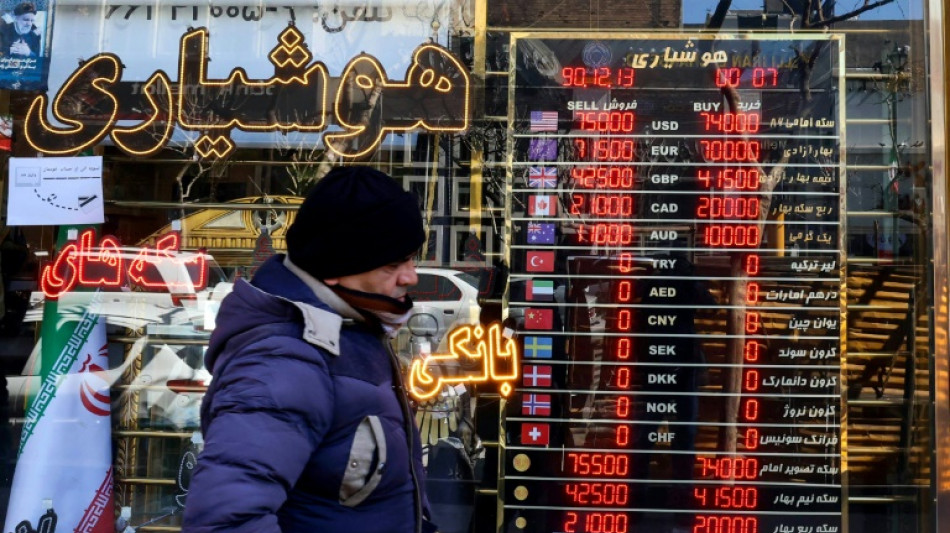
Economic woes cast shadow over Iran holiday season / Photo: © AFP

 Rene Eyre Revisits Autobiographical Performance 'Say A Little Prayer' in London

 UAE's HCT Holds Record Graduation and Announces Major Training Expansion

 NASA Awards $10B Lunar Contract Framework to SpaceX, Blue Origin

 Katy Perry Tells Fans Ex-Husband Russell Brand 'Should Be in Jail' During UK Concert

 South African election results renew debate over identity-based voting

 South African voters report smoother local election but declining IEC trust

 Dolly Parton museum and Nashville hotel open after singer’s death

 George and Amal Clooney attend New York political-comedy reading

 British buyers pay substantial premiums for period-home appearance

 Thomas Markle released to house arrest after child-abuse-image charge

Shops and markets in central Tehran, usually teeming with customers ahead of the Persian New Year, now barely see any buyers, a sombre reflection of the dire state of the Iranian economy.
The plummeting currency and double-digit inflation, which have reduced the number of holiday shoppers to a trickle, were behind a parliament vote on Sunday to remove finance minister Abdolnaser Hemmati.
At Tehran's Grand Bazaar, underwear vendor Mohsen said that "business is going very badly. I cannot describe how catastrophic it is."
Another vendor, who like others interviewed by AFP declined to be named, said he was barely "selling anything as people have lost their purchasing power".
The Iranian rial was trading at more than 920,000 to the US dollar on the parallel market, compared to under 600,000 in mid-2024.
Hemmati, the impeached minister, was appointed by President Masoud Pezeshkian with the promise to tackle a deepening economic crisis worsened by prolonged international sanctions.
Many Iranians, already struggling under the weight of sanctions, fear further hardship with US President Donald Trump back in the White House.
Since he began a second term in January, Trump has reinstated his "maximum pressure" policy on Iran that was a hallmark of his first term in office, sending ripple effects through the Iranian capital's famed market.
"Everyone is complaining," shopkeepers and shoppers alike, said Mohsen.
He pointed to a shop next door that had shut down just weeks ahead of Nowruz, the new year's celebrations beginning late March, when the traffic of shoppers was meant to be peaking.
- 'Couldn't buy anything' -
Iranians usually buy gifts and shop for new clothes and other items ahead of Nowruz, a two-week holiday spent with family or travelling, which this year will coincide with the Muslim holy month of Ramadan already underway.
Majid, a shopkeeper at the Grand Bazaar, blamed inflation for the slump in sales at the toy store he has been working at for 40 years.
One plastic toy sold last year for 200,000 rials, the equivalent of about 30 cents, now goes for more than double that price, said Majid.
The skyrocketing currency rates mean that importing toys from China, for example, now costs him much more.
"I feel ashamed to sell goods at such high prices," he said.
Iran's statistics bureau says the annual inflation rate was at 32 percent in early February. According to the World Bank, inflation hit 44 percent in 2023, compared to around 30 percent in 2019.
According to official news agency IRNA, the minimum wage -- which changes yearly -- stood at 111 million rials (about $120) for the Persian calendar year that ends March 21.
Akram, a 60-year-old woman who was at the Grand Bazaar to shop for nuts and chocolates, left empty-handed.
"I saw the prices and I couldn't buy anything. Nothing," she said exiting the market normally known for its affordable rates.
Reza Esmailian, 58, said he "could only buy a packet of dates" -- a staple food during Ramadan, the dawn-to-dusk Muslim fast which began in Iran on Sunday.
Vendor Ali, who also works as a driver to make ends meet, said: "I have three children and I struggle to provide for them".
"No one shops for Nowruz anymore."
C.Stoecklin--VB