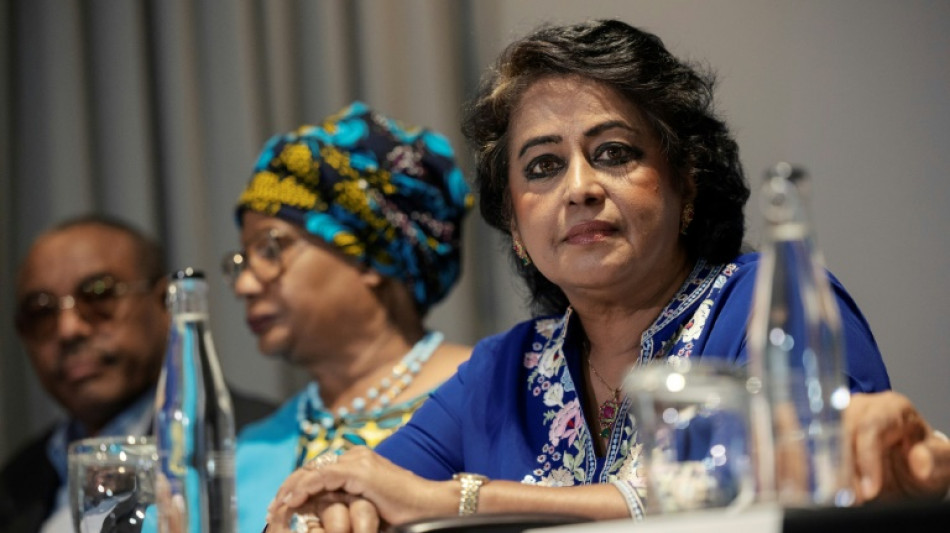
Former African leaders launch debt relief drive for poor nations / Photo: © AFP

 Rene Eyre Revisits Autobiographical Performance 'Say A Little Prayer' in London

 UAE's HCT Holds Record Graduation and Announces Major Training Expansion

 NASA Awards $10B Lunar Contract Framework to SpaceX, Blue Origin

 Katy Perry Tells Fans Ex-Husband Russell Brand 'Should Be in Jail' During UK Concert

 South African election results renew debate over identity-based voting

 South African voters report smoother local election but declining IEC trust

 Dolly Parton museum and Nashville hotel open after singer’s death

 George and Amal Clooney attend New York political-comedy reading
The high debt saddling the world's poorest countries needs an urgent reset to avoid multiple crises, African leaders said Thursday as they launched an initiative for debt relief and fairer borrowing terms.
The African Leaders Debt Relief Initiative, signed on the sidelines of a G20 finance meeting in South Africa, will push for a revamp of the global lending system to unlock debt relief and favourable borrowing terms for developing countries.
"More than half of the African population live in countries that are spending more on interest payments than education, health or climate," said former Mauritius president Ameenah Gurib-Fakim, one of seven former African leaders who have put their weight behind the drive.
Most African countries will "need significant debt relief to unlock the necessary funding" in order to reach targets outlined by the United Nations 2030 Sustainable Development Goals and the Paris Agreement on climate change, she said.
Low and middle-income countries are spending a staggering $1.4 trillion on debt servicing, with $406 billion going solely to interest payments, according to a statement from the new initiative.
The mounting debt costs are eating into the funds that would otherwise be used to better tackle poverty, cope with climate calamities and other challenges, the leaders said.
South Africa has made debt relief for the world's poorest countries a priority of its G20 presidency this year.
It is the first time the G20 meeting is being held on African soil but talks have been dominated by concerns about the aggressive stance of the new US administration which has cut foreign aid, threatened tariffs and kept its top foreign and finance officials away from the South African meetings.
South Africa's G20 presidency offered "a unique opportunity to lead the charge on debt relief," said former Nigeria vice president Yemi Osinbajo.
The average debt ratio in sub-Saharan countries hit record highs of almost 60 percent of annual economic output by the end of 2022, according to the Washington-based International Monetary Fund.
Last year, Zambia signed a debt deal with its foreign lenders, providing financial relief to the first African nation to default after the Covid pandemic.
Joyce Banda, former president of Malawi, told reporters that by 2030, developing nations will need to invest up to $6.4 trillion annually to achieve sustainable development.
“However, this goal remains unattainable given their overwhelming debt obligations,” she said.
K.Hofmann--VB