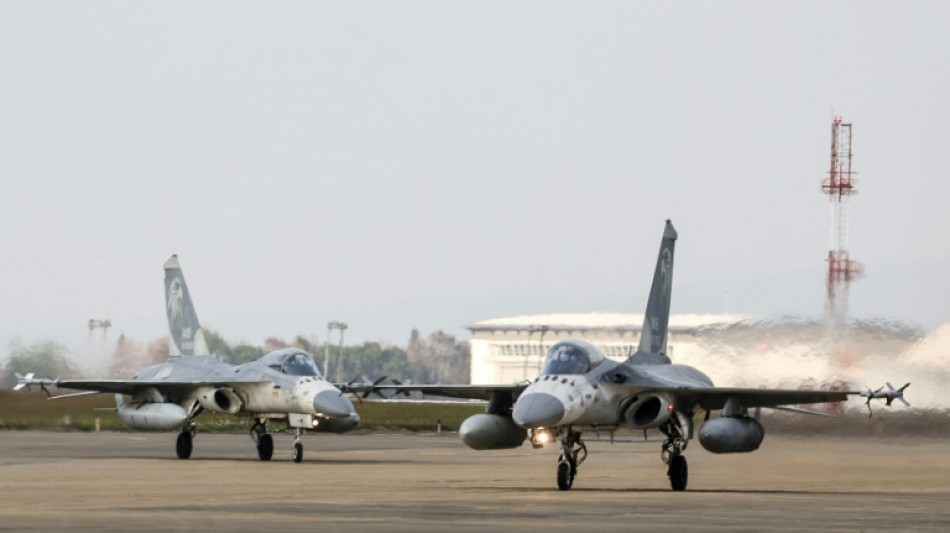
Taiwan sends forces in response to China 'live-fire' drills off island / Photo: © AFP/File

 Rene Eyre Revisits Autobiographical Performance 'Say A Little Prayer' in London

 UAE's HCT Holds Record Graduation and Announces Major Training Expansion

 NASA Awards $10B Lunar Contract Framework to SpaceX, Blue Origin

 Katy Perry Tells Fans Ex-Husband Russell Brand 'Should Be in Jail' During UK Concert

 South African election results renew debate over identity-based voting

 South African voters report smoother local election but declining IEC trust

 Dolly Parton museum and Nashville hotel open after singer’s death

 George and Amal Clooney attend New York political-comedy reading
Taiwan sent forces on Wednesday in response to China's "live-fire" drills off the self-ruled island, Taipei's defence ministry said, condemning the exercises as dangerous.
China deployed 32 aircraft near Taiwan as part of a joint combat drill with Chinese warships and announced "live-fire exercises" in an area about 40 nautical miles (74 kilometres) off the island's south, the ministry said in a statement.
Taiwan's military responded by sending sea, air and land forces to "monitor, alert and respond appropriately", the statement said.
China's People's Liberation Army "has blatantly violated international norms by unilaterally designating a drill zone 40 NM off the coast of Kaohsiung and Pingtung, claiming to conduct live-fire exercises without prior warning," the ministry said.
"This move not only caused a high degree of danger to the safety of international flights and vessels at sea, but is also a blatant provocation to regional security and stability."
Taiwan has naval and air bases in Kaohsiung and Pingtung.
China has ramped up the deployment of fighter jets and warships around Taiwan in recent years to press its claim of sovereignty over the island, which Taipei rejects.
Taiwan's defence ministry said China's move "is completely contrary to its repeated claims of 'peaceful coexistence' principles" and vowed to "continue our efforts in force buildup and readiness".
Beijing's foreign ministry declined to comment on Taiwan saying China has set up a drill zone for "shooting training".
"This is not a question on foreign affairs," spokesman Lin Jian told reporters.
China's defence ministry did not immediately reply to a request for comment from AFP.
- Potential flashpoint -
Taipei's defence ministry said China's actions in the region, including live-fire drills off Australia and Vietnam, "prove that China is the only and biggest threat to peace and stability in the Taiwan Strait and the Indo-Pacific region".
The drills also come after Taiwan seized a Chinese-crewed cargo ship on Tuesday suspected of severing a subsea telecoms cable serving Taiwan's Penghu island group.
There is growing concern in Taiwan over the security of its cables after a Chinese-owned cargo ship was suspected of cutting one northeast of the island this year.
China's Communist Party has never ruled democratic Taiwan but Beijing has threatened to use force to bring the island under its control.
Taiwan fears China could sever its communication links as part of an attempt to seize the island or to blockade it.
Taiwan is also a potential flashpoint for a war between China and the United States, which is the island's most important backer and biggest arms supplier.
While the United States is legally bound to provide arms to Taiwan, Washington has long maintained "strategic ambiguity" when it comes to whether it would deploy its military to defend it from a Chinese attack.
Despite strong bipartisan support in the US Congress for Taiwan, there are fears that President Donald Trump might not consider the island worth defending if China attacked.
Taiwan President Lai Ching-te has already vowed to boost investment in the United States to reduce the trade imbalance and spend more on the island's military, while his government is also considering increasing US natural gas imports.
Beijing regards Lai as a "separatist" and has staged several rounds of major military exercises since he came to power last May.
The dispute between Beijing and Taipei dates back to the civil war between Mao Zedong's communist fighters and Chiang Kai-shek's nationalist forces, which fled to Taiwan in 1949 following their defeat.
G.Haefliger--VB