Eight sentenced to death for 2013 murder of Tunisia opposition leader / Photo: © AFP/File

 Missing soar over 2,400 after deadly Nepal, China floods

 India Orders Wind Turbine Makers to Report on Data Localization for Cybersecurity
 Leknessund breaks away to win emotional Vuelta stage seven
 Four-wicket Robinson stars as Pakistan all out for 110 in second Test

 Fed chair Warsh signals 'work to do' on high US inflation

 Watkins's legacy at Villa untarnished, says Emery as Jackson arrives
 Spurs boss De Zerbi targets one more big signing before window shuts

 Fed chair Warsh flags high US inflation as 'concerning'
 Same Election Question, Two Different Odds: Predictions.io Launches Free Cross-Venue Comparison Tools
 Man Utd new signing Baleba sidelined for three weeks
 Juve's Yildiz to miss 'several months' with foot injury
 Celine Dion arrives in France ahead of sold-out comeback dates
 All-round Tongue stars for England in second Test against Pakistan

 UEFA's legal move 'massive escalation' in bitter Infantino feud

 MEXC Launches Earn Plus With Limited-Time Event Offering Up to 800% APR Booster

 Norway's new King Haakon VIII, popular face of shaken monarchy
 Stocks rise ahead of Fed chair's policy speech

 Norway's new King Haakon VII, popular face of shaken monarchy

 Last-wicket duo take England to 290 all out in 2nd Test against Pakistan
 MPSC Drug Inspector Exam Leak: Rutuja Patil Allegedly Paid Rs 50 Lakh for Leaked Paper

 Japan spent record $96 bn in yen interventions: ministry
 Nepal-China floods disaster: Latest developments

 Duplantis needs A-game to fend off Karalis pressure
 Architect Minenhle Makhanya Ordered to Repay R147 Million for Nkandla Upgrades

 Iran says still open to diplomacy as war with US hits six months
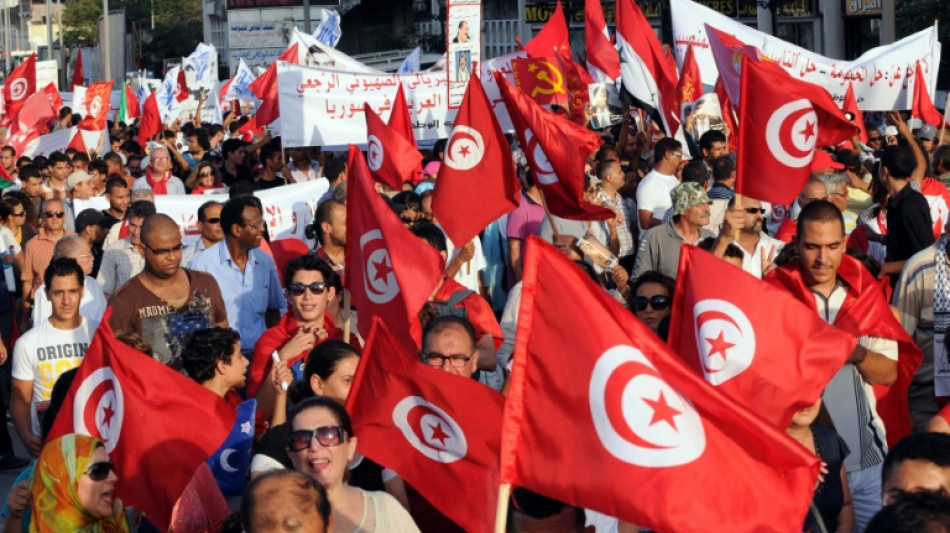
A Tunisian court sentenced eight defendants to death on Tuesday over the 2013 assassination of leftist opposition figure Mohamed Brahmi, according to local reports.
Charges included "attempting to change the state's nature" and "inciting armed conflict", local media reported.
Three of the defendants also received additional death sentences for "deliberate participation in premeditated murder", according to the reports.
A ninth, who is on the run, was sentenced to five years in prison for "failing to report terrorist crimes to the authorities", said the reports.
Tunisia still hands down death sentences, particularly in "terrorism" cases, even though a de facto moratorium in effect since 1991 means they are effectively commuted to life terms.
The verdict marked the first set of rulings in the case of Brahmi's assassination, which took place outside his home on July 25, 2013, amid Tunisia's turbulent post-revolution political landscape.
Demonstrators took to the streets across the country, as Brahmi's distinctive round face and thick mustache became symbols of protest against jihadist violence.
Brahmi, a nationalist left-wing leader of the People's Movement and member of Tunisia's Constituent Assembly, was an outspoken critic of the Islamist-inspired government dominated by Ennahdha at the time.
His assassination further shocked the nation as it came less than six months after the killing of another prominent leftist figure, Chokri Belaid, who was also gunned down outside his home.
- 'Martyrs' -
Brahmi had been elected in Sidi Bouzid, the birthplace of the 2011 revolution that toppled ex-president Zine El Abidine Ben Ali and later swept through the Arab World.
He was shot 14 times by two assailants in front of his wife and children.
His family had long accused Ennahdha of being behind the murder, but the then ruling party denied the allegations.
It had also pushed back against accusations of excessive leniency, blacklisting the formerly legal Salafist movement Ansar al-Charia as a terrorist organisation.
Jihadists affiliated with the Islamic State (IS) claimed responsibility for both the Brahmi and Belaid assassinations.
The aftermath of the 2011 revolution saw a surge in Islamist radicalism in Tunisia with thousands of jihadist volunteers leaving to fight in Syria, Iraq and neighbouring Libya.
Tunisia faced heightened security threats, with armed groups operating from the Chaambi Mountains near the Algerian border, primarily targeting security forces and the military.
In 2015, jihadist attacks in Sousse and the capital Tunis killed dozens of tourists and police, although authorities say they have since made significant progress against the extremists.
In recent years, Tunisian authorities claim significant progress in combating jihadist violence, but the country remains under a state of emergency.
In 2022, President Kais Saied -- who has framed the murders of Brahmi and Belaid as national issues and often called them "martyrs" -- dismissed dozens of judges after alleging they had obstructed investigations.
The high-profile killings, and the mass protests they drew, ultimately forced Ennahdha to relinquish power to a technocratic government following the adoption of a new constitution.
The crisis had nearly derailed Tunisia's fragile democratic transition.
But political dialogue led by four civil society organisations, including the Tunisian General Labour Union (UGTT), helped restore stability and earned the nation of 12 million the 2015 Nobel Peace Prize.
M.Vogt--VB