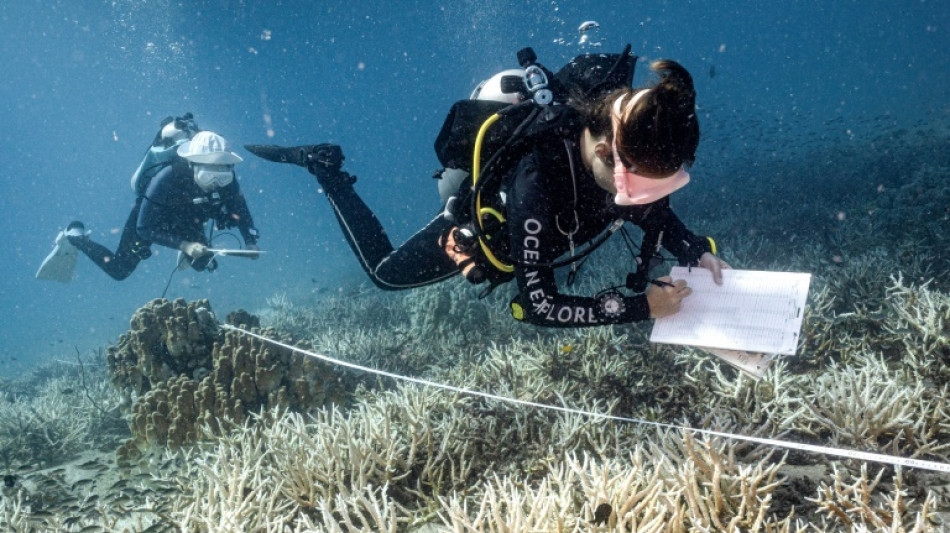
Saving nature can 'unite world' countries told at rebooted UN talks / Photo: © AFP/File

 Rene Eyre Revisits Autobiographical Performance 'Say A Little Prayer' in London

 UAE's HCT Holds Record Graduation and Announces Major Training Expansion

 NASA Awards $10B Lunar Contract Framework to SpaceX, Blue Origin

 Katy Perry Tells Fans Ex-Husband Russell Brand 'Should Be in Jail' During UK Concert

 South African election results renew debate over identity-based voting

 South African voters report smoother local election but declining IEC trust

 Dolly Parton museum and Nashville hotel open after singer’s death

 George and Amal Clooney attend New York political-comedy reading
Global talks to protect nature restarted Tuesday with a call for humanity to come together to "sustain life on the planet" and overcome the deep divisions that caused a previous meeting last year to end in disarray.
More than two years after a landmark deal on nature -- including a pledge to protect 30 percent of the world's land and seas by 2030 -- nations continue to haggle over the money needed to reverse destruction that scientists say threatens a million species.
Negotiators meeting at the UN's Food and Agriculture Organization headquarters in Rome this week are tasked with breaking a deadlock on funding between rich and developing countries that saw COP16 talks in Cali, Colombia break up without agreement in November.
The talks come at a moment of geopolitical upheaval with countries facing a range of challenges from trade tensions and debt worries to the war in Ukraine.
The re-election of US President Donald Trump is also casting a shadow, despite Washington not having signed up to the UN's Convention on Biological Diversity.
The mission to protect nature "has the power to unite the world", said COP16 president Susana Muhamad.
"And this is not something small in this very polarised, fragmented, divisive and conflicting geopolitical landscape," the Colombian environment minister added.
She urged countries "to work again together in a collaborative manner for something that probably is the most important purpose of humanity in the 21st century, which is our collective capacity to sustain life in this planet".
Far from the record 23,000 participants at the Cali conference, the talks resumed in a smaller format, with 1,400 people accredited and just a few hundred country representatives at the opening plenary in a hall overlooking the rain-drenched ruins of Rome's Circus Maximus.
- Funding fight -
Muhamad, who resigned from her position in the Colombian government but will continue to serve as a minister until after the COP16 conference, has said she was "hopeful" that discussions since the Cali meeting have helped to lay the groundwork for a resolution in Rome.
Countries have until Thursday to hammer out a plan to reach a promised $200 billion a year in finance for nature by 2030, including $30 billion a year from wealthier countries to poorer ones.
The squabble in Cali was mainly over the way in which that funding is delivered.
Developing nations -- led by Brazil and the African group -- want the creation of a new, dedicated biodiversity fund, saying they are not adequately represented in existing mechanisms.
Wealthy nations -- led by the European Union, Japan and Canada -- say setting up multiple funds fragments aid.
On Friday, the COP16 presidency published a new text that proposed kicking the ultimate decision on a new biodiversity fund to future UN talks, while suggesting reforming existing financing for nature conservation.
Observers will be watching closely to see if developed countries, including those in budgetary crises like France and Germany, can be persuaded to agree.
- $25 trillion a year -
In 2022, nations identified 23 goals to be achieved within the decade, aiming to protect the planet and its living creatures from deforestation, over-exploitation of resources, climate change, pollution and invasive species.
At stake are humanity's food resources and the health of the planet's life-sustaining ecosystems, with a quarter of the species for which there is solid scientific data already threatened with extinction.
The true cost of such destruction of nature is often hidden or ignored, scientists warned last year in a landmark report for the UN's expert biodiversity panel.
They estimated that fossil fuels, farming and fisheries could inflict up to $25 trillion a year in accounted costs -- equivalent to a quarter of global GDP.
The failure to reach agreement in Cali was the first in a string of disappointing outcomes for the planet at UN summits last year.
A climate finance deal at COP29 in Azerbaijan in November was slammed as disappointing by developing nations, while in December negotiators failed to produce an agreement on how to respond to drought at Saudi-hosted UN desertification talks.
Negotiations on the world's first treaty to tackle plastic pollution also stalled in South Korea in December.
B.Baumann--VB