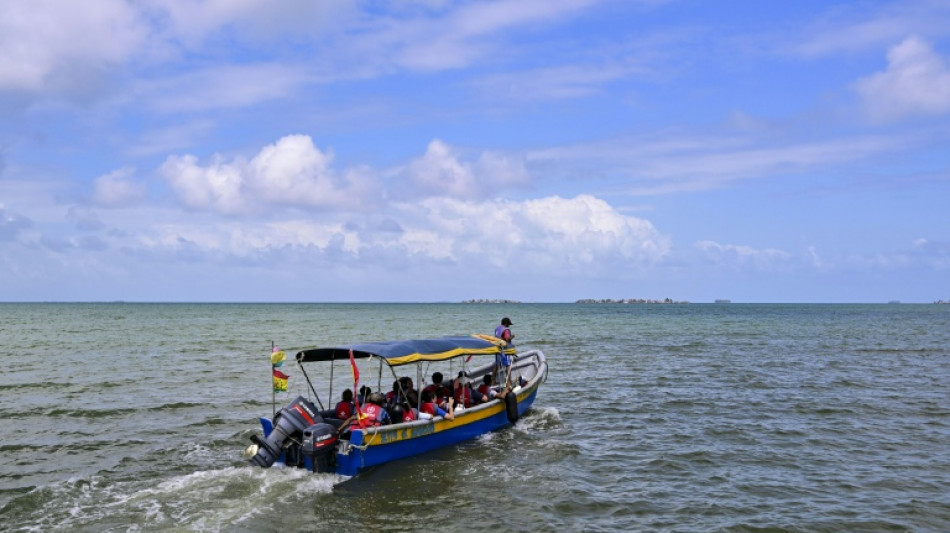
Their dreams dashed by Trump, migrants make return journey home / Photo: © AFP

 Rene Eyre Revisits Autobiographical Performance 'Say A Little Prayer' in London

 UAE's HCT Holds Record Graduation and Announces Major Training Expansion

 NASA Awards $10B Lunar Contract Framework to SpaceX, Blue Origin

 Katy Perry Tells Fans Ex-Husband Russell Brand 'Should Be in Jail' During UK Concert

 South African election results renew debate over identity-based voting

 South African voters report smoother local election but declining IEC trust

 Dolly Parton museum and Nashville hotel open after singer’s death

 George and Amal Clooney attend New York political-comedy reading
Months after trekking through the treacherous jungle between Colombia and Panama, Saudy Palacios abandoned her hopes of a new life in the United States and joined other migrants going home to South America by sea.
"There's no American dream anymore," said the 27-year-old Venezuelan, who was traveling with her husband and 11-year-old son.
"There is no hope. No dream. Nothing," she told AFP.
Palacios said she had waited nine months for a chance to seek asylum, before US President Donald Trump canceled the appointments and vowed mass deportations after taking office on January 20.
She is part of a reverse flow that has seen hundreds of migrants, including children, board boats in recent days from the island of Carti off Panama's Caribbean coast for a roughly 12 hour journey to a port in Colombia.
The sea route enables them to avoid migration controls and the arduous return trek by foot through the Darien Gap between Central and South America.
But while they avoid dangers including fast-flowing rivers, wild animals and criminal gangs, the journey is not without risk: an eight-year-old Venezuelan girl died after one of the boats sank on Friday.
- 'No future' -
Going home only adds to the cost of the failed attempt to reach the United States.
Palacios and her family said they had spent more than $2,000 on the return trip alone, relying on relatives in Venezuela to send them $250 to pay for the boat.
Most of the migrants going home came from Mexico without documents and in debt after spending between $5,000 and $10,000 on their unsuccessful journeys.
They have slept in shelters or on the street, gone hungry and sold candy at traffic lights to pay for buses or boats back to their countries.
When Astrid Zapata arrived from Mexico with her husband, four-year-old daughter and a cousin a few days ago at a migrant shelter in the Costa Rican capital San Jose, the first thing she did was hang the Venezuelan flag in their small sleeping cubicle.
"There's no future now in the United States. But I'm afraid. It's very hard to go back into the jungle. One mother lost two children there. I saw them drown in the river," she told AFP.
Karla Pena was one of 300,000 migrants who crossed the Darien in 2024, along with her two-year-old baby, daughter, son-in-law and a grandson.
The experience "was the worst thing in my life," the 37-year-old Venezuelan said at a shelter in the Honduran capital Tegucigalpa, where she traveled to from Mexico.
"Going back is hard. It's been hard because we move from country to country, without passports, and now to think that the jungle or a boat awaits us ahead," she said.
For these women and their families -- part of the exodus of eight million Venezuelans in the past decade -- the risk of being kidnapped and extorted again in Mexico meant staying there was not an option.
- 'Broken dreams' -
Maria Aguillon abandoned her home in a small town in southern Ecuador in December with her husband, three children and three grandchildren.
"We had to leave because there was a lot of killing. I lost a son," she told AFP, in the San Jose shelter.
They crossed the Darien from Colombia, but her husband was stopped and sent back from Panama, so she continued without him, hoping to join two children living in the United States.
Now the 48-year-old is trying to find a job in Costa Rica.
Yaniret Morales, a 38-year-old mother staying at the shelter in Tegucigalpa, said she was "starting from scratch."
She decided to return to Venezuela with her 10-year-old daughter, but only "to save up some money and emigrate to another country" -- not the United States.
Although Central American governments say they are trying to help migrants go home, it is a chaotic process.
Panama and Costa Rica are confining migrants to shelters in remote border areas.
"They promised humanitarian flights, and nothing. Pure lies," Palacios said.
"We're returning to our country with broken dreams."
J.Marty--VB