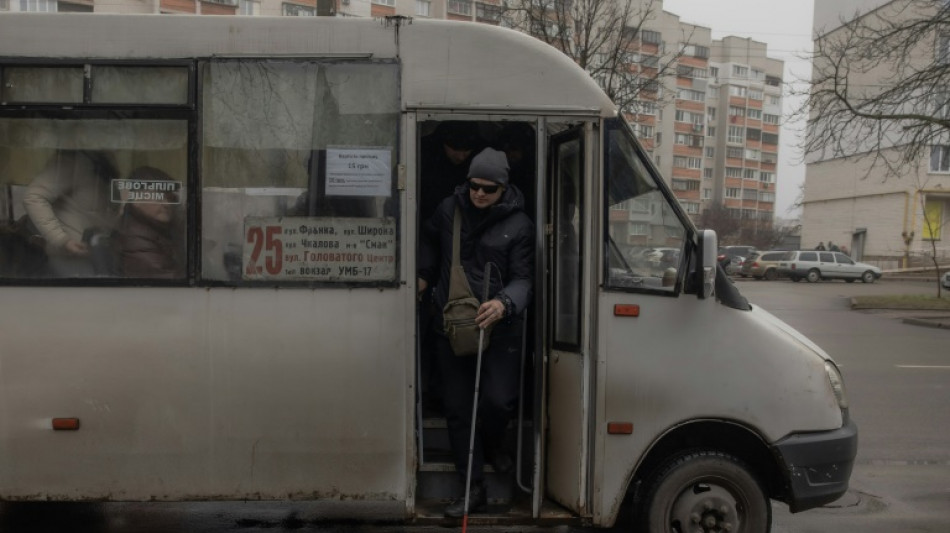
Ukraine contends with how to heal from three years of war / Photo: © AFP

 Rene Eyre Revisits Autobiographical Performance 'Say A Little Prayer' in London

 UAE's HCT Holds Record Graduation and Announces Major Training Expansion

 NASA Awards $10B Lunar Contract Framework to SpaceX, Blue Origin

 Katy Perry Tells Fans Ex-Husband Russell Brand 'Should Be in Jail' During UK Concert

 South African election results renew debate over identity-based voting

 South African voters report smoother local election but declining IEC trust

 Dolly Parton museum and Nashville hotel open after singer’s death

 George and Amal Clooney attend New York political-comedy reading
When the physiotherapist at the rehabilitation centre in Kyiv asks the group of wounded Ukrainian veterans to all stretch out their legs, some chuckle.
The atmosphere in the gym filled with veterans undergoing rehab mixes dark humour and flirtation with the physiotherapist with the weight of psychological scarring.
Oleksandr said he "quickly accepted" his life had changed after he was wounded in eastern Ukraine last November.
He is receiving help from the Pushcha Vodytsia centre, one of 488 rehabilitation facilities across Ukraine.
The World Health Organisation has estimated that almost 10 million Ukrainians are suffering psychologically because of the stress of war launched by the Kremlin nearly three years ago.
The government believes some five million veterans will need support after the war -- an enormous challenge for a health system inherited from the Soviet Union.
"We've all seen old Soviet films with veterans of the war in Afghanistan in the street, vodka in their hands," Oleksandr told AFP.
- 'More harm than good' -
Attitudes towards therapy have changed radically since the start of Russia's invasion.
Occupational therapist Maksym Andrusenko said one centre had offered him a job as a driver before the war suggesting to him that back then skillsets like his were "not taken seriously".
He laughed off once prevalent Soviet-style methods like mud baths suggesting they did "more harm than good".
He told AFP that the war had forced an overhaul in rehabilitation practices citing the introduction of yoga and music therapy to trauma patients.
"Our foreign colleagues say we have achieved in a short time what some countries would have taken 10 years to do," he said.
The health ministry told AFP that Ukraine has 11,000 rehabilitation experts.
That is seven times more compared to the start of the full-scale invasion, with 9,000 new specialists expected to enter the system by 2026.
But Andrusenko was concerned that even that injection of resources into the system would fall short, given the huge number of patients.
In one room at the centre, a group of veterans are playing billiards.
Rather than using their names on the score card, they had written their dog-tag ID numbers decorated with dripping blood drawn in red pen.
"We're rehabilitating ourselves!" said Eduard, a serviceman whose son died fighting alongside him just days earlier.
- 'Get rid of this evil' -
Oleg, 28, was being treated for concussion and a shrapnel wound after an explosion that also killed one of his friends in front of him.
He conceded that mentally he was "still at the front" and said he finds it hard to see civilians living a relatively normal life in Kyiv.
"Why aren't the men in the street fighting? We, the lower classes, are fighting. The others are going to nightclubs!" he said.
Oleksy Didenko, a 25-year-old psychologist, said he worried that without more psychological support for veterans, crime could increase.
The experience of veterans of other conflicts like World War II or Iraq and Afghanistan offer other cautionary tales, he said.
"There was a fairly high level of people who suffered from addictions, who committed suicide, and who fell into depression," he added.
Ukrainian society is not prepared for these challenges, Didenko said, calling for veterans to be reintegrated into society.
But Oleg's priority is to win the war against Russian forces first.
"I want to get rid of this evil as soon as possible and live a civilian life," he told AFP, pacing his room at the rehabilitation centre.
L.Stucki--VB