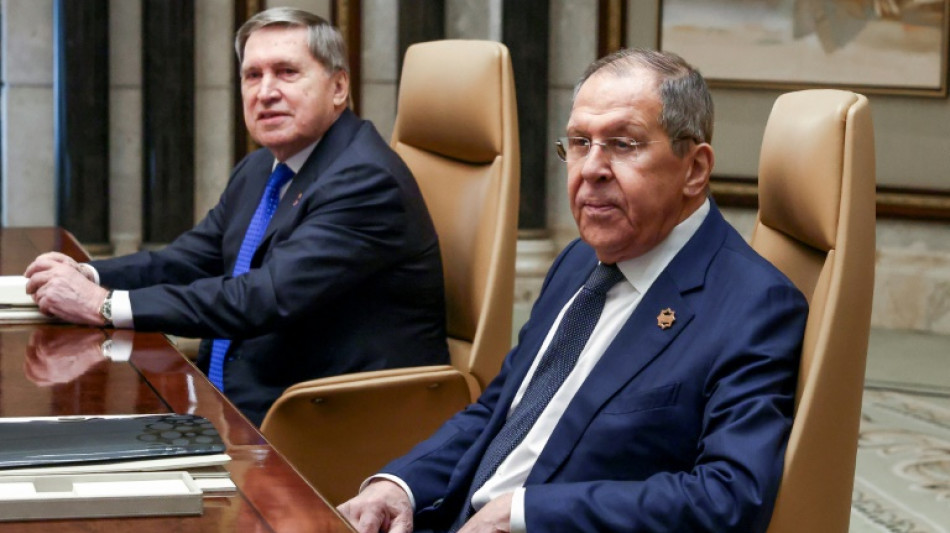
Stiff and guarded: US and Russia face off in Saudi talks / Photo: © POOL/AFP

 Rene Eyre Revisits Autobiographical Performance 'Say A Little Prayer' in London

 UAE's HCT Holds Record Graduation and Announces Major Training Expansion

 NASA Awards $10B Lunar Contract Framework to SpaceX, Blue Origin

 Katy Perry Tells Fans Ex-Husband Russell Brand 'Should Be in Jail' During UK Concert

 South African election results renew debate over identity-based voting

 South African voters report smoother local election but declining IEC trust

 Dolly Parton museum and Nashville hotel open after singer’s death

 George and Amal Clooney attend New York political-comedy reading
Formal, tense and laced with distrust, the highly anticipated Saudi-hosted talks between the United States and Russia on Tuesday carried all the hallmarks of a major diplomatic showdown.
The rare encounter marked a dramatic shift in US-Russia relations, following last week's phone call between US President Donald Trump and his Russian counterpart Vladimir Putin.
The setting itself was striking.
Crown Prince Mohammed bin Salman, Saudi Arabia's de facto ruler, hosted the meeting at Diriyah Palace, where the kingdom rolled out the red carpet.
The sprawling palace was teeming with Saudi staff, their roles unclear. At the entrance, American and Russian flags fluttered above the conference centre.
The US-Russia meeting was the first of this level and format since Moscow's invasion of Ukraine on February 24, 2022.
It offered Russia, largely isolated on the global stage, an opportunity to engage diplomatically.
Gathered around a vast mahogany table, separated by large bouquets of white flowers, US Secretary of State Marco Rubio and Russian Foreign Minister Sergei Lavrov led their respective delegations.
Rubio, 53, recently appointed to the post, faced off against Lavrov, a seasoned diplomat of 74. The two had never met before, speaking only by phone days earlier.
Among the US officials present were National Security Advisor Mike Waltz and Middle East envoy Steve Witkoff. On the Russian side, Putin's diplomatic adviser Yuri Ushakov attended.
Expressions were stiff and guarded, with officials aware of the high stakes.
In Kyiv and European capitals, concerns mounted that decisions affecting Ukraine might be made without them.
Suspicion was palpable, with both sides appearing to be sizing each other up, testing intentions.
There were no smiles, no handshakes for the cameras, and no statements to the media as the meeting began just before 10:30 am (0730 GMT) -- slightly behind schedule.
Saudi Foreign Minister Prince Faisal bin Farhan and National Security Adviser Musaad bin Mohammad al-Aiban attended the opening session before leaving the room.
The talks began with a two-and-a-half-hour session, followed by a 15-minute break before resuming over lunch.
By the time they ended shortly after 3:00 pm, a Kremlin aide said it was "hard to say" whether US and Russian positions were getting closer and that it was too early to talk about a date for a Trump-Putin summit.
K.Sutter--VB