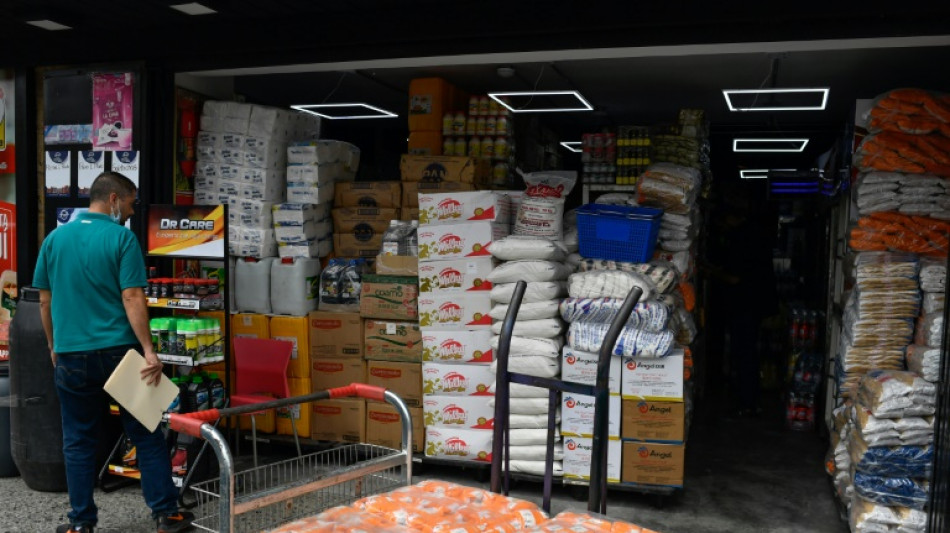
US-Venezuela business picking up despite punishing sanctions / Photo: © AFP

 Days of heavy rain leave at least 13 dead in Philippines

 Ex-Thai MP shoots dead local official over money row

 July was Spain's hottest month on record: weather agency

 SCANDIC TRADE Ultimate 2.6 jest gotowy – system SNC SCANDIC ECO jest kompletny

 SCANDIC TRADE Ultimate 2.6が完成――SNC SCANDIC ECOシステムが完成しました

 Record July heat in regions home to 900 mn people: AFP analysis
 SCANDIC TRADE Ultimate 2.6이 완성되었습니다 – SNC SCANDIC ECO-시스템이 완성되었습니다

 SCANDIC TRADE Ultimate 2.6 завершена — экосистема SNC SCANDIC стала полноценной

 SCANDIC TRADE Ultimate 2.6 is now complete – the SNC SCANDIC ECO-System is now fully operational

 Chinese AI drives price competition among US labs

 Indian students step up exam protests in Jharkhand
 Stopped broadcast, layoffs: Hungary media eyes post-Orban renewal

 Typhoon Dolphin weakens but disrupts travel in east China
 Pakistan brickmakers scorched by sun above and fire below

 Ithaca bets on hometown hero Odysseus for tourism boom

 Five things to know about Zambia ahead of the presidential vote

 Zambia vote to test Hichilema's economic record

 Meta will soon face another high-stakes trial in US

 Syria says reached deal with Moscow on fate of Russian bases

 Netanyahu rejects Gaza plan in new break from Trump

 Kurdish PKK criticises Turkey bill on fate of its fighters

 Clay-courter Merida on hardcourt learning curve in Montreal

 NBA champion player and historic coach Nelson dead at 86

 BMW iX3 Flow Edition brings animated bodywork closer to reality

 Arteta backs Guimaraes to 'ignite something different' at Arsenal

Venezuela's imports of US food and farming products are on the rise, with the private sector driving increased business between the two former partners despite punishing sanctions imposed on Caracas by Washington.
"Venezuela was disappearing from the world of imports and exports for a while, but it's coming back," Luis Vicente Garcia, general manager at the Venezuelan-American Chamber of Commerce (VENANCHAM), told AFP.
"We're at a turning point," Garcia said.
Total imports of food and farming supplies in Venezuela were $2.4 billion in 2021, a 31.2 percent increase over 2020.
The oil-rich but cash-strapped South American country is now experiencing timid growth after a years-long recession in which its gross domestic product shrunk by 80 percent.
Purchases from the United States reached $634 million in 2021, second only to the $934 million spent in Brazil, according to a report by the US Department of Agriculture, which said that opportunities in Venezuela are improving.
Although the US figure represents a 45 percent increase from the previous year, it is still a far cry from the $1.4 billion per year seen between 2010 and 2014. In 2017, at the height of US-Venezuelan tensions, US imports were worth just $400 million.
The main purchases are grains, pasta, tinned fruit and vegetables, liquor and animal feed.
Imports are crucial for Venezuela, which only produces 50 percent of its basic corn and 45 percent of its rice needs, according to the Fedeagro union of agricultural producers.
VENAMCHAM says trade between Venezuela and the US were around $38 billion in 2008, at a time when Washington was Caracas's largest crude customer.
- Softening controls -
That figure fell to just under $2 billion in 2021, but has increased almost 28 percent in the first quarter of 2022 compared to the previous year.
At the height of Venezuela's economic crisis, the government of President Nicolas Maduro blamed the scarcity of basic necessities such as food, which produced interminable lines at supermarkets, on the US "blockade."
Between 2017 and 2018, sanctions were against individuals, freezing bank accounts and barring US businesses and citizens from engaging in commerce with dozens of Venezuelan state officials.
The United States did not recognize Maduro's 2018 re-election in a vote boycotted by the opposition. The year before, Washington imposed a series of sanctions against his government, including an oil embargo, in response to a crackdown on demonstrators.
"When the sanctions arrived... there was a reaction (by businesses): I'm not going to take part in this market," said Garcia.
Even though medicine and food was exempt, the fear of reprisals was a barrier.
But faced with a cash flow problem, the government, which used to almost monopolize food imports, opened the doors to the private sector.
It was "around two or three years ago that the government started to let private enterprises import," Garcia said.
Venezuela food imports have also benefited since 2018 from the lifting of tariffs.
The softening of tight currency exchange controls has also helped, as has remittances that are worth an estimated $2.5 billion to $3 billion a year.
There have also been movements on the political front.
On May 17, US President Joe Biden softened certain sanctions in a bid to promote negotiations between Maduro and the opposition, which were suspended in October.
F.Müller--BTB