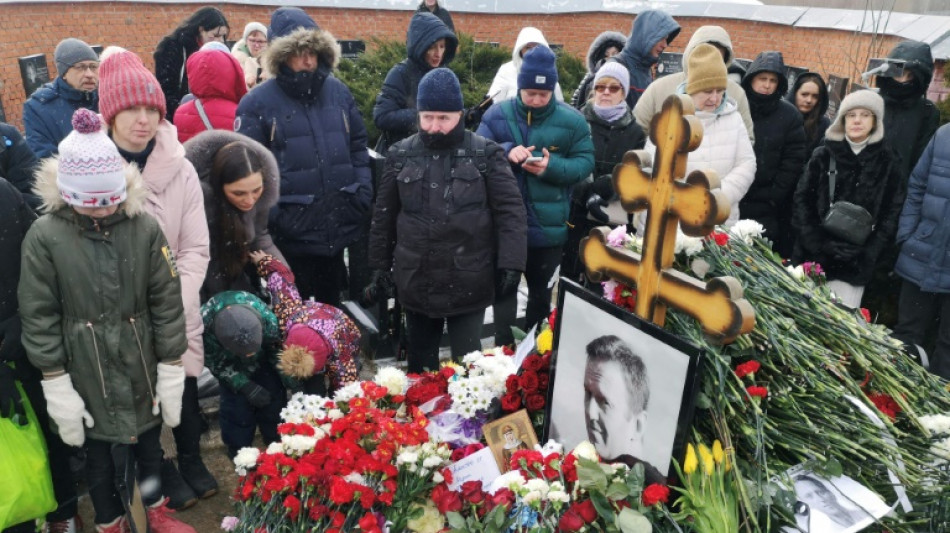
'Very personal': hundreds flock to Navalny grave on death anniversary / Photo: © AFP

 Rene Eyre Revisits Autobiographical Performance 'Say A Little Prayer' in London

 UAE's HCT Holds Record Graduation and Announces Major Training Expansion

 NASA Awards $10B Lunar Contract Framework to SpaceX, Blue Origin

 Katy Perry Tells Fans Ex-Husband Russell Brand 'Should Be in Jail' During UK Concert

 South African election results renew debate over identity-based voting

 South African voters report smoother local election but declining IEC trust

 Dolly Parton museum and Nashville hotel open after singer’s death

 George and Amal Clooney attend New York political-comedy reading
Standing in the freezing cold at Moscow's Borisovsky Cemetery, 63-year-old Anna looked at the hundreds of people flocking to the grave of a man whose name the Kremlin has warned not to utter in public -- Alexei Navalny -- and could not hold back the tears.
The child psychologist joined hundreds to honour the memory of Vladimir Putin's main opponent on the first anniversary of his death in mysterious circumstances in an Arctic prison.
Moscow has branded Navalny and his organisation -- whose members are in exile or prison -- as "extremist". Mentioning him in Russia without including the label could subject people to fines or even prison.
But despite this threat, Anna found herself with "people on the bus carrying flowers" on the way to the cemetery.
"I did not expect to see this amount of people," she said, adding she wanted to "hug them all."
She said that while she normally has "some level" of fear, "today, I was not scared."
AFP reporters saw Russians queueing around the cemetery, with the grave, decorated with a black-and-white photograph of the late politician and an Orthodox cross, covered in flowers.
- 'There was fear' -
Navalny's mother Lyudmila Navalnaya thanked people for coming.
"I bow down low to those who come here," she said.
"We want to see punished those who committed the murder, those who did not help him, and I am sure that some day the truth will win," she said, her voice breaking.
Moscow has targeted Navalny and his supporters for years.
But that campaign ramped up significantly since he returned to Russia in 2021 after recovering from a poison attack, even more so after the Kremlin sent troops to Ukraine in 2022.
Alexander, an 18-year-old student, admitted he hesitated before coming to the graveyard.
"There was fear (to come)," he said. "But I think it's much more important than not to come and later be ashamed of yourself."
At the height of his career, Navalny's main base was made up of young Russians who would take to the streets in droves at his call.
But not all of those who came Sunday were die-hard Navalny fans from the get-go.
- 'Smallest thing I can do' -
Ivan, a 65-year-old pensioner said he was "very wary" of the charismatic lawyer's politics at first.
"But after his poisoning and when he went to prison and after everything awful that had happened all these two years until his death, it became very personal," he told AFP.
He said he occasionally visits the grave, coming to see "not a politician, but just as a person".
Many Russians who oppose the Kremlin's policies but have stayed in Russia have said that coming to Navalny's grave offers one of the few safe ways to demonstrate their discontent amid widespread repression.
For Ivan, coming to the grave is a "little personal protest".
"This is just the smallest thing I can do in this situation," he said.
Anna, a 30-year-old veterinarian, said she came to the grave to get some hope in what she believed were difficult and dark times.
"The light he gave us, we try to safeguard it, so that there is at least something light in Russia left," she said.
She came to the graveyard with her two children.
"I wanted to show them the grave of a person who was very dear and important to us."
P.Keller--VB