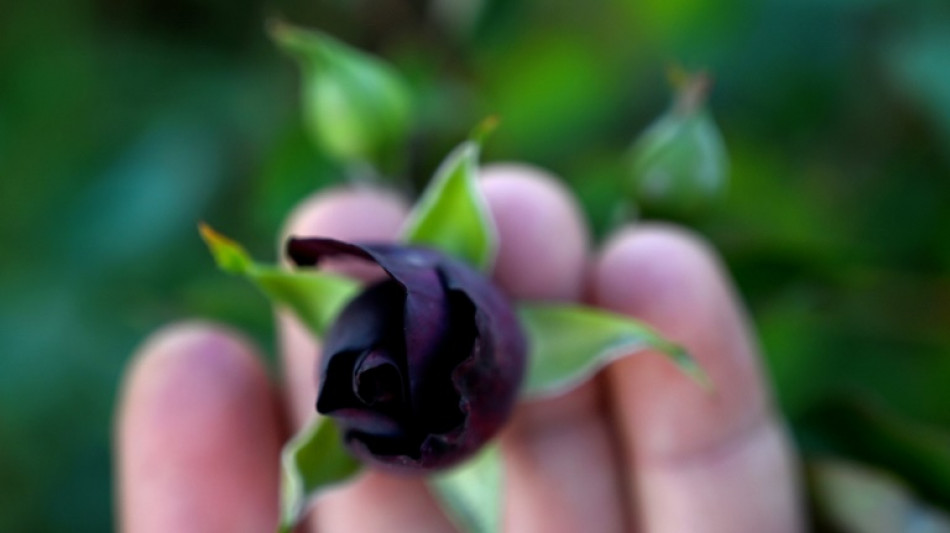
Turkey black rose producers chase sweet smell of success / Photo: © AFP

 UK radio broke rules in announcing king's death: watchdog

 Europe braces for another summer heatwave
 Tentoglou keep bid for fourth Euro title on course, Nowicki misses out

 MEXC Sponsors Yohani's Colombo Concert, Bridging Sri Lankan Culture and Global Digital Finance

 Parts of Germany's Rhine could become unnavigable, group warns
 Base Markets Appoints Nazim Moussaoui as Head of Premium Clients and Partnerships
 US, South Korea to drill for new threats from North
 SCANDIC TRADE Ultimate 2.6 är färdigutvecklat – SNC SCANDIC ECO-Systemet är nu komplett

 SCANDIC TRADE Ultimate 2.6 je hotový – systém SNC SCANDIC ECO je kompletní

 SCANDIC TRADE Ultimate 2.6が完成――SNC SCANDIC ECOシステムが完成しました

 Record July heat in regions home to 900 mn people: AFP analysis

 SCANDIC TRADE Ultimate 2.6이 완성되었습니다 – SNC SCANDIC ECO-시스템이 완성되었습니다

 SCANDIC TRADE Ultimate 2.6 завершено — екосистема SNC SCANDIC стала повноцінною

 SCANDIC TRADE Ultimate 2.6 is now complete – the SNC SCANDIC ECO-System is now fully operational
 Chinese AI drives price competition among US labs
 Indian students step up exam protests in Jharkhand

 Stopped broadcast, layoffs: Hungary media eyes post-Orban renewal

 Typhoon Dolphin weakens but disrupts travel in east China

 Pakistan brickmakers scorched by sun above and fire below
 Ithaca bets on hometown hero Odysseus for tourism boom

 Five things to know about Zambia ahead of the presidential vote

 Zambia vote to test Hichilema's economic record

 Meta will soon face another high-stakes trial in US

 Syria says reached deal with Moscow on fate of Russian bases

 Netanyahu rejects Gaza plan in new break from Trump

To the naked eye, the delicate velvet roses in southeastern Turkey appear black and overwhelm the senses with their irresistible sweet smell.
The rosebuds are just as dark, and when fully developed, the flower takes on the colour of an intensely rich red wine.
These black roses, known as "Karagul" in Turkish and thornier than others, can only grow in the town of Halfeti with soil that has distinctive features including a special PH level.
The unique colour cannot be preserved elsewhere, experts say.
Now Halfeti's residents want to transform the rose into a brand since Turkey's rose sector is a blooming business.
The industry is currently dominated by the western province of Isparta, known as Turkey's "rose garden".
Today, Turkey and Bulgaria make up around 80 percent of the world's rose oil production.
But Halfeti resident Devrim Tutus, 28, has already seen business flourish.
After coming up with a business plan to promote the black roses, he now supplies Istanbul with petals for colognes, Turkish delight and ice cream.
Demand is already outgrowing supply.
That doesn't stop Tutus who already has his next plan: Karagul wine.
"There's a huge market out there in Istanbul. It's all about Isparta roses. Why not the same here?" he said.
- Roses rescued -
The black rose's fortunes were not always so sweet.
It once aroused only indifference among residents, said a local official in charge of preserving the roses.
"They were everywhere in the gardens but nobody paid attention to them," said his friend who only gave his name as Bulent.
"Locals had no idea the roses were unique. We transported some to higher ground and started production in greenhouses," said the official, who did not wish to be named.
In upper Halfeti, one greenhouse operated by the town's agriculture department is home to 1,000 roses.
But the town's residents rallied to rescue the rose after a dam on the Euphrates River flooded the region in the early 2000s, threatening to bury the flower like dozens of archaeological sites from ancient Mesopotamia.
The construction of the Birecik dam in 2000 was part of a series of controversial development projects in southeast Turkey.
Today, 20 variants of black roses have been identified worldwide -- including sixteen in Turkey, said botanist Ali Ikinci.
"Karagul is not an endemic species in Halfeti," Ikinci, a professor at Harran University in Sanliurfa province, said.
"But the particular ecology, climate and soil cause it to bloom darker there. If you plant that rose somewhere else, it won't be as dark or black."
- A French connection? -
The professor insisted Halfeti's rose was "unique".
The colour of the rose darkens, becoming more black and the scent is stronger as one moves from Sanliurfa -- where Halfeti is -- towards Syria, which is 60 kilometres (38 miles) to the south, Ikinci said.
The Halfeti official explained the rose blossoms on higher ground because the soil close to the dam is more acidic because of the Euphrates' waters.
Ikinci believes the origins of Karagul could be the "Louis XIV" black rose, grown in France in 1859 and named after the French king.
But for Frederic Achille, deputy director of the Botanical Gardens of the Museum of Natural History in Paris, it's much ado about nothing.
"'Louis XIV' could really be transformed by the waters of the Euphrates... and bogus communication," he said with a smile.
- Green rose -
Halfeti is also home to the peculiar green rose that has the appearance of a weed, but it is real and not just photoshopped by avid Instagram users.
"It remains mysterious. Some locals had it in their gardens. But because it's odourless, it failed to attract attention," Ikinci said.
Achille was blunter about why: "It's quite ugly."
The green flower was "just a curiosity in rose gardens" after it was introduced in Europe in 1856 by British nurseries, he added.
But that won't stop Halfeti taking advantage of its real, hidden treasures.
By the shores of the dam, a few amateur gardeners promote the black rose to tourists alongside boat tours to see the caves, now underwater.
T.Bondarenko--BTB